Wool Quality in Handmade Rugs: What to Actually Look For Before You Buy

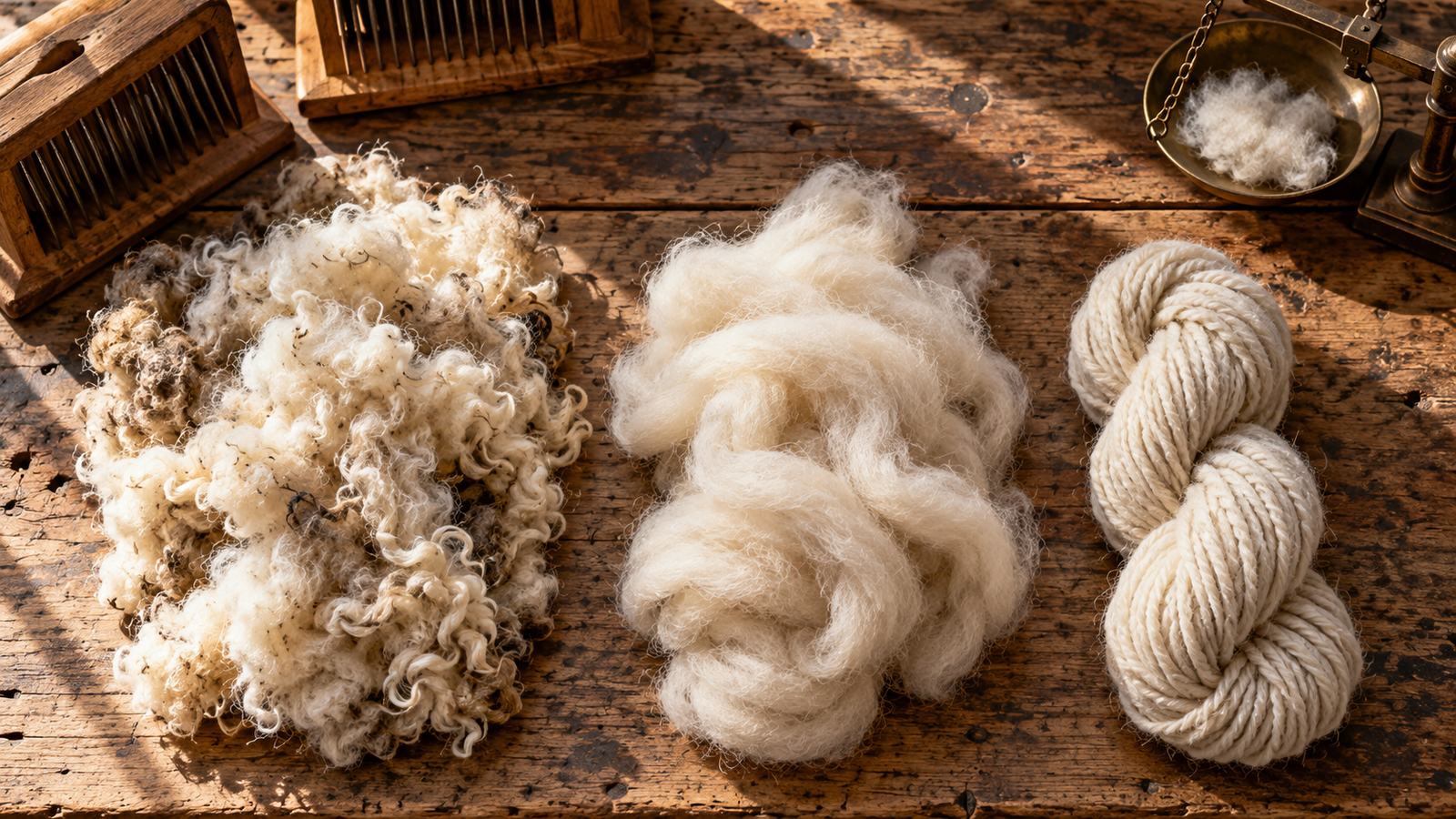
Wool quality in handmade rugs is one of those phrases that gets used constantly and explained rarely, which leaves most buyers with nothing more concrete than "feels nice" to go on. There's actually a real, measurable way to think about this, and the first thing worth knowing is that it isn't the same standard you'd use to judge a sweater. A lot of buyers assume softer automatically means better quality, carried over from how we think about clothing, and that assumption works against you when you're buying a rug specifically. The wool that makes a brilliant jumper is often the wrong wool for a floor. This guide covers what actually determines wool quality in a rug, fibre diameter and length, what that means for durability, and the handful of things you can genuinely check for yourself, whether you're buying online from photos and reviews or standing in front of the rug in person.
Table of Contents
The One Thing Most Buyers Get Backwards: Finer Isn't Better For A Rug
Wool quality is measured in microns, the diameter of a single fibre. A lower micron number means a finer, softer fibre. A higher number means a coarser, thicker one. For clothing, especially anything worn against skin, lower micron wool is genuinely better, it's softer and less likely to feel scratchy.
For a rug, that preference flips. Textile classification systems group wool into different performance categories depending on what it's actually used for, and carpet and rug wool sits deliberately in the coarser, more durable category rather than the fine, soft one. One well-known framework for this even labels carpet wool a "utility fibre," prioritising durability over next-to-skin comfort, exactly the trade a rug needs made in its favour. A rug gets walked on, sat on, vacuumed, and generally asked to survive years of daily contact in a way a sweater never has to. Coarser wool fibres are more resilient under that kind of repeated pressure, which is precisely why the softest, finest wool available isn't actually the best choice for a floor.
What Micron Count Actually Means, And Why Rugs Want More Of It
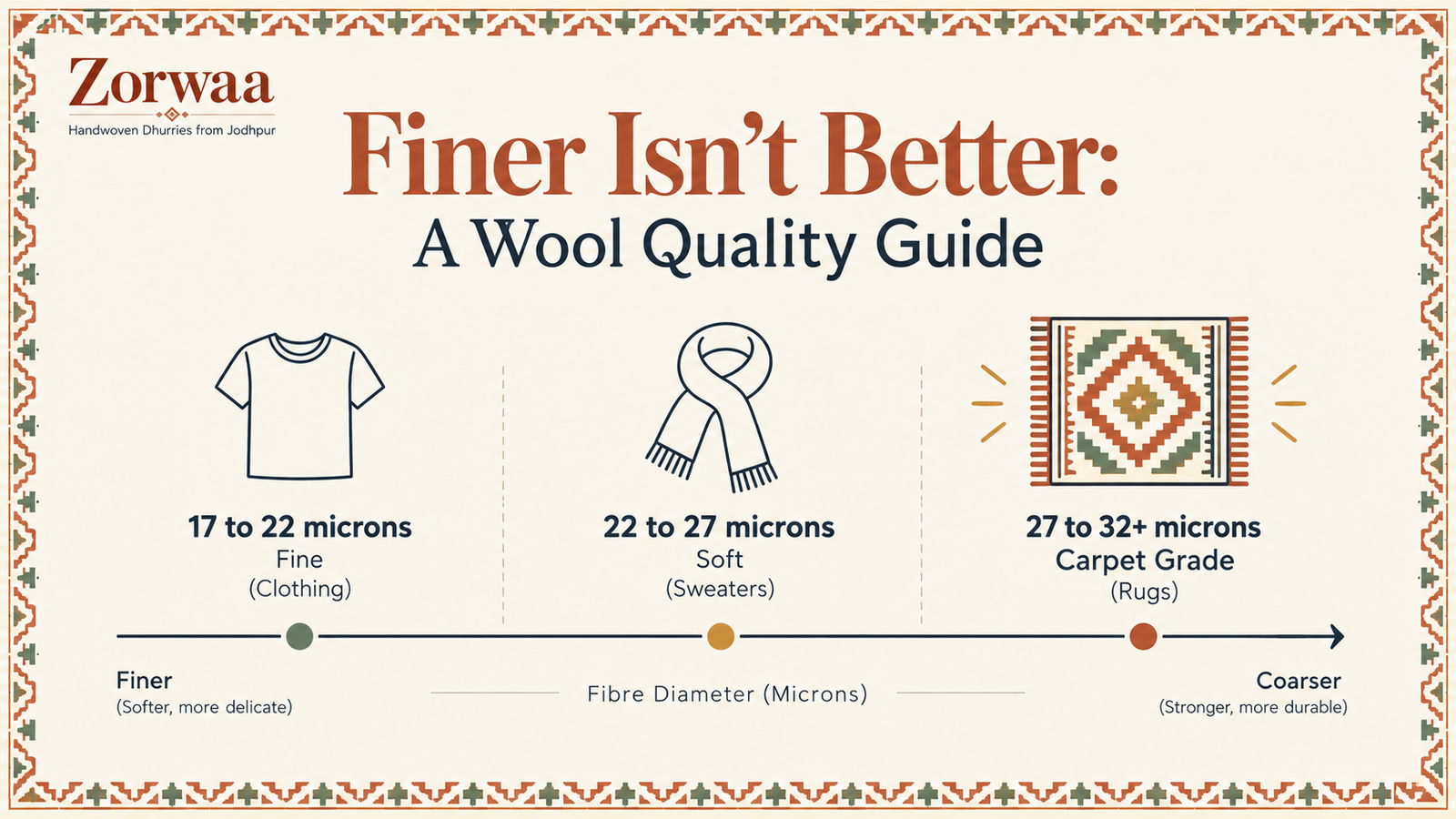
Rough ranges help put this in context. Wool in the 17 to 22 micron range is considered fine, the kind used for next-to-skin clothing. Around 22 to 27 microns produces softer, versatile wool suited to sweaters and accessories. From roughly 27 to 32 microns and up, wool is valued specifically for resilient outer layers, textured weaving, blankets, and rugs, exactly the category a quality hand-woven dhurrie's wool typically falls into.
This isn't a chart you'll usually find printed on a rug's product listing. Unlike wool clothing, where brands increasingly advertise micron count as a selling point, rugs rarely come with a stated number. What's worth taking from this isn't a specific figure to hunt for, it's the underlying principle: a rug described as having "silky soft, fine wool" is being sold to you on clothing criteria, not flooring criteria, and that's worth being a little sceptical of rather than automatically impressed by. Wool measurement, as a field, exists specifically because this distinction matters enough to measure precisely, it's not a marketing invention, it's an actual, standardised part of how the textile industry grades fibre.
Fibre Length Matters As Much As Fibre Diameter
Micron count isn't the only measurement that matters. Staple length, how long an individual wool fibre is before it gets spun into yarn, plays just as big a role in how a rug performs over time.
Longer fibres interlock more securely with each other during spinning, producing a stronger, more cohesive yarn. Shorter fibres have more loose ends working their way free over time, which is a big part of why some rugs shed noticeably more than others in their first few months. We've covered the shedding question in detail separately, our guide to whether wool rugs shed explains the full timeline, but the short version connects directly back to fibre quality: wool with a longer staple length sheds less because there's simply less loose fibre sitting inside the yarn to begin with.
Between the two measurements, fibre length is actually the easier one to get a sense of indirectly. A rug that sheds heavily and keeps shedding well past the normal settling-in period is often telling you something about the staple length of the wool used, even without a lab test to confirm it. It's one of the few genuine quality signals that reveals itself over time rather than needing to be checked upfront.
What You Can Actually Check When Buying Online
Since most rug listings won't give you a micron count or staple length measurement, the practical version of quality-checking online relies on a handful of indirect signals instead.
Close-up photos of the weave tell you more than the hero shot. Look for individual fibres that appear slightly varied in thickness and texture rather than perfectly uniform, hand-processed wool rarely looks machine-smooth, and some natural irregularity is usually a good sign rather than a flaw. Weight and density matter too, a rug description mentioning a substantial, dense weave generally points to better fibre and tighter construction than one emphasising how feather-light it is, lightness is not typically a selling point for wool durability the way it might be for a blanket.
Reviews are genuinely useful here, more useful than most people realise. Look specifically for mentions of durability over months or years rather than first-impression softness, a review saying "still looks great after two years of daily use" tells you considerably more about fibre quality than one simply praising how it felt on day one. And treat marketing language like "ultra-soft" or "silky" with a bit of healthy scepticism for exactly the reason covered above, that's a clothing compliment being borrowed for a flooring product, and it's worth asking what it's actually telling you about durability rather than taking it as a straightforward positive.
What You Can Check In Person, If You Get The Chance
A few quick physical tests are worth doing if you can actually get your hands on a rug before buying, at a showroom, a market stall, or once a sample arrives.
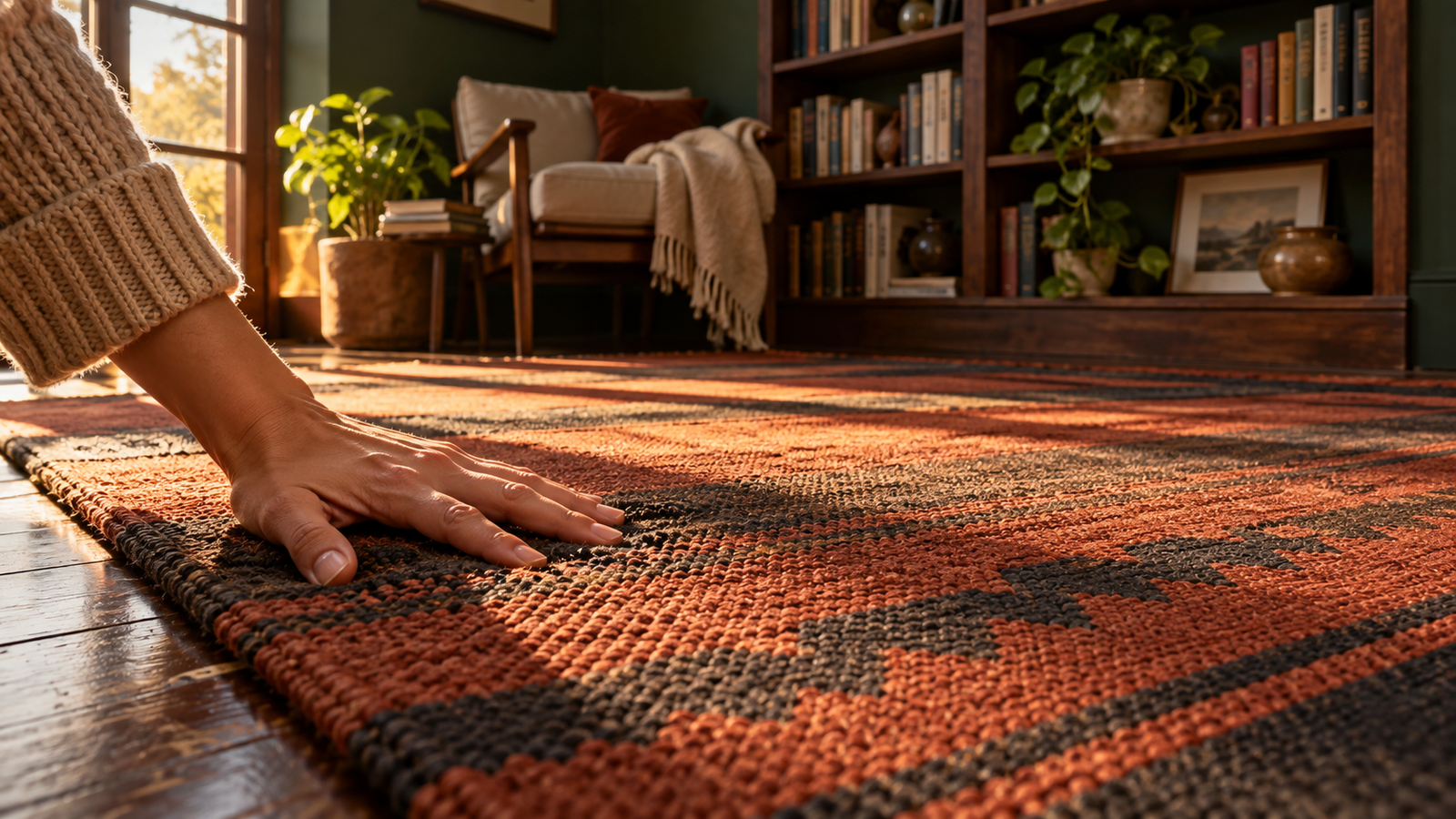
Press down firmly on the weave with your palm, then release. Good-quality wool springs back toward its original shape fairly quickly. Wool that stays visibly flattened suggests weaker, lower-quality fibre or a looser weave that isn't holding its structure well.
A genuine wool smell is also a reliable, low-tech check, clean wool has a faint, slightly earthy, animal smell rather than a chemical or plastic one, especially noticeable if you get close to it. And run your hand across the surface, quality wool typically has a bit of natural texture and a subtle sheen, rather than feeling uniformly flat or artificially smooth, which can sometimes signal a lower grade or heavily processed fibre. None of these tests requires any special equipment or expertise, just a few seconds of attention before you commit.
A Note On Colour And Dye Consistency
Slight variation in colour across a hand-dyed rug is normal, and honestly a reasonably good sign rather than a defect, it usually means natural dye processes and small-batch dyeing rather than a single uniform industrial vat. A rug that's absolutely identical in shade across every square inch, with zero natural variation, is sometimes a sign of synthetic dye applied by a more mechanised process rather than hand-dyed small batches.
That said, there's a difference between gentle, attractive variation and genuine unevenness. Patchy, blotchy colour that looks like an inconsistent dye job rather than natural character is worth questioning, particularly if it's concentrated in one area rather than spread naturally across the piece. The distinction is subtle but real: variation that reads as texture is good, variation that reads as a mistake usually is one.
Why This Matters More For A Flatweave Dhurrie Than You Might Think
Fibre quality shows up more honestly in a flatweave than in a pile rug, worth knowing if you're choosing between the two. A pile rug has a backing layer and a dense, cut or looped surface that can disguise a fair amount of lower-grade yarn underneath, the pile does a lot of the visual work regardless of what's holding it in place. Our flatweave versus pile guide covers the fuller construction comparison if that's useful context.
A dhurrie has nowhere to hide. The yarn itself is the entire visible structure, front and back, since there's no pile sitting on top and no backing layer underneath. Every thread you can see is doing real structural work, which means fibre quality, diameter, length, how evenly it's spun, has a far more direct and visible relationship to how the finished rug actually performs. It's a genuine reason flatweave construction rewards good wool more directly than a pile rug does, there's simply nowhere for a lower grade of fibre to hide.
Quick Quality-Check List
- Coarser wool, not finer, is actually the right choice for a rug, carpet-grade wool is intentionally durable over soft
- Longer fibre length means less shedding and a stronger yarn, shorter fibres shed more
- Look for close-up weave photos showing slight natural fibre variation rather than machine-uniform texture
- Read reviews for long-term durability mentions, not just first-impression softness
- Be sceptical of "ultra-soft" or "silky" marketing language on a rug specifically
- In person: press-and-release spring test, a clean wool smell, and natural surface texture are all good signs
- Gentle colour variation in a hand-dyed piece is normal and often a good sign, patchy unevenness is worth questioning
Frequently Asked Questions
Is softer wool always better quality in a rug?
No, this is the most common misconception. Rugs benefit from coarser, more durable wool, while fine, soft wool is better suited to clothing. A rug marketed purely on softness may be prioritising the wrong quality for a floor.
What is a good micron count for rug wool?
Rug and carpet wool typically falls in the roughly 27 to 32+ micron range, noticeably coarser than the 17 to 22 micron range used for soft clothing wool. Most rug listings won’t state this number directly, but it’s useful context for evaluating marketing claims.
Why do some wool rugs shed more than others?
Often down to fibre length. Wool with a shorter staple length has more loose fibre ends that work free over time, leading to more noticeable and longer-lasting shedding than wool with longer, more securely spun fibres.
Is colour variation in a wool rug a sign of poor quality?
Not usually, gentle, natural variation is common in hand-dyed wool and often indicates genuine small-batch processing. Patchy or blotchy unevenness is a different matter and worth questioning.
How can I check wool quality without touching the rug in person?
Look closely at zoomed-in weave photos for natural fibre texture, read reviews for long-term durability rather than just initial softness, and treat heavy “ultra-soft” marketing language with some scepticism, since that’s a clothing standard being applied to a flooring product.
Good wool quality in a rug looks almost nothing like good wool quality in a sweater, and that single reframe is worth more than any specific number or test on this list. Look for durability signals over softness claims, check reviews for how a rug holds up over years rather than how it felt on day one, and remember that gentle colour variation is usually character, not a flaw. Our natural fibre rugs guide covers how wool compares to cotton and jute more broadly, and our traditional collection is woven from exactly the kind of durable, carpet-grade wool this guide has been describing.