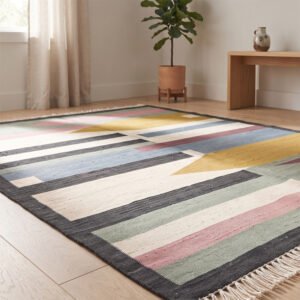
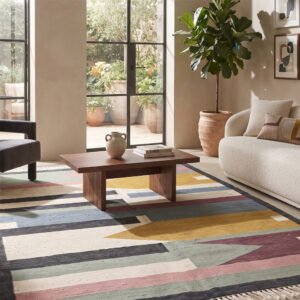
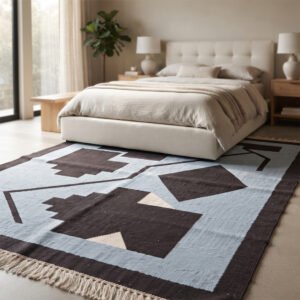
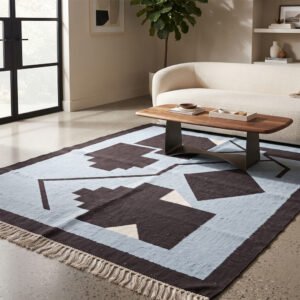
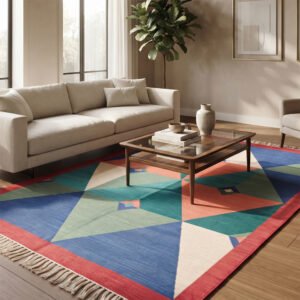
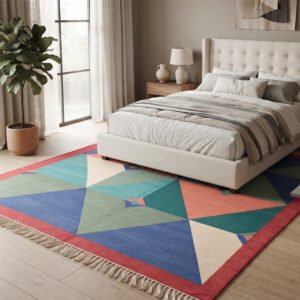
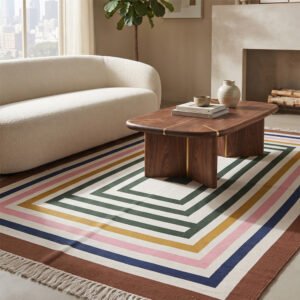
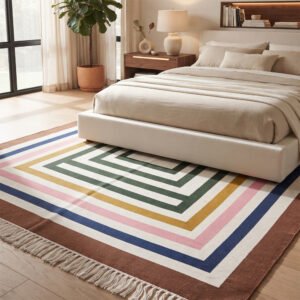
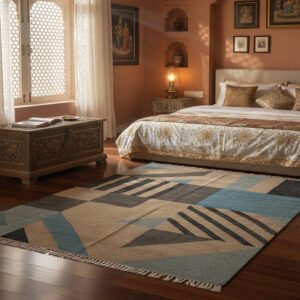
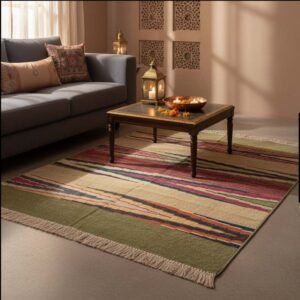
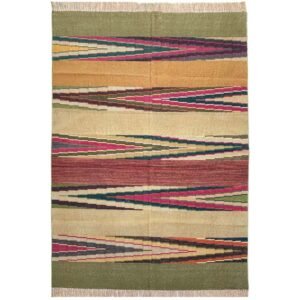
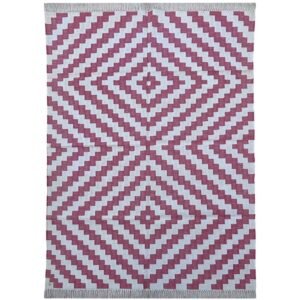
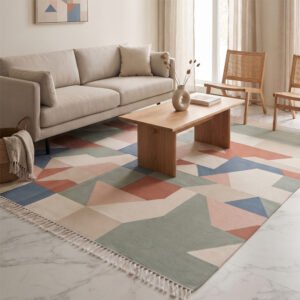
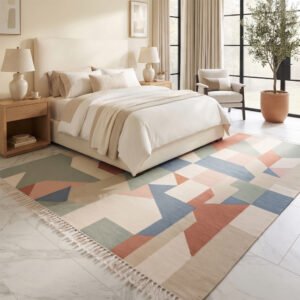
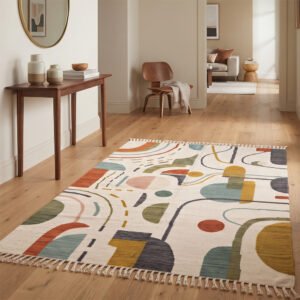
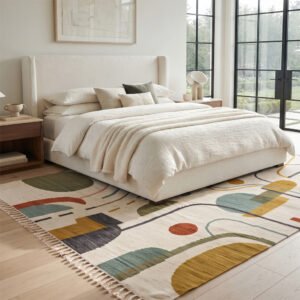
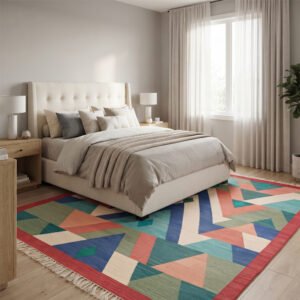
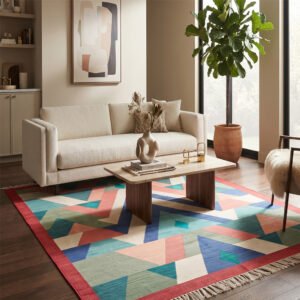
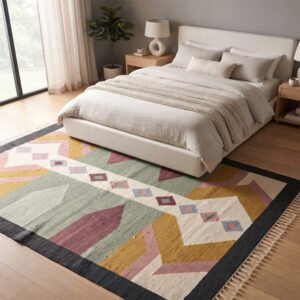
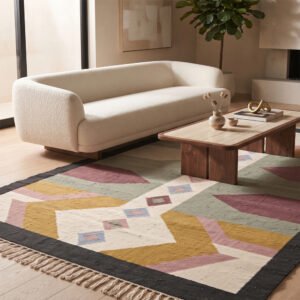
Abstract is probably the loosest category name in the rug world, and honestly, that is partly the point. It covers everything that is not geometric, not traditional, not floral and not a solid. That sounds like a leftover category until you look at what ends up in it.
In a handloom context, abstract patterns are not designed the way a digital pattern is designed. A weaver working on a panja loom in Jodhpur does not start from a grid. The colour changes happen along the weft as the thread shifts. The border between one tone and the next is never perfectly clean. The result is a rug that has movement in it - not because it was planned to look that way, but because that is what happens when colour and material meet a handloom at close range.
Every rug in this collection is made in Bishnoi Village and Salawas, near Jodhpur, by artisan weavers who have been working on handlooms their whole lives. We buy directly from them, no wholesalers in the middle. The abstract quality in these rugs is not a design choice overlaid on machine production - it is a natural outcome of the craft itself.
What "Abstract" Means in a Handwoven Indian Rug
When you buy an abstract rug from a mass-market retailer, the pattern is typically a digital graphic printed onto the pile surface. The "abstract" look is a style choice applied after production.
In a handwoven flatweave rug, the abstract quality is structural. The pattern lives in the weave itself - which means it appears on both sides of the rug and cannot fade away from the surface separately from the material. The colour transitions you see in our abstract cotton dhurries and wool-jute kilims happen because the weaver switches between thread colours at specific points in the weft, creating gradients, blocks and irregular shapes that
a machine cannot reproduce with the same variation.
This is also why no two abstract handwoven rugs from our collection are exactly the same. The weaver controls the colour placement by hand. There will always be slight differences between one piece and the next, even within the same design. That is not a defect. It is what handmade actually means.
Abstract Kilim Rugs - Where Kilim Technique Meets Free-Form Design
Several rugs in this collection are kilim-style abstract pieces, wool-jute flatweaves where the interlocking weft technique creates colour blocks and irregular shapes rather than the strict geometric repeats you see in traditional kilims.
Kilim construction in the Jodhpur tradition uses interlock weaving where weft threads from adjacent colour areas are connected at the colour boundary. When this technique is applied to free-form colour placement rather than strict geometric patterns, the result is what we call an abstract kilim - the structure is kilim, the layout is expressive.
Abstract kilim rugs in wool-jute blends are among the most durable pieces in this range. Jute gives the rug structural weight and a natural, muted base tone that makes abstract colour work read better rather than louder. These are the rugs that work particularly well in rooms with earthy palettes, natural materials and unfinished surfaces - exposed brick, raw wood, concrete, linen.
Colour Palettes - Earth Tones, Multicolour and What Works in Practice
The abstract rugs in this collection fall into two broad colour directions.
Earth tone abstract rugs use terracotta, rust, olive, cream, brown and natural undyed fibre tones. These are the quieter pieces - they add colour and texture to a floor without pulling the room's palette in a strong direction. They work in rooms that are already warm in tone and rooms that are deliberately neutral and need some warmth added.
Multicolour abstract rugs use broader colour ranges - sometimes across the full spectrum, sometimes in bold contrast combinations of two or three tones. These are more assertive. They work best in rooms where the floor covering is meant to be the visual anchor - larger open-plan spaces, dining rooms where the rug goes under a table and needs to hold its own, or rooms with mostly neutral walls and furniture where the floor can take the colour.
If you are unsure which direction fits your space, the product images on each listing show both the full rug and a close up of the weave surface. The close-up is usually more informative than the full-rug shot when you are trying to read colour accuracy.
Where Abstract Rugs Work Best in the Home
Abstract rugs are a good fit for spaces where you want the floor to feel finished without the rug becoming the main thing the eye goes to. Living rooms with a lot of pattern already on the walls or upholstery, bedrooms where the bedding is doing most of the decorative work, and study rooms where the priority is a calm, considered base rather than a statement piece - these are the spaces where abstract flatweave rugs land well.
That said, the bolder multicolour abstract pieces in this collection can hold their own as a room's main colour element. If you have a plain room and want to build the palette outward from the floor rather than inward from the walls, an abstract rug with a strong colour story is a reasonable place to start.
Practically, the cotton dhurries in this range work well on marble, stone and polished tile - common in Indian homes - because they sit flat, do not add bulk and clean easily. The wool-jute abstract kilims work better on wood floors and in rooms where you want the rug to stay put without a pad.
Materials in the Abstract Rug Collection
Cotton abstract dhurries make up the lighter pieces in this collection. Cotton takes dye cleanly, which is why the colour transitions and blocks in cotton abstract rugs tend to have sharper definition than in wool-heavy blends. They are lightweight, reversible and well suited to Indian homes in warmer climates.
Wool-jute abstract kilims are heavier and more textured. The jute provides structural base weight and a naturally earthy, slightly rough surface that reads well under the colour work. Wool adds warmth and durability. These pieces work better in cooler climates or rooms where you want the rug to have some substance underfoot - not just a flat layer on the floor but something with actual presence.
Wool-cotton blends sit between the two - more softness than jute, more structure than pure cotton. These appear in some of the mid - weight pieces in this collection and are a good all-purpose choice if you are unsure which material direction to take.
All fibres are natural. No synthetic materials, no chemical backing.
Custom Abstract Rug Design - Colour, Size and Material
Abstract rugs are probably the best category for customization requests because the design is inherently flexible. Unlike a geometric pattern where the repeat has to fit a specific size, or a traditional motif where the border has to work at a certain scale, an abstract layout adapts more easily to different dimensions.
If you need a specific size that is not in the standard range, or you want an existing abstract design in a different colour palette, fill in the customization form. Our weavers in Jodhpur handle both size adjustments and colour variations directly on the loom. Most custom abstract rug orders complete in 3 to 5 weeks. We reply to all customization enquiries within 24 hours.
Shipping Abstract Rugs Across India and Internationally
All abstract rugs and carpets in this collection ship across India with standard tracked delivery. International orders go to the US, UK, Europe, Australia and the Middle East. Abstract flatweave rugs from Jodhpur travel well - they are thin, roll up easily and arrive without the shipping damage risks that pile rugs can have in transit.
Hotels, interior designers and commercial buyers sourcing abstract Indian carpets in volume can contact us directly for B2B pricing and lead time details.