

How To Choose Rug Size For Every Room

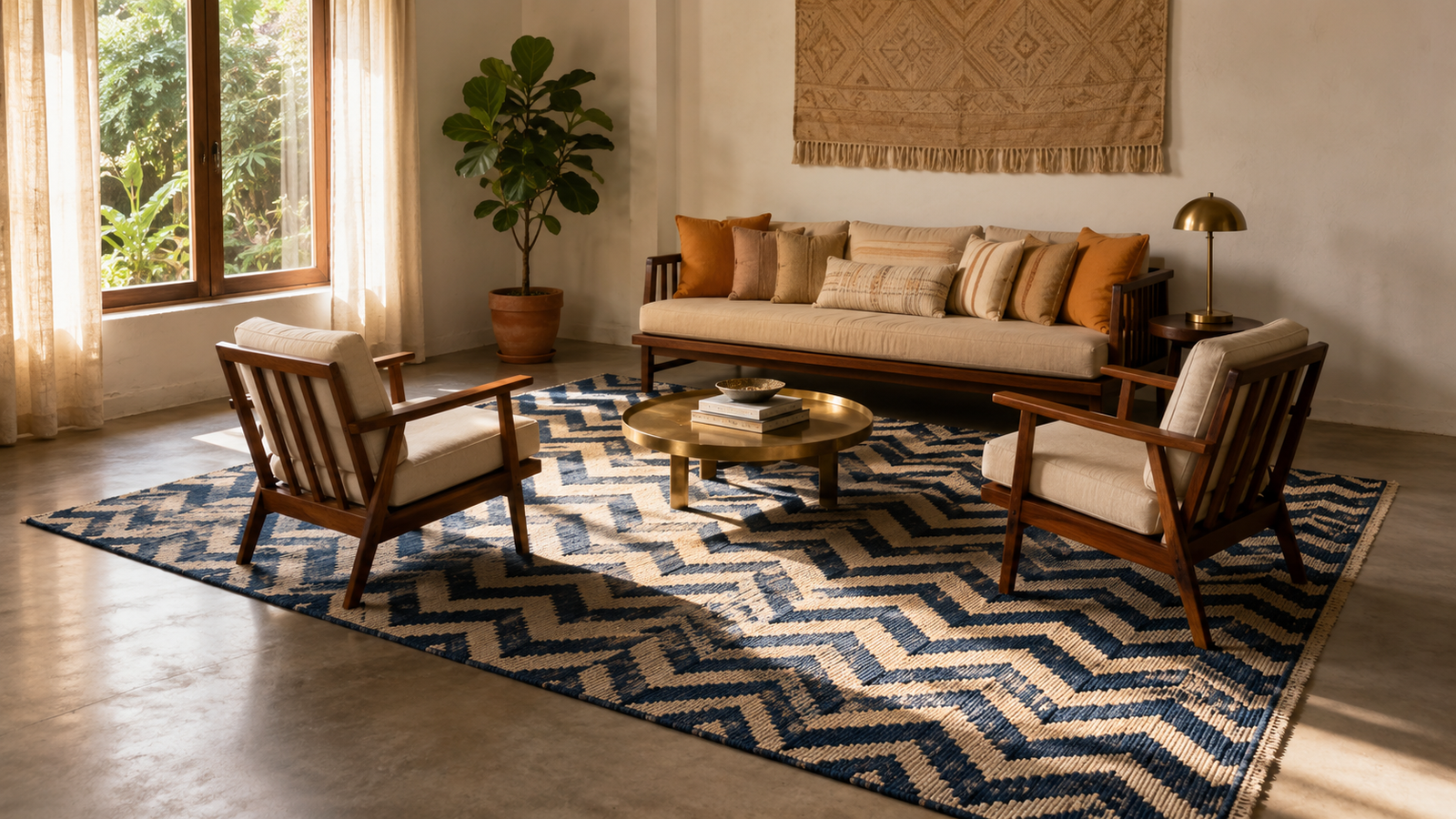
The wrong rug size doesn't announce itself immediately. You lay it down, stand back, and something feels slightly off. The room looks smaller than it should. The furniture feels unanchored. The rug looks like it's floating, or like it was meant for a different space entirely.
The right size does the opposite, it makes a room feel intentional. Like someone thought about it. Because sizing, more than colour or pattern or material, is what determines whether a rug works in a space.
This is a room-by-room guide to getting it right.
The One Rule That Applies Everywhere
Before the room-by-room breakdown, one principle applies across every space in the house:
A rug should define a zone, not just fill an empty floor.
A rug's job isn't to cover as much floor as possible. Its job is to visually anchor a seating group, mark a dining area, frame a bed, or define a pathway. The size question is really a zone question: what are the edges of this space, and how do I frame them?
With that in mind - room by room we are going to discuss everything.
Living Room Rug Size
The living room is where people get rug sizing most consistently wrong. The most common mistake: buying a rug that is too small, then wondering why the room feels disconnected.
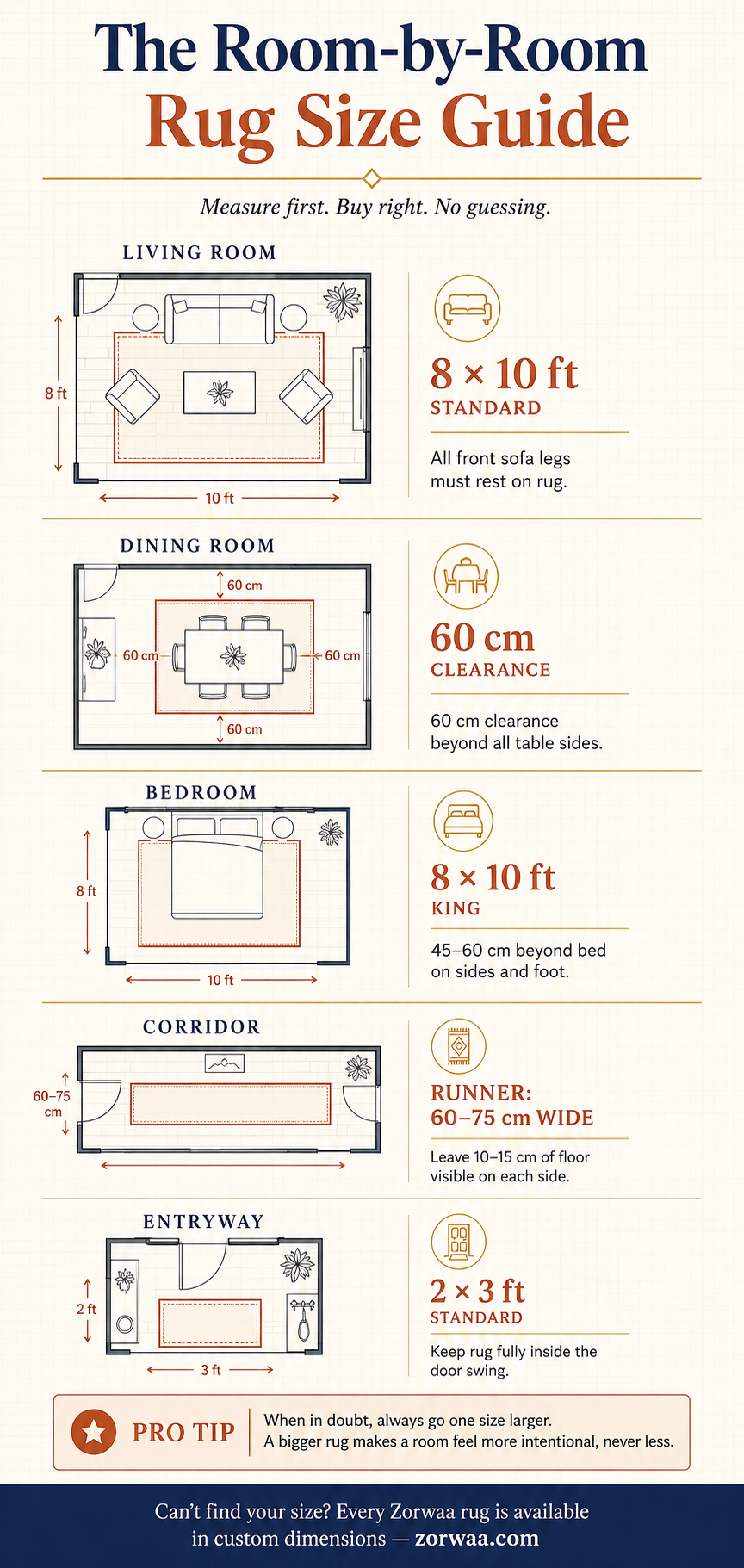
The rule for living rooms: at minimum, all front legs of every major piece of seating furniture should rest on the rug. Ideally particularly in larger rooms, all four legs of every sofa and chair sit on the rug entirely.
A rug that only sits under the coffee table, with no furniture legs on it at all, is acting as a decorative mat not a room anchor. It won't make the space feel grounded.
Sizing guidelines for living rooms:
For a standard Indian living room with a three-seater sofa, two armchairs, and a centre table, a 5x7 ft or 6x9 ft rug is the minimum starting point. For larger rooms with L-shaped seating or sectional sofas, an 8x10 ft or 9x12 ft rug is more appropriate.
The tape test: Before buying, lay masking tape or newspaper on the floor in the shape of the rug you're considering. Arrange the furniture as it will be. Stand in the room and see how it feels. This takes ten minutes and prevents expensive mistakes.
Leave a border of bare floor between the rug edge and the wall, typically 30 to 50 centimetres on each side. A rug that runs edge to edge doesn't feel like a rug; it feels like carpet.
Dining Room Rug Size
The dining room has a more precise requirement than the living room, and the logic is practical as well as visual.
The rule for dining rooms: the rug must extend at least 60 cm beyond every side of the dining table, so that chairs remain on the rug when pulled out.
This is the detail most people miss. They measure the table, buy a rug slightly larger than the table, and then discover that every time a chair is pulled out, the back legs fall off the edge. The rug bunches, the chair wobbles slightly, and the whole thing is mildly irritating every mealtime for years.
Sizing guidelines for dining rooms:
For a standard 4-seater dining table (approximately 90x150 cm), a 6x9 ft rug works. For a 6-seater table (approximately 90x180 cm), an 8x10 ft rug is more appropriate. For large 8-seater tables, consider a 9x12 ft or go custom.
Round dining tables work well with round rugs if you can find them, or with square rugs placed on the diagonal. The 60 cm clearance rule applies regardless of shape.
Bedroom Rug Size
In the bedroom, the rug's purpose is specific: it should provide a warm, comfortable surface for bare feet when you step out of bed in the morning. Cold tiles at 6am against bare feet is an entirely preventable experience.
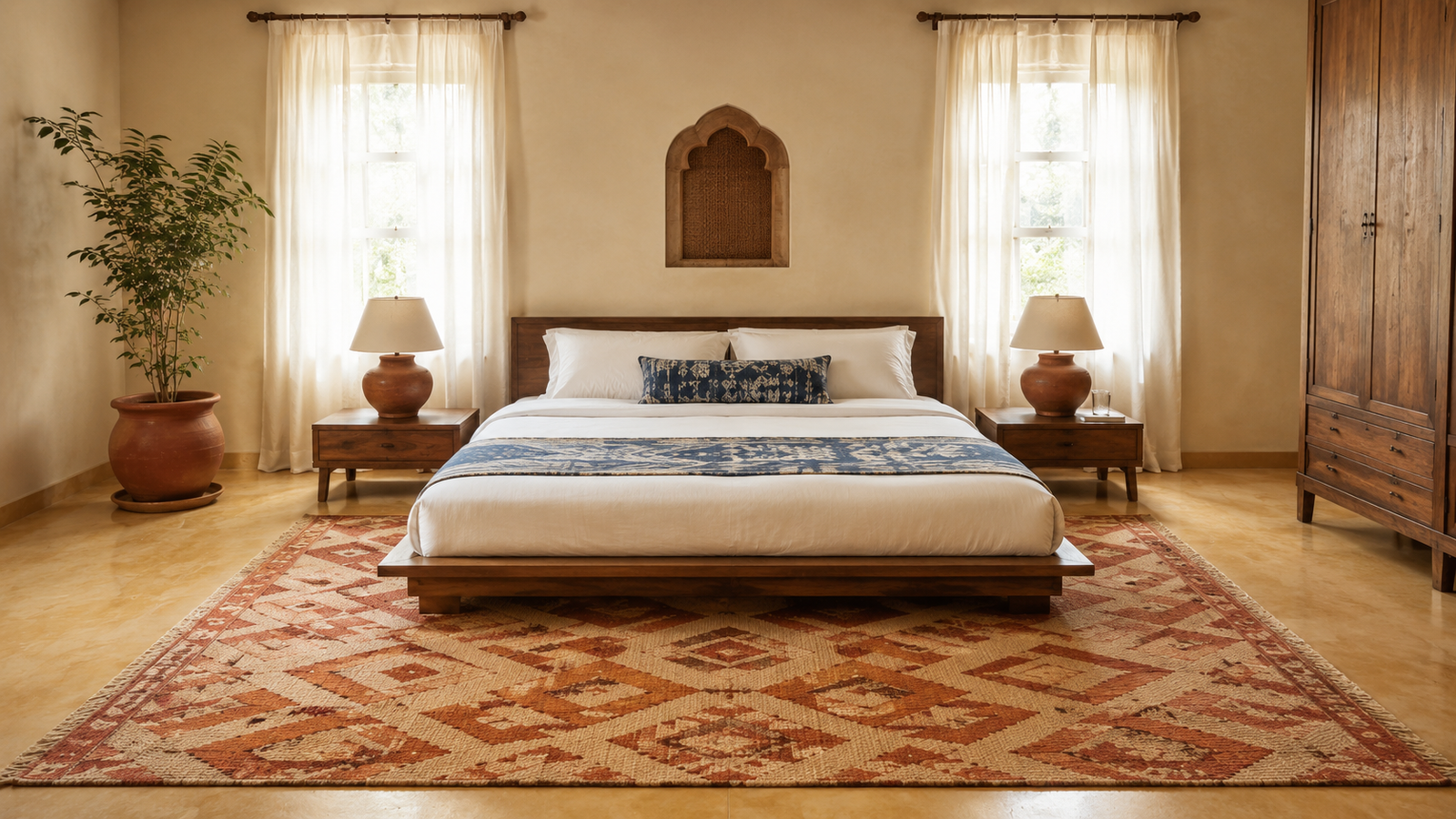
The rule for bedrooms: the rug should extend at least 45 to 60 cm beyond the sides and foot of the bed. If only the area between the nightstands and the foot of the bed is covered, the rug is too small.
Sizing guidelines for bedrooms:
For a standard double bed (approximately 135x190 cm), a 5x7 ft rug centred under the bed is the minimum, this provides some overhang on the sides and the foot. For a queen-size bed (approximately 150x200 cm), a 6x9 ft rug gives comfortable clearance. For a king-size bed (180x200 cm), an 8x10 ft rug is ideal.
Placement matters as much as size. The most visually effective placement for a bedroom rug is centred under the bed with one-third of the rug under the bed and two-thirds extending out. This anchors the bed and provides the practical underfoot surface without the rug being buried under furniture.
Alternative approach for smaller bedrooms: two matching runners, one on each side of the bed. This solves the practical function, warm surface for bare feet without requiring a large rug in a compact room.
Corridor And Entryway Rug Size
Runners which are long, narrow rugs are made for corridors, hallways, and entryways. They guide movement through a space, protect the floor in high-traffic lanes, and give a home a finished, considered feeling as soon as you walk in.
The rule for runners: the runner should leave approximately 10 to 15 cm of bare floor visible on each side. A runner that's too narrow looks like a strip of fabric dropped on the floor. One that's too wide begins to look like a short rug rather than a defined pathway.
Sizing guidelines for corridors:
Standard corridor widths in Indian homes typically run between 90 and 120 cm. A runner of 60 to 75 cm width works for most of these. Length should leave 30 to 45 cm of bare floor at each end of the corridor. The runner shouldn't run wall to wall.
Browse our runner rug collection to see standard sizes and consider a custom length if your corridor has an unusual proportion.
Entryway And Foyer
The entryway is often overlooked. People leave it bare or put a small doormat and call it done. A proper entryway rug, even a modest one changes how a home feels the moment you enter.
The rule for entryways: the rug should be large enough that both feet land on it as you step through the door and turn to face the room. A rug that only accommodates one foot-length is a mat, not a rug.
For most standard Indian home entryways, a 2x3 ft or 3x5 ft rug is appropriate. In larger foyer spaces, a 4x6 ft piece can anchor the entry properly. The material matters here, natural fibre rugs in the entryway handle high traffic well and don't show footmarks the way pile rugs do.
Common Rug Sizing Mistakes To Avoid
Buying before measuring. This is responsible for the majority of wrong-size rug purchases. Measure the room, measure the furniture footprint, decide on the zone, then shop.
Choosing based on the rug size you think you need versus what the room requires. A 4x6 ft rug sounds generously sized until you put it in a room with a large sofa. Room sizes, especially in photographs, are deceptive. Always measure.
Going too small to save money. A smaller rug is cheaper upfront. But a rug that doesn't work in a space is money spent on something you'll want to replace within two years. The cost of getting it right the first time is almost always lower than getting it wrong twice.
Forgetting about floor borders. A rug should not meet every wall. The visible border of bare floor around the rug is part of the composition. Without it, the room looks carpeted rather than styled.
When Standard Sizes Don't Fit Your Space
Indian homes particularly older construction, heritage properties, apartments with unusual proportions, and open-plan layouts frequently have rooms that don't correspond to standard rug dimensions.
This is precisely where custom sizing becomes valuable. Zorwaa offers fully customisable sizing across the entire handmade rug collection. You specify the exact dimensions you need, and the rug is woven to that size by artisans in Rajasthan. The cost premium is smaller than most people expect, and the result is a rug that fits the space as if it was designed for it.
Also worth exploring are our flatweave carpets, available in a wide range of standard sizes and adaptable to custom dimensions if your room calls for something specific.
Quick Reference: Room-By-Room Sizing Guide
Room | Furniture | Recommended Size |
Small living room | 2-seater sofa + 1 chair | 5x7 ft |
Standard living room | 3-seater sofa + 2 chairs | 6x9 ft or 8x10 ft |
Large living room | Sectional / L-shaped | 9x12 ft or larger |
Dining room (4-seater) | 90x150 cm table | 6x9 ft |
Dining room (6-seater) | 90x180 cm table | 8x10 ft |
Double bedroom | Double bed | 5x7 ft |
Queen bedroom | Queen bed | 6x9 ft |
King bedroom | King bed | 8x10 ft |
Corridor / hallway | N/A | Runner: 60–75 cm wide |
Entryway / foyer | N/A | 2x3 ft or 3x5 ft |
Frequently Asked Questions
What is the most common rug size mistake?
Buying a rug that’s too small. A rug that doesn’t extend under at least the front legs of your seating furniture in a living room will always make the space feel smaller and disconnected. When in doubt, go one size larger than you think you need.
Should a rug go under a sofa?
In a living room, yes at least the front legs should rest on the rug. This anchors the furniture to the rug visually and prevents the rug from shifting. Fully placing all legs on the rug works well in larger rooms.
Can I use multiple rugs in one room?
Yes, and in very large rooms this is often the right approach defining multiple zones with separate rugs rather than trying to find one oversized piece. The rugs should complement each other in colour or pattern without competing.
How do I choose rug size for an open-plan home?
In open-plan spaces, each functional zone like seating area, dining area, workspace etc gets its own rug. The rugs define where one zone ends and another begins. A consistent palette ties them together. Sizes are determined zone by zone, not by the overall room dimensions.