Rug Pad for Dhurrie: Do You Need One, and Which Type?
A rug pad for dhurrie is one of the cheapest upgrades you can make and one of the most often skipped. A dhurrie is thin and has no backing, so on a polished floor it creeps, and its corners tend to curl. The right pad fixes both problems. The wrong one can stain your floor and fall apart within a couple of years.
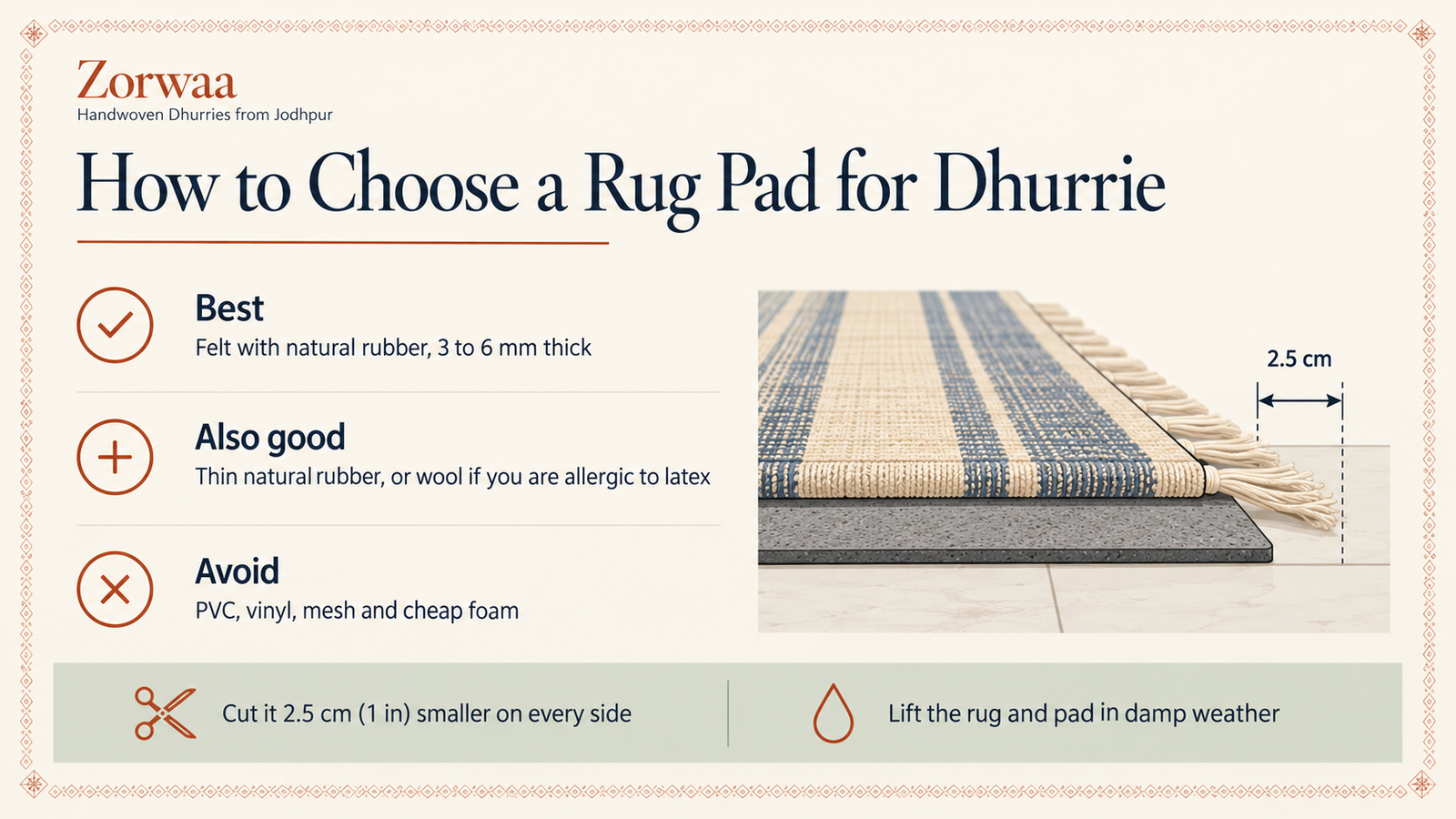
Here is the short version. Most dhurries do better with a pad. A felt and natural rubber pad about 3 to 6 mm thick, cut roughly 2.5 cm smaller than the rug on every side, suits nearly every home. The rest of this guide explains why, and what to avoid.
Table of Contents
Do You Need a Rug Pad for a Dhurrie?
In most homes, yes. A flatweave is light and dense, with no pile to grip the floor, and no rubber or latex backing like a machine-made mat. On marble, tile, vitrified floors or polished wood, it slides underfoot, bunches when a chair is pulled across it and slowly walks away from where you put it. Any of those can become a tripping hazard.
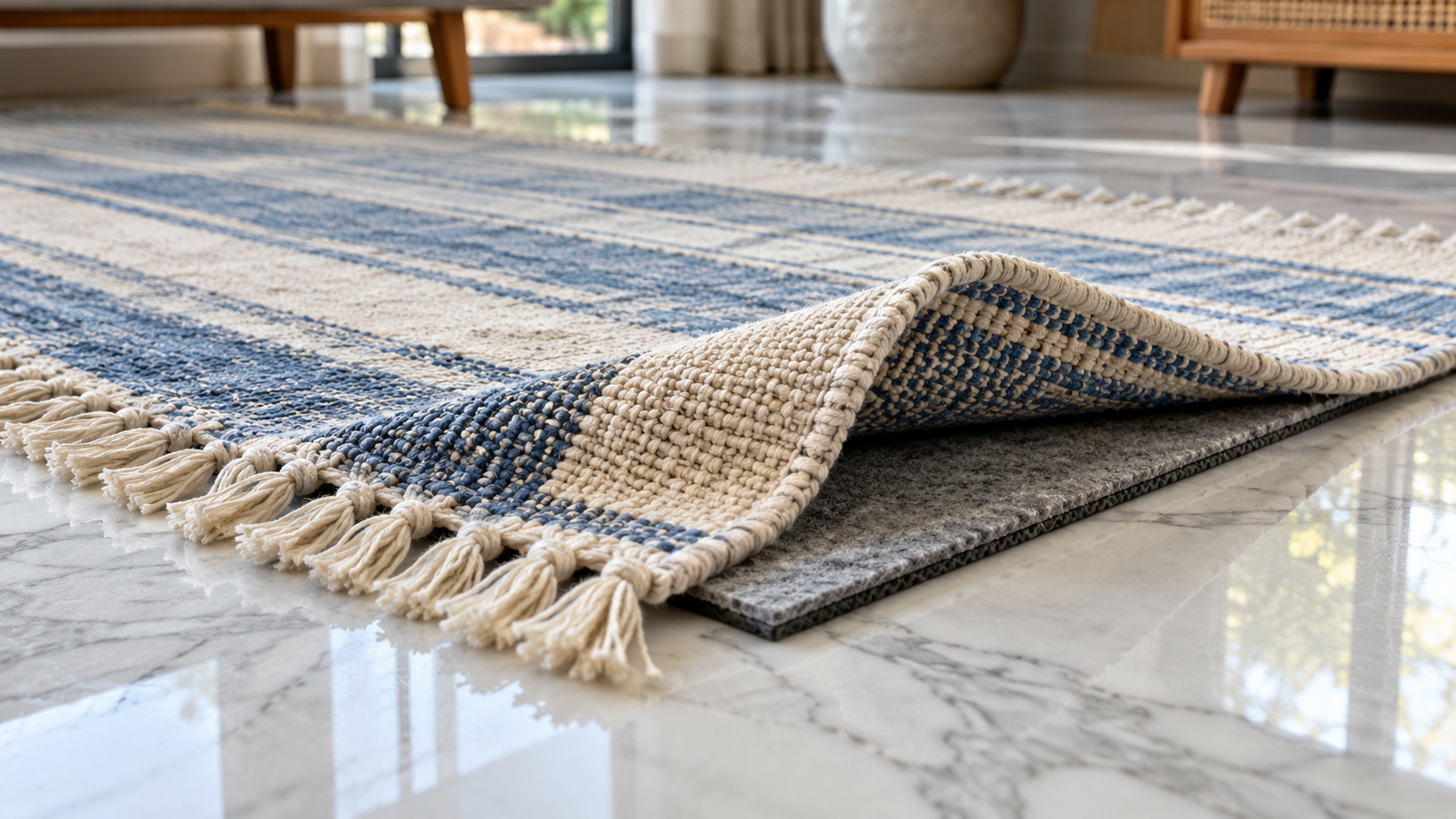
Flatweaves also tend to curl at the corners, as Houzz notes in its guide to choosing a rug pad. A pad holds the rug flat against the floor, which keeps the corners down and the rug square.
There are a few cases where you can skip it. A dhurrie that sits entirely under heavy furniture, such as a dining table and chairs, on a floor with some texture, may stay put on its own. A rug on top of wall-to-wall carpet is a different case that needs a dense felt pad. And a small mat in a doorway with its own anti-slip backing does not need another layer. For everything else, a pad is worth the small cost.
What a Rug Pad Does for a Flatweave
The first job is grip. A pad stops sliding and creeping, which matters most on smooth stone and tile, and for anyone elderly or unsteady in the house.
The second job is protection. A pad stops the underside of the rug from rubbing against the floor with every step, which wears both surfaces. It also acts as a shock absorber, so the weave is not pressed flat against hard stone all day.
The third is comfort. A flatweave on marble feels hard underfoot, and a felt layer adds a little give. Felt also insulates against cold and softens sound, which is why a pad appears in our guide to dhurrie rugs for winter. Together these make a pad more than an accessory. It changes how the rug behaves.
Which Type of Rug Pad Suits a Dhurrie
Pads come in a handful of materials, and they behave very differently.
Felt and natural rubber is the best all-round choice. The felt side cushions and insulates, and the rubber underside grips the floor. Houzz recommends this combination for thin rugs such as flatweaves, in a thickness of 1/8 or 1/4 inch.
Solid natural rubber grips well and is very thin, which suits spots where height matters, such as under a door swing. It offers little cushioning or insulation, though.
Felt alone is dense and comfortable and good under large rugs, but it does not fully stop movement, so on slippery floors a dhurrie can still shift.
Wool pads are a good option if you are allergic to latex. They are natural and insulating, but they can bother people with airborne allergies.
PVC, vinyl and mesh pads are the cheap ones that are easy to find. Houzz advises avoiding PVC altogether, because it cannot breathe, can "sweat" against the floor and can transfer residue from its grip chemicals. Pads made from synthetic latex mixed with clay fillers are also best avoided, because the filler can break down into powder within a few years.
What Thickness of Rug Pad to Choose
A dhurrie is thin, so a thin pad is enough. For most flatweaves, 1/8 to 1/4 inch (about 3 to 6 mm) is the right range, according to Houzz. A 3 mm pad keeps the rug close to the floor, which suits doorways, hallways and busy walkways where a bump could trip someone. A 5 or 6 mm pad gives more cushioning and insulation, and it suits a living room or a bedroom.
Thicker is not better. A very thick pad lifts the edge of a thin rug into a ridge that people catch their toes on. Houzz makes the same point from the other direction, noting that too thick a pad creates a level change that people can trip on.
Rug Pad Size: How to Cut It
Cut the pad about 1 inch (2.5 cm) smaller than the rug on every side. That lets the edges of the rug relax down to the floor, and it hides the pad. Here is what that looks like for common sizes.
Rug size (feet) | Pad size (feet and inches) | Pad size (cm) |
2 x 8 runner | 1 ft 10 in x 7 ft 10 in | 56 x 239 |
5 x 8 | 4 ft 10 in x 7 ft 10 in | 147 x 239 |
6 x 9 | 5 ft 10 in x 8 ft 10 in | 178 x 269 |
8 x 10 | 7 ft 10 in x 9 ft 10 in | 239 x 300 |
9 x 12 | 8 ft 10 in x 11 ft 10 in | 269 x 361 |
Pads are usually sold in sheets or rolls and are easy to trim with a sharp utility knife and a straight edge. Measure twice before you cut, and remember that a handmade rug can differ slightly from its listed size, so measure the actual rug rather than trusting the label. Our standard rug sizes chart explains why.
Products You May Like
-51%
Select options
This product has multiple variants. The options may be chosen on the product page
Modern Wool Dhurrie Rug Blue | Handmade Flatweave with Timeless Neutral Style
₹2,399.00 – ₹43,200.00Price range: ₹2,399.00 through ₹43,200.00-40%
Select options
This product has multiple variants. The options may be chosen on the product page
Modern Handwoven Wool Jute Rug – Colorful Kilim Design
₹2,850.00 – ₹54,000.00Price range: ₹2,850.00 through ₹54,000.00-50%
Select options
This product has multiple variants. The options may be chosen on the product page
Patio-Perfect: Weather-Resistant Style Cotton Dhurrie
₹3,800.00 – ₹64,800.00Price range: ₹3,800.00 through ₹64,800.00-51%
Select options
This product has multiple variants. The options may be chosen on the product page
Kilim Wool Jute Rug Handmade, Flatweave Area Rug for Home
₹2,399.00 – ₹43,200.00Price range: ₹2,399.00 through ₹43,200.00Rug Pads on Marble, Tile, Wood and Heated Floors
Marble and tile are hard, cold and slippery, so a flatweave needs a pad more there than anywhere. Choose felt with a natural rubber underside. Polished or pale marble can show marks, so ask the maker whether the pad is safe for natural stone, and check a corner of the floor after the first few weeks.
On wood, natural rubber and felt are the safe materials. Avoid PVC, which can damage the finish. On vinyl and laminate flooring, some rubber can discolour the surface, so ask for a felt pad, or a pad rated for that floor.
On heated floors, use a thin felt pad or none, and avoid thick foam or rubber, which hold heat in. Our winter guide covers this in more detail. On carpet, use a dense felt pad meant to go between a rug and carpet.
Rug Pads in Humid and Monsoon Weather
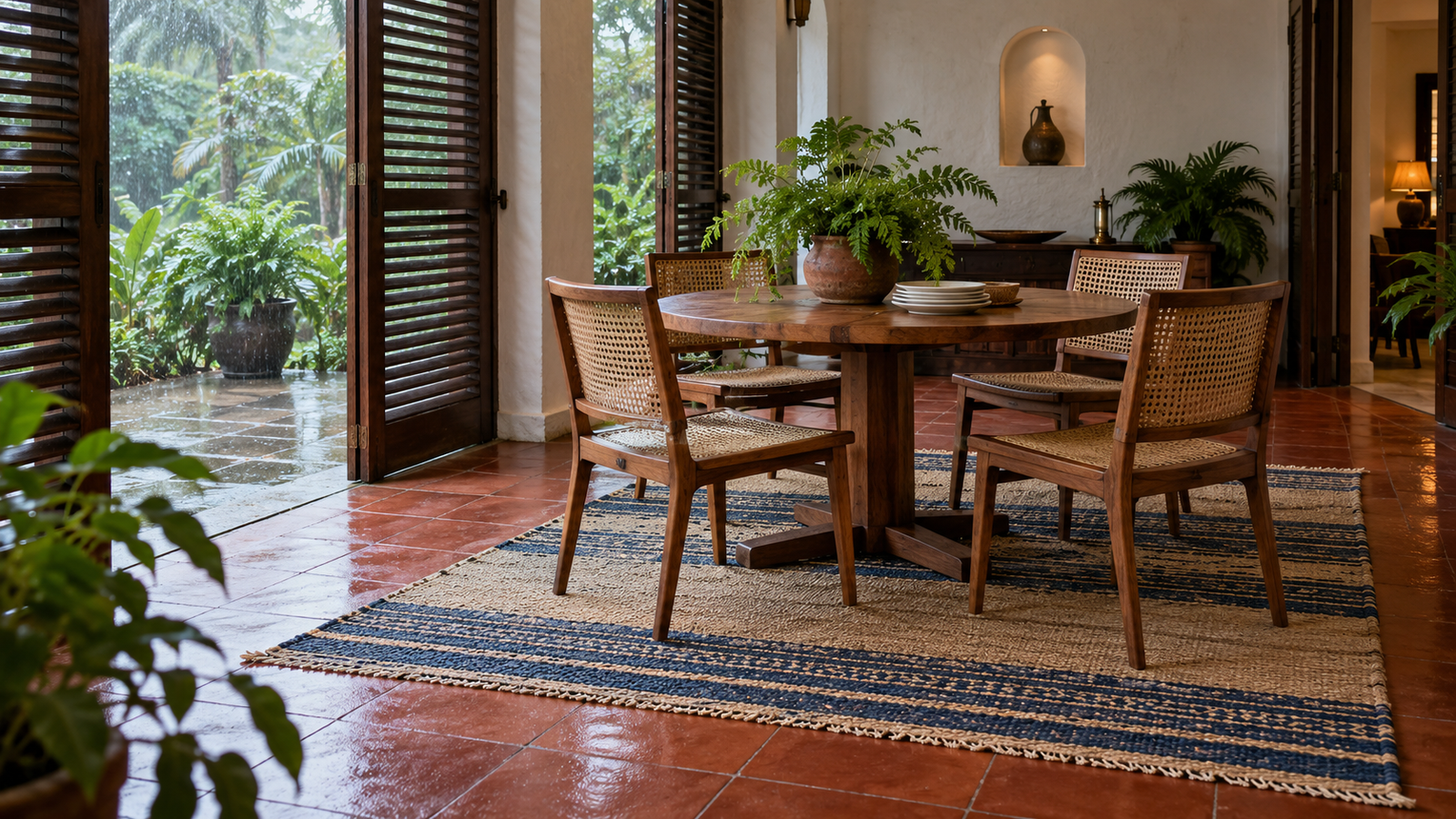
Any pad with a solid underside can hold moisture against the floor, and in humid weather that matters. During the monsoon, lift the rug and the pad every few weeks and let the floor dry before you put them back. If a spill soaks through, clean it up and let both the pad and the floor dry completely.
A pad does not replace regular care. Our monsoon rug care guide covers airing, drying and mould prevention in detail.
Runners, Stairs and Other Alternatives
Hallway runners benefit from a pad as much as any other rug, and a narrow pad cut to the runner's size works well. Stairs are different. They need pads or grippers made for stairs, and our guide to runner rugs for hallways and staircases goes through the options.
Other fixes exist, but they have limits. Corner grippers hold only the corners and do nothing for the middle of a larger rug. Double-sided rug tape can leave residue on some floors. Anti-slip mesh is often PVC, which brings back the problems above. A proper felt and rubber pad remains the most reliable choice.
Quick Checklist for Choosing a Rug Pad
- Choose felt with natural rubber for most dhurries, or wool if you are allergic to latex.
- Skip PVC, vinyl, mesh and cheap foam pads.
- Pick a thickness of 3 to 6 mm, and go thinner at doorways.
- Cut the pad about 2.5 cm smaller than the rug on every side.
- Ask whether the pad is safe for your floor, especially pale marble and vinyl.
- On heated floors, use a thin felt pad.
- In humid weather, lift the rug and pad regularly to let the floor dry.
Frequently Asked Questions
Do dhurrie rugs need a rug pad?
Usually yes. A dhurrie is thin and has no backing, so on smooth floors it slides and its corners curl. A pad keeps it flat, grips the floor and protects both surfaces.
What thickness rug pad is best for a dhurrie?
About 3 to 6 mm (1/8 to 1/4 inch). Use the thinner end at doorways and the thicker end in a living room or bedroom where you want more cushioning.
Can I use a rug pad on marble or tile?
Yes, and it helps a lot because those floors are hard and slippery. Choose felt with natural rubber, ask whether it is safe for natural stone, and check a corner of the floor after a few weeks.
What size rug pad do I need for a dhurrie?
Cut it about 1 inch (2.5 cm) smaller than the rug on every side. For a 6 x 9 foot rug, that is about 5 ft 10 in x 8 ft 10 in.
Is a PVC anti-slip mat safe under a dhurrie?
It is best avoided. PVC does not breathe, can sweat against the floor and can leave residue. A felt and natural rubber pad is the safer choice.
A good pad costs little compared with the rug above it, and it makes the rug safer and longer lasting. Choose the material first, then the thickness, then cut it to size.