Uncategorized

First-Time Rug Buyer’s Checklist: What to Check Before You Buy a Handmade Rug

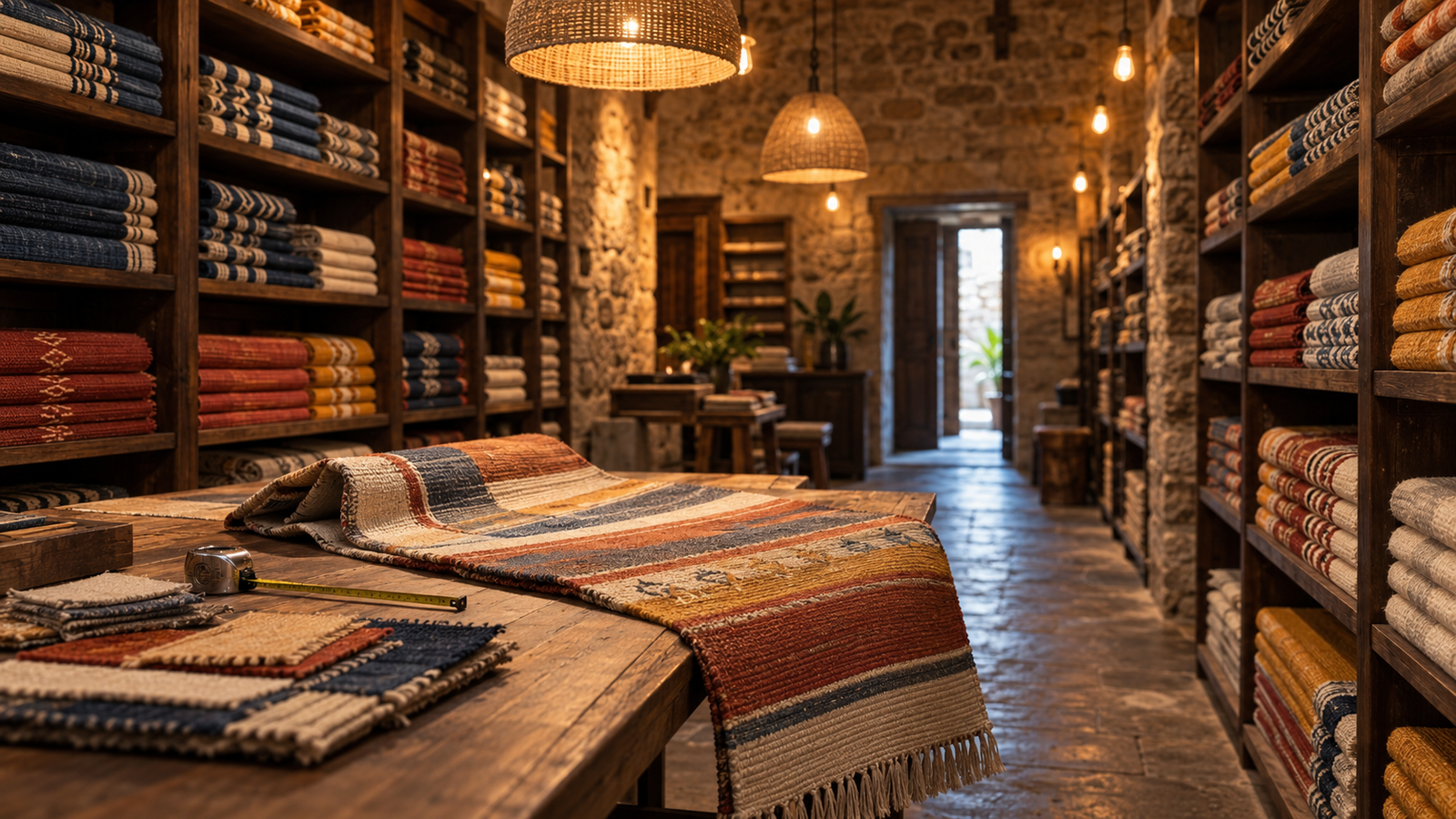
Folded handwoven dhurries stacked on wooden shelves in a warmly lit rug showroom, with one rug unfolded for inspection

A first-time rug buyer's checklist should be short enough to actually use and thorough enough to stop the expensive mistakes. Buying a handmade rug is a bigger decision than it looks from the product page. The rug is large, it's awkward to return, and it will sit under your feet and your furniture for years, so getting the size, the material or the construction wrong costs more than it would with almost anything else in a room. The good news is that most regrets come from the same handful of oversights. This checklist walks through ten checks in a sensible order, from deciding how the rug will be used to planning its care before it arrives.

Table of Contents

1. Decide How The Rug Will Be Used

Start with the room and the traffic, not the pattern. A rug at a front door, under a dining table or in a child's room takes far more punishment than one beside a bed, and that should shape everything that follows. High-traffic spots suit a tightly woven wool or cotton flatweave in a mid-tone or a busier pattern that hides dirt and wear. Low-traffic spots give you freedom to choose something paler or more delicate. If you have pets or small children, or the space is near a door or window that lets in rain or damp, decide that now, because it changes which fibre makes sense, and jute in particular copes badly with moisture and spills.

2. Measure The Space Before You Browse

Measure the floor, then mark the rug's dimensions on it with painter's tape and live with the outline for a day or two. Photos have no scale, so a rug that looks right online can be far too small in your room, and going too small is the most common mistake in every room of the house. As a general rule, the front legs of your main furniture should sit on the rug, and in a bedroom the rug should extend about 18 to 24 inches beyond the bed. Our rug size guide gives measurements room by room.

3. Match The Material To How You Live

Wool, cotton and jute each behave differently. Wool is the most resilient and the most forgiving of stains and damp, which makes it the safest all-rounder. Cotton is lighter and cooler underfoot, and suits bedrooms and everyday spaces well. Jute is textured and natural-looking but absorbs moisture readily, so it belongs in dry, low-spill rooms rather than a dining area or a humid corner. Blends sit somewhere in between. Our guide to wool, cotton and jute compares them in full if you're still deciding.

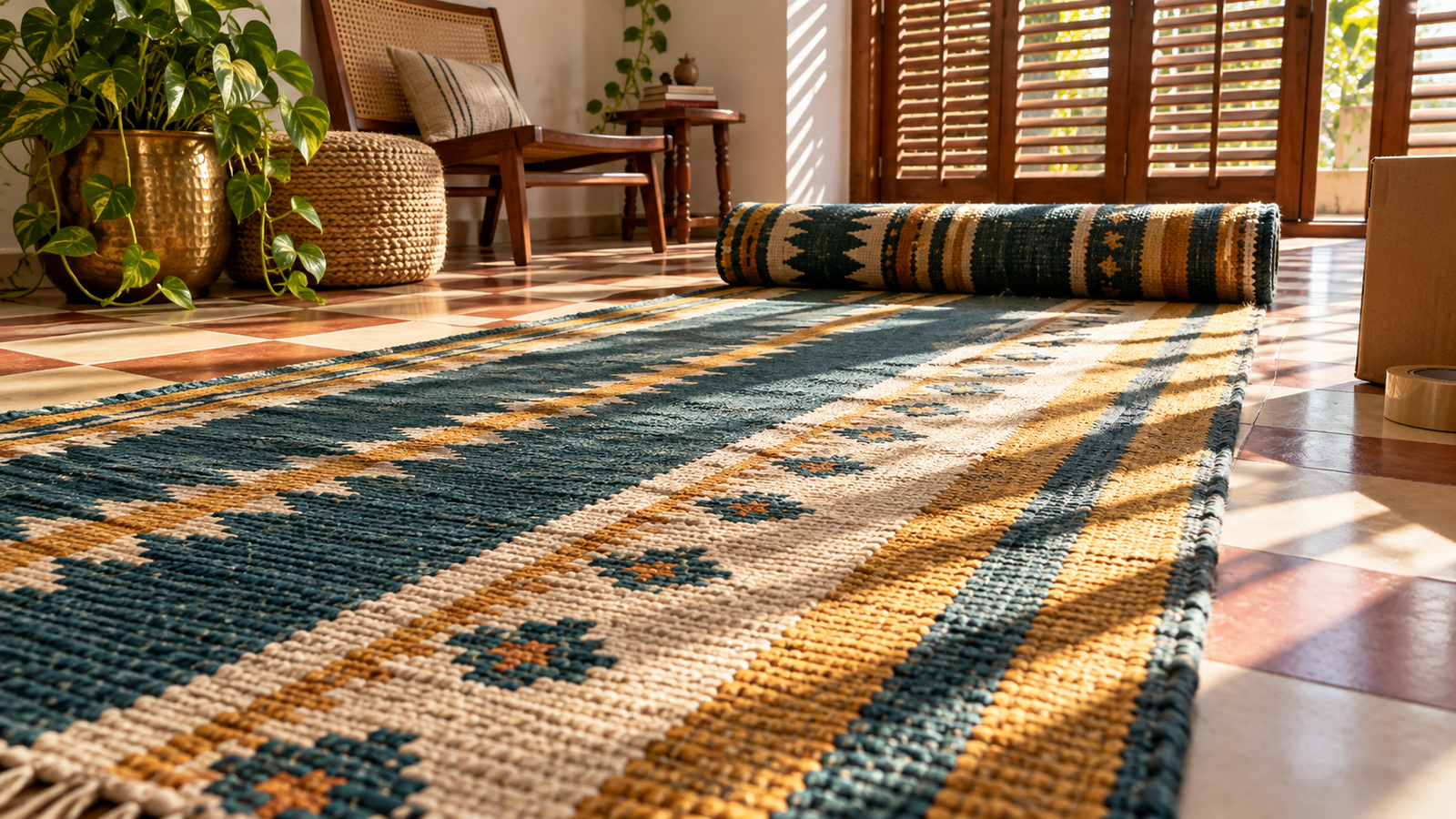
Handwoven flatweave dhurrie being unrolled across the floor of a sunny apartment living room

4. Understand How The Rug Is Made

Handmade covers several different constructions, and they differ in price, feel and upkeep. Hand-knotted rugs have a pile built knot by knot, hand-tufted rugs have yarn punched through a backing, and flatweaves such as dhurries are woven flat with no pile at all. Britannica's overview of rug and carpet making covers the materials and techniques in more depth.

The simplest practical check is the back of the rug. A genuinely handwoven flatweave shows the same clean, slightly irregular pattern on both sides, while a printed or machine-made imitation usually looks different, or perfectly uniform, on the reverse. A seller who tells you plainly which construction you're getting is usually worth trusting.

5. Judge Colour And Pattern Realistically

Colour on a screen is an approximation, because every device displays it slightly differently, and styled photos use a quality of light that your room won't have. Look for pictures taken in daylight, ask for extra photos if the shade matters, and request a swatch where one is offered. Think about how the rug will sit against your floor and walls as well. A rug close to your floor in tone makes a room feel more open, while a high-contrast pattern gives it more energy. In a small or dark room, stay with lighter, quieter tones and small-scale patterns.

Products You May Like

-50%
Select options This product has multiple variants. The options may be chosen on the product page

Indian Cotton Dhurrie Area Rug, Handwoven Reversible Flatweave

₹3,800.00 ₹64,800.00Price range: ₹3,800.00 through ₹64,800.00
-50%
Select options This product has multiple variants. The options may be chosen on the product page

Cotton Panja Dhurrie Rug for Large Hall Area Handmade

₹3,800.00 ₹64,800.00Price range: ₹3,800.00 through ₹64,800.00
-50%
Select options This product has multiple variants. The options may be chosen on the product page

Artisan Panja Weave: Flatwoven Perfection durry

₹3,800.00 ₹64,800.00Price range: ₹3,800.00 through ₹64,800.00
-50%
Select options This product has multiple variants. The options may be chosen on the product page

Cotton Panja Dhurrie Rug for Dining Room Artisan Decor

₹3,800.00 ₹64,800.00Price range: ₹3,800.00 through ₹64,800.00
6. Check The Quality Signals You Can Actually See

A few checks work even from a photo or a short visit. Hold a corner up to the light, since a tightly woven rug lets very little through. Rub a damp white cloth gently over a hidden spot to see whether any colour transfers. Look for natural variation in the fibre rather than machine-smooth uniformity. And remember that for a rug, coarser wool is a sign of durability rather than poor quality, so be wary of listings that sell on softness alone.

Reviews that mention how a rug looks after a year or two of daily use tell you far more than first impressions. If you're looking at a pile rug, ask about shedding, which is normal for a few months but shouldn't go on indefinitely.

7. Know What You're Actually Paying For

Price follows material, size, design complexity and the time the weaving takes, and it also follows how many hands the rug passes through before it reaches you. Two identical rugs can carry very different prices depending on whether they come directly from the maker or through several middlemen and a showroom. Most rugs are priced per square foot, so size scales the cost fairly directly. When you compare quotes, compare like for like: the material, the construction, the size, and whether shipping and any import duty are included.

8. Ask About Returns, Shipping And Customs Before You Pay

A rug is bulky, so returns are slower and costlier than for most purchases, and it's worth knowing the rules before you commit. Ask how long you have to decide, who pays return shipping, and whether the terms change for custom or made-to-order pieces, which are usually harder to return because they're woven to your specification. If you're ordering across a border, ask whether duty and tax are included in the price or billed on delivery, and ask for a realistic delivery window rather than a vague one.

9. Know When A Custom Rug Is The Better Answer

Off-the-shelf sizes cover most rooms, but not all. If you have an unusual floor plan, a bed or table that falls between standard sizes, a staircase, or a specific colour you can't find, custom sizing is often a better answer than compromising. You specify the size, shape and colour, and the rug is woven to match. The trade-off is time and flexibility: a made-to-order piece takes longer and is harder to change once weaving has started, so confirm every dimension and colour in writing first.

10. Plan The Pad And The Care From Day One

A thin rug pad is worth buying with the rug. It stops sliding, adds cushioning and protects the floor underneath, and on a rented floor it's a much safer choice than tape or glue. Then settle on a simple routine: vacuum regularly, without a beater bar on pile rugs, rotate the rug every few months so wear and sunlight even out, blot spills straight away rather than rubbing, and keep the rug away from damp, which matters most in monsoon. Flatweave dhurries are reversible, so you can flip them as one side ages.

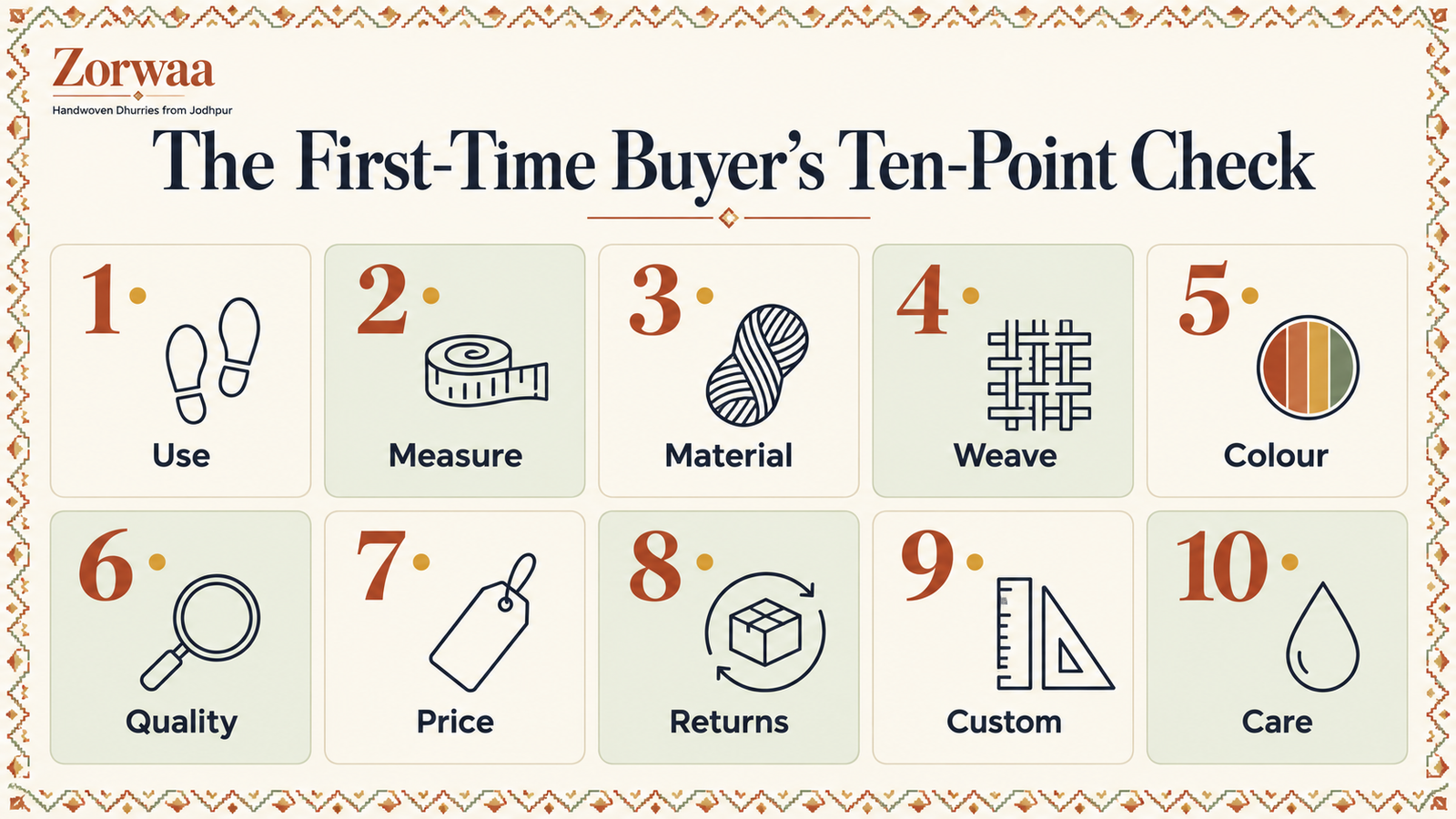
The First-Time Rug Buyer's Checklist At A Glance

  • Decide where and how the rug will be used, including traffic, pets and damp
  • Measure the space and mark the size out with painter's tape
  • Choose wool, cotton or jute for how you actually live
  • Confirm the construction, and check the back of the rug
  • Treat screen colour as approximate and look for daylight photos
  • Hold the weave up to the light and test colourfastness in a hidden spot
  • Compare quotes like for like, including shipping and duty
  • Check return terms, especially for custom and international orders
  • Consider a custom size if your space doesn't fit the standard ones
  • Buy a rug pad and plan basic care before the rug arrives
Zorwaa infographic showing the ten checks a first-time buyer should make before buying a handmade rug

Frequently Asked Questions

Start with size, material and construction. Measure the space, choose a fibre that suits how the room is used, and confirm whether the rug is flatwoven, knotted or tufted, since that decides its price, feel and care.

Check the back. A handwoven flatweave shows the same slightly irregular pattern on both sides, while a machine-made or printed rug usually looks uniform, or noticeably different, on the reverse. Ask the seller to confirm the construction and where the rug was made.

Large enough that the front legs of your main seating sit on the rug. Mark out the dimensions with painter’s tape first, because photos give no sense of scale and going too small is the most common mistake.

Yes, if you check the dimensions, look for daylight photos and close-ups of the weave, read reviews for long-term durability, and confirm the return policy beforehand.

When your room, furniture or staircase doesn’t match a standard size, or when you need a specific shape or colour. Allow extra time and confirm every detail in writing, since made-to-order rugs are harder to change or return.

Most rug regrets trace back to a handful of skipped checks: a size guessed from a photo, a fibre that didn't suit the room, or terms read after the purchase instead of before. Work through the list above and the decision gets much calmer. If you're ready to look, browse our traditional collection, or get in touch if you need a size or shape that isn't listed.