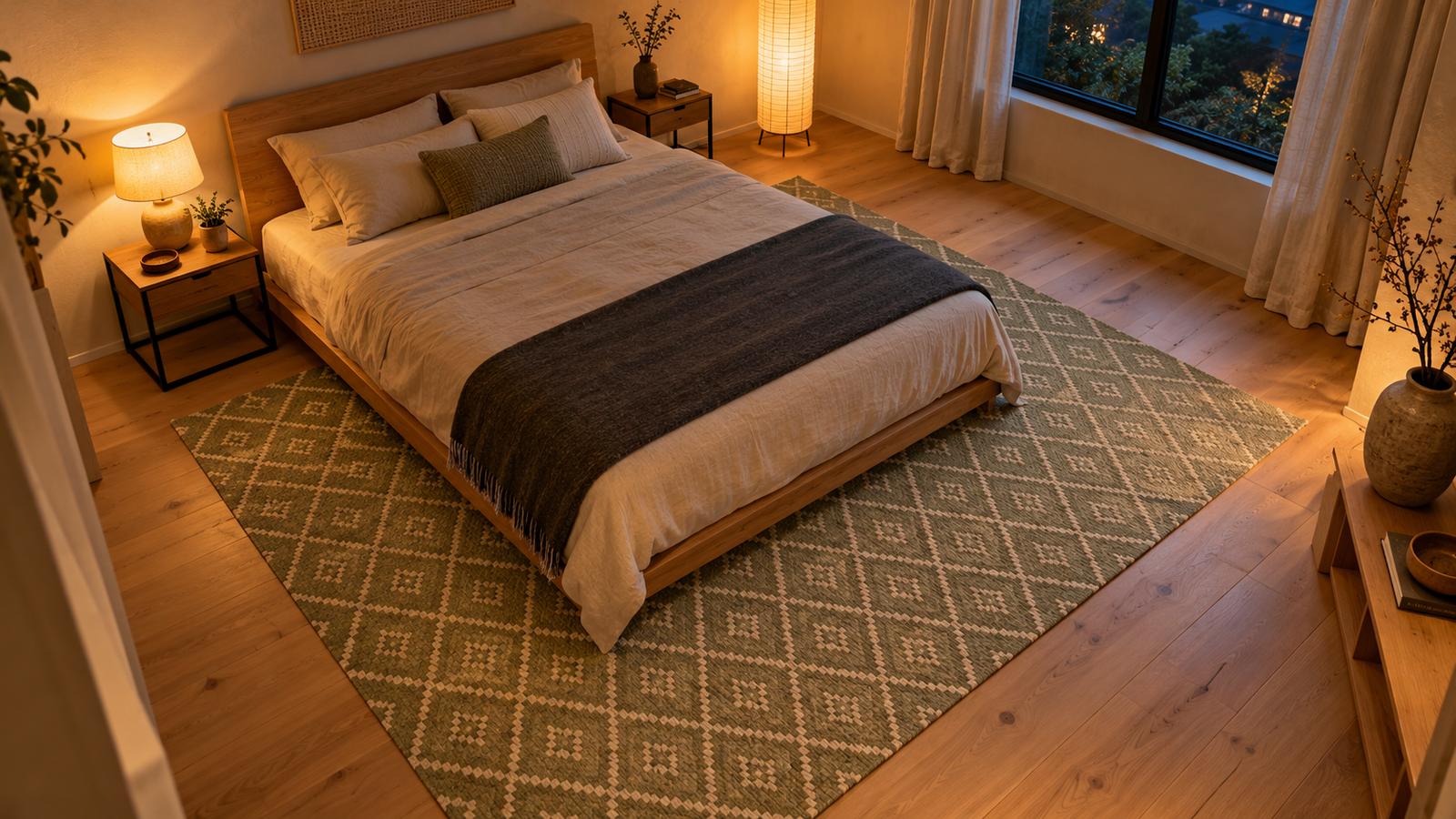

What Size Rug Goes Under a Bed? A Placement and Sizing Guide
What size rug goes under a bed? For most bedrooms the answer is an 8x10 under a queen and a 9x12 under a king, with enough rug sticking out along the sides that your feet land on wool instead of cold floor. The usual rule is 18 to 24 inches of rug showing along the sides and the foot of the bed, and almost every sizing chart you'll find is built on it. What those charts rarely mention is that they're built on American bed sizes. A king in India, the UK and the US can differ by several inches, and several inches is enough to turn a rug that fits perfectly into one that looks slightly stingy.
Table of Contents
What Size Rug Goes Under A Bed? The 18-To-24-Inch Rule
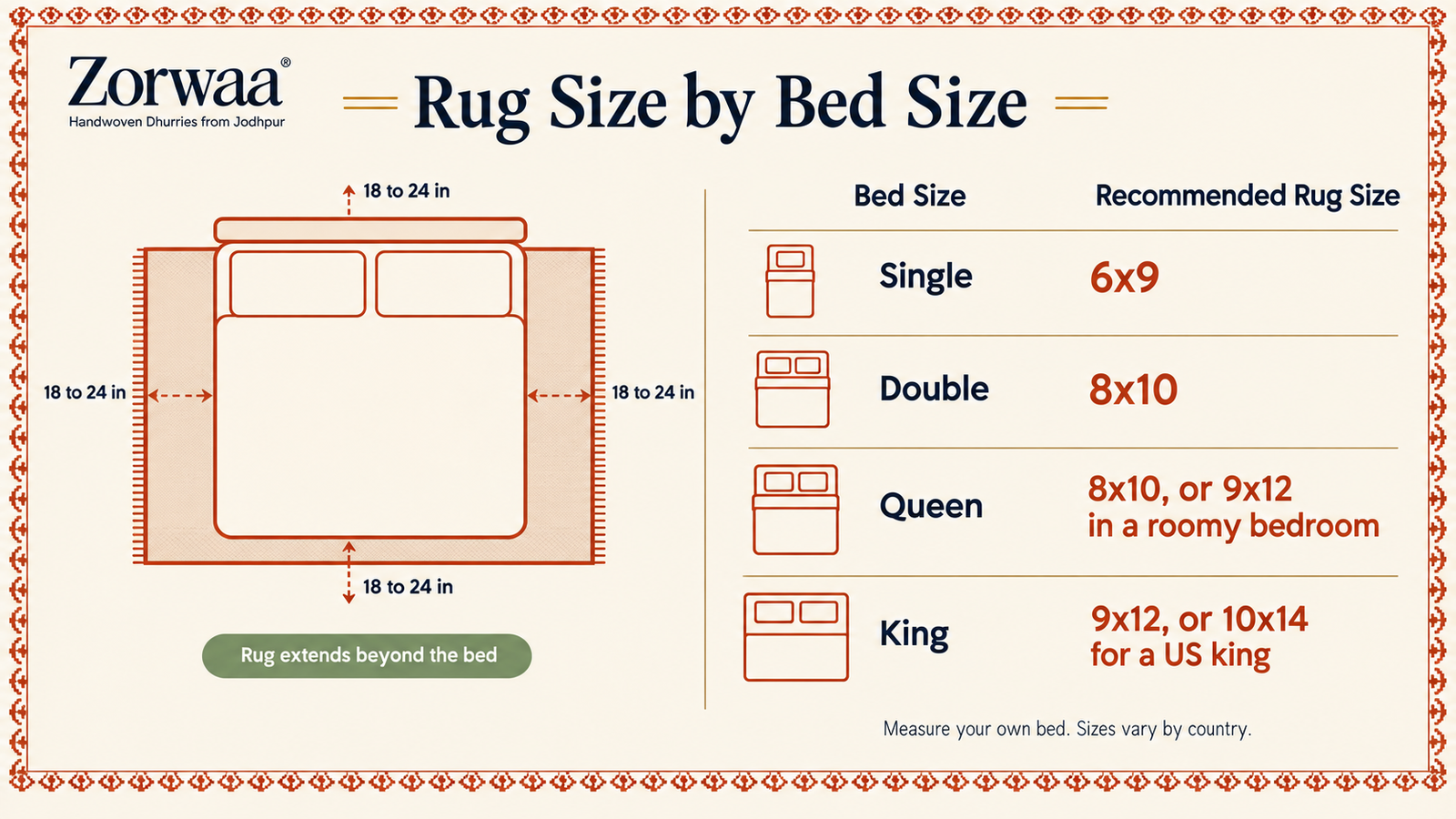
The rule exists for a simple, physical reason. When you get out of bed in the morning, your feet go down on the side, and where they land should be rug. Eighteen to twenty-four inches along each side gives you that landing strip, and the same margin at the foot means the rug frames the bed instead of disappearing underneath it.
Width is almost always the number that decides the size. Length is more forgiving, because the headboard end can sit off the rug and the foot end usually has room to spare. Take your bed's width, add 36 to 48 inches, which is 18 to 24 on each side, and you have the minimum width of the rug in inches. Divide by twelve and you have it in feet. A 60-inch queen needs a rug at least 96 inches wide, which is exactly an 8-foot rug. The maths works the same way for every bed once you know its real width.
Rug Sizes By Bed Size
The table below shows how much rug you get on each side of the bed with the common sizes, measured with the rug centred on the bed's width, so you can see where each pairing lands against the 18 to 24 inch target.
Bed (mattress width) | Typical sizes | Best rug size | Rug showing per side |
Single (36 to 38 in) | India 36x75, US twin 38x75 | 6x9 | 17 to 18 in |
Double or full (48 to 54 in) | India 48x75, US full 54x75 | 8x10 | 21 to 24 in |
Queen (60 in) | India 60x78, US 60x80 | 8x10 | 18 in |
Queen, roomy bedroom | Same | 9x12 | 24 in |
King, India (72 in) | 72x78 | 9x12 | 18 in |
King, US (76 in) | 76x80 | 9x12 (tight) or 10x14 (generous) | 16 in or 22 in |
An 8x10 under a queen sits right at the 18-inch minimum, which is why a 9x12 looks more generous if the room can take it, and a US king lands awkwardly between standard sizes, something we'll come back to. For a single bed, a 6x9 gives you the full margin, and a 5x8 can work in a tight room if you accept about 12 inches a side.
The Mistake That Catches Most Buyers: A Rug That's Too Small
The most common bedroom rug error is buying for the floor instead of the bed.
The numbers are unforgiving. A 5x8 rug is 60 inches wide, exactly the width of a queen bed, so it would slide underneath with no margin showing at all. A 6x9 is 72 inches wide and leaves just 6 inches on each side of a queen, which is a rug peeking out rather than a rug framing anything. When in doubt, go up a size, because a larger rug nearly always looks better under a bed than a smaller one.
Bed Sizes Aren't The Same Everywhere, So Measure Yours
A queen in the US is 60 by 80 inches. In India a queen is usually 60 by 78, though 60 by 72, 60 by 75 and 60 by 80 all get sold under the same name. A king is where it really drifts. An Indian king is commonly 72 by 78, but 72 by 75 and 72 by 84 exist too, while a US king is a wider 76 by 80. The UK adds its own twist, where a king is 60 by 78 inches and the bigger super king is 72 by 78. The Wikipedia entry on bed sizes lays out how national naming standards diverge.
The practical lesson is to ignore the name and measure. Measure the width of the mattress, then check the frame as well, since a chunky headboard or thick side rails can add several inches to the overall width, and what you want the rug to clear is the frame, not just the mattress. Put that real width into the formula above and you'll land on the right rug regardless of what the bed was called in the shop.
Three Placements That Work
Where the rug sits matters as much as how big it is. Three layouts cover nearly every bedroom.
Fully Under The Bed
The whole bed and both nightstands sit on the rug, with a margin showing on every side. It's the most generous look and the one that needs the biggest rug, typically a 9x12 under a queen or a 10x14 under a king. Decide about the nightstands on purpose, either both fully on the rug or both fully off. On a thick pile rug a nightstand with only some legs on it can sit unevenly, though a thin flatweave keeps that to a minimum.
Two-Thirds Under, Starting From The Foot
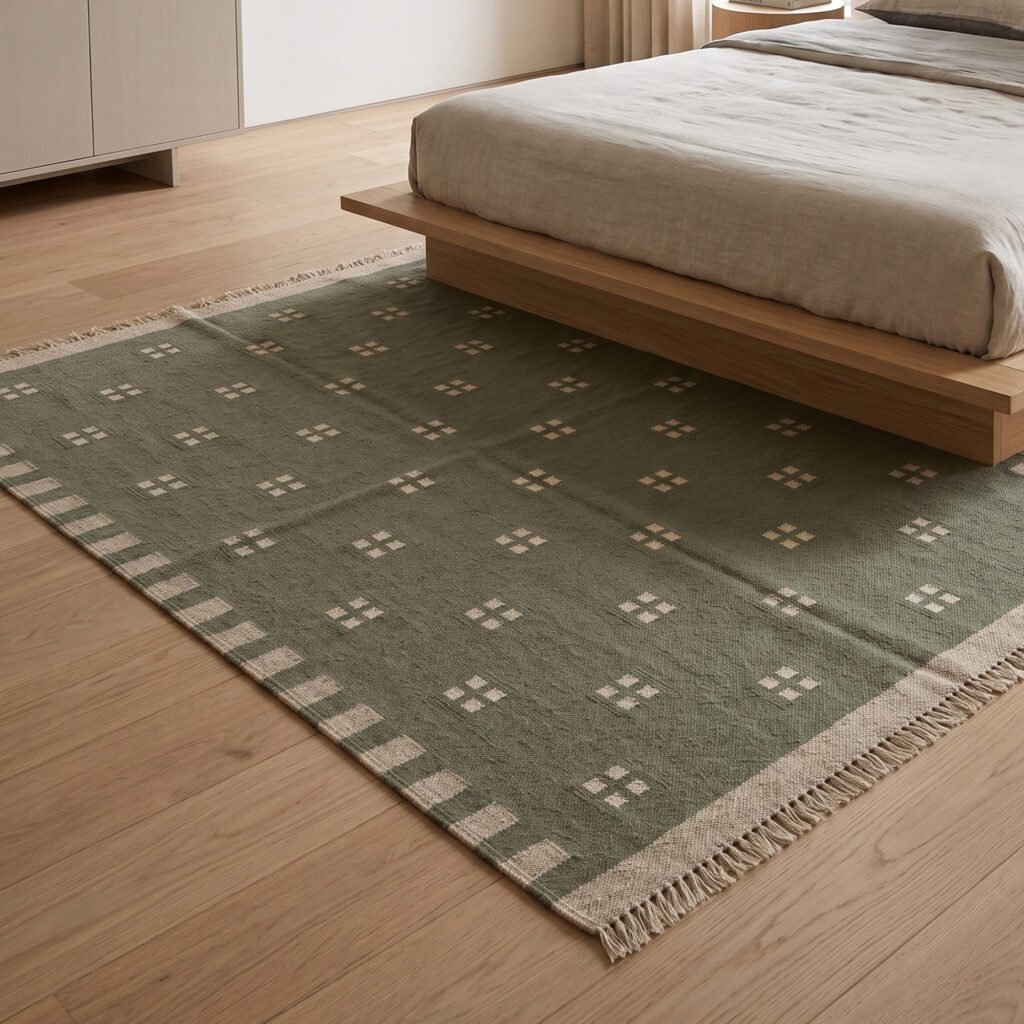
The rug slides under the lower two-thirds of the bed, and the headboard end and nightstands stay on bare floor. This is the most popular layout, mainly because it lets a smaller, less expensive rug do the job, and it shows more of the pattern too. It's how an 8x10 works under a king in a smaller room. The width rule still applies, so check the side margins before you commit.
Two Runners, One On Each Side
A pair of long runners flanking the bed gives you a soft landing strip along both sides without covering the floor at the foot. Each should run about as long as the bed, and our guide to runner rugs covers how to size them. It suits narrow rooms well, and anyone who wants to see more of a rug's pattern.
How Much Floor To Leave Around The Rug
Keep the rug from touching the walls. Leaving roughly 6 to 18 inches of bare floor between the rug's edge and the wall makes the room feel larger and the rug look deliberate, rather than like something that was pushed into a corner. What matters more is keeping it even, so the margin on the left of the bed matches the right.
If the numbers say a rug is too big for your room, don't squeeze the margin around the bed to make it fit. Step down a size and switch to the two-thirds placement instead. A slightly smaller rug placed well looks far better than a bigger one jammed against the skirting.
Products You May Like
-49%
Select options
This product has multiple variants. The options may be chosen on the product page
Handmade Kilim Wool Jute Rug, Boho Rustic Flatweave
$84.00 – $1,200.00Price range: $84.00 through $1,200.00-49%
Select options
This product has multiple variants. The options may be chosen on the product page
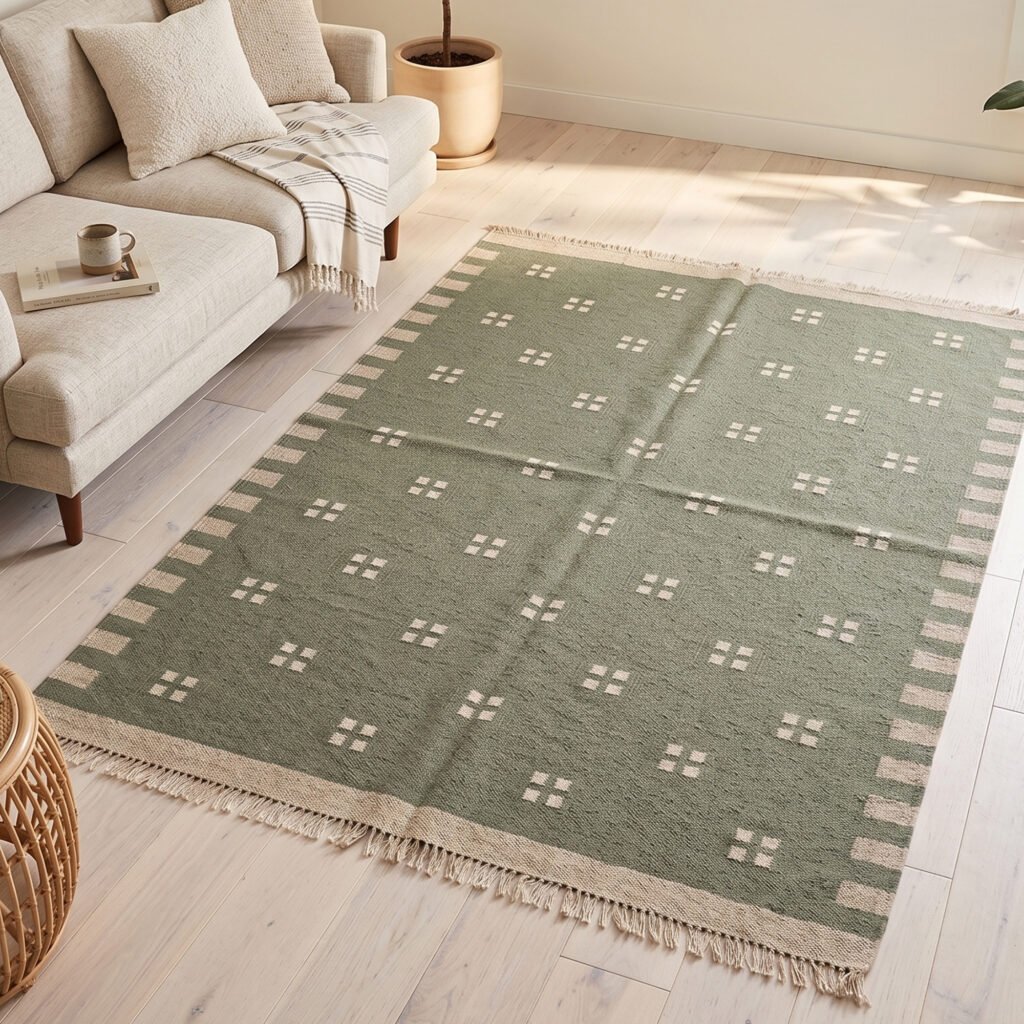
Handwoven Wool Dhurrie Rug Green | Quiet Luxury Flatweave for Modern Spaces
$84.00 – $1,200.00Price range: $84.00 through $1,200.00-55%
Select options
This product has multiple variants. The options may be chosen on the product page
Heritage Panja Weave: Hand-Knotted Pure Cotton Dhurrie
$95.00 – $1,400.00Price range: $95.00 through $1,400.00-55%
Select options
This product has multiple variants. The options may be chosen on the product page
Bohemian Soul Hand-Made Reversible Cotton Dhurrie
$95.00 – $1,400.00Price range: $95.00 through $1,400.00Why A Flatweave Works Well In A Bedroom
A bed is heavy, and where its legs press into a rug matters. On a deep pile rug the legs sink in and can leave dents that take a long time to recover, and a bed can sit slightly unevenly if the pile compresses more on one side. A flatweave dhurrie has no pile to crush, so the bed stands level and the legs leave very little mark. It's also light enough to pull out when you need to vacuum underneath. Our flatweave versus pile guide covers the wider comparison if you want it.
The honest trade-off is that a flatweave is thinner, so it feels less plush underfoot first thing in the morning than a thick pile rug would. A thin rug pad underneath fixes most of that, adding cushioning and stopping the rug from creeping when you swing out of bed. Wool and cotton dhurries both take a pad well, and it's a small cost for a rug that will spend years being stepped on at its edges.
When Your Bed Or Room Doesn't Match The Standard Sizes
Standard rug sizes assume standard beds, and plenty of beds aren't. A storage bed with a wide frame, a platform bed with a deep headboard shelf, a super king, or a diwan with an oversized base can all push the footprint past what a chart expects. Even a plain US king runs into trouble. At 76 inches wide it needs about 9 feet 4 inches of rug to reach the 18-inch minimum and about 10 feet 4 inches to reach 24, and standard sizes jump from 9 feet to 10 feet with nothing in between. A 9x12 leaves 16 inches a side, a little short, while a 10x14 can overwhelm a medium-sized bedroom.
That gap is where custom sizing earns its place. Give us your bed's real width and the floor space you have, and the rug gets woven to the dimensions that actually fit, a 9 foot 6 inch width, say, instead of rounding to the nearest standard size and living with the compromise. For a bed you'll sleep in for years, it's worth getting the proportions right.
Quick Sizing Checklist
- Add 36 to 48 inches to your bed's width to find the minimum rug width, which gives 18 to 24 inches on each side
- Queen beds usually pair with an 8x10, or a 9x12 in a roomy bedroom
- Indian kings (72 inches) suit a 9x12, while US kings (76 inches) are tight in a 9x12 and generous in a 10x14
- Measure your own bed and frame, since sizes vary by country and brand
- Choose fully under, two-thirds under or two runners, and keep nightstands either fully on or fully off the rug
- Leave 6 to 18 inches between the rug and the walls
- Add a thin rug pad for cushioning and grip
Frequently Asked Questions
What size rug goes under a queen bed?
An 8×10 is the standard pairing, giving about 18 inches on each side of a 60-inch bed. In a roomier bedroom, a 9×12 gives a more generous 24 inches.
What size rug goes under a king bed?
A 9×12 is the usual choice. It gives 18 inches a side on an Indian 72-inch king and about 16 inches on a US 76-inch king. A 10×14 is the more generous option where the room allows it.
Can I use a smaller rug under the bed?
Yes, with a two-thirds placement, where the rug sits under the lower two-thirds of the bed and the headboard end stays on bare floor. Check that the width still leaves a reasonable margin at the sides.
Should nightstands be on the rug?
Either fully on or fully off, decided on purpose. A nightstand with only some of its legs on a thick rug can sit unevenly.
How far should a rug stick out from the bed?
About 18 to 24 inches on the sides and at the foot, so your feet land on the rug when you get up instead of on the floor.
The right rug under a bed comes down to one measurement, the width of your own bed plus 18 to 24 inches per side, and the rest is a choice of layout. Measure the bed rather than trusting its name, pick the placement that suits the room, and if the numbers land between standard sizes, ask for the size you actually need. Browse our bedroom collection for flatweave dhurries in the weights and patterns that suit a bedroom.