

Runner Rugs for Hallways and Staircases: A Sizing and Buying Guide

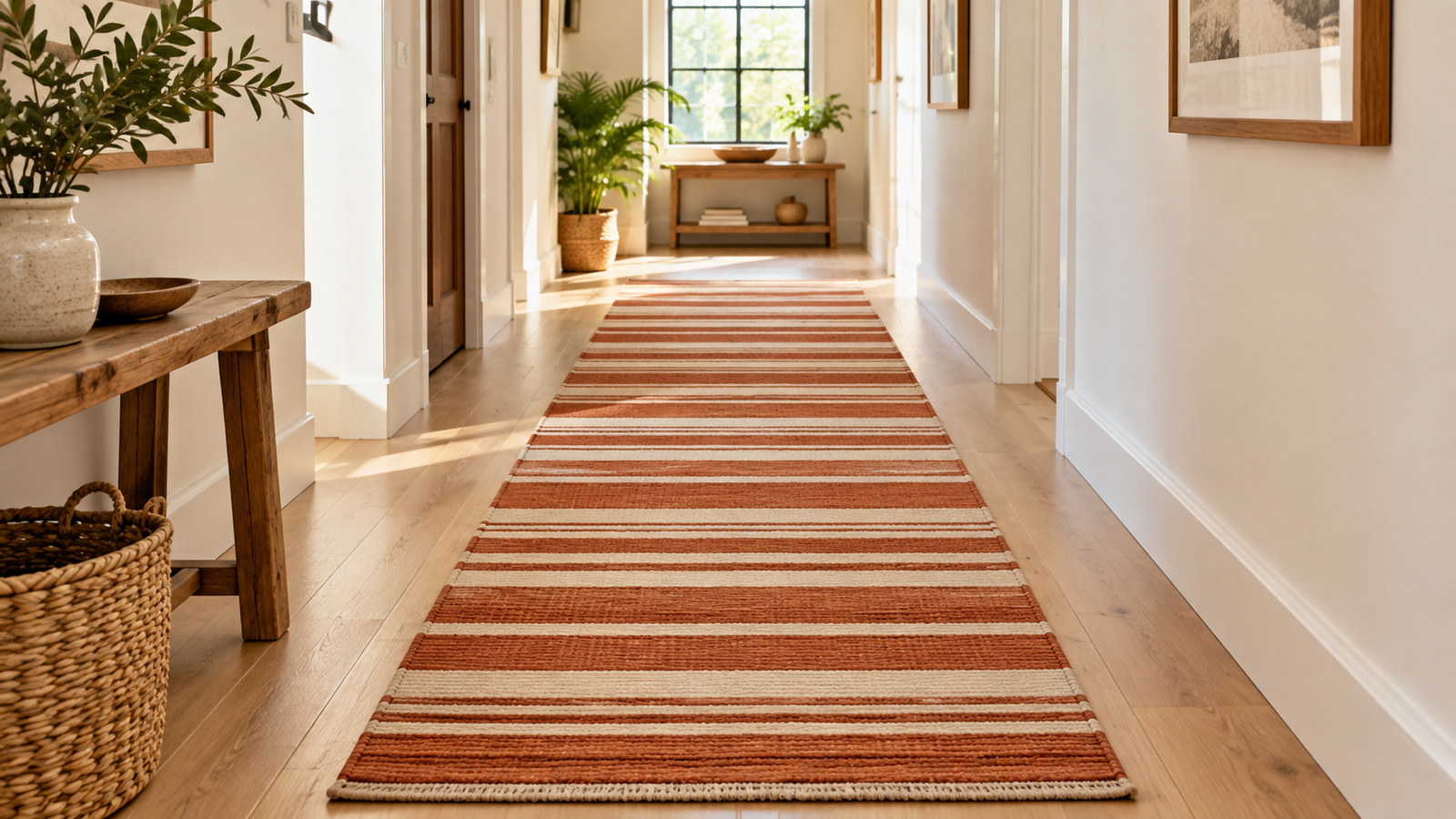
Runner rugs for hallways and staircases solve a sizing problem area rugs don't, fitting a long, narrow space properly rather than just picking the next size up and hoping it works. Both call for a runner for the same basic reason, a long, narrow footprint that a standard rectangle was never built for, but the actual sizing math, and the safety considerations, are different enough between the two that it's worth treating them as separate problems rather than one. This guide covers both: how much floor or tread to leave exposed on each side, how to calculate the right length, and the one thing worth taking seriously on a staircase specifically that barely matters in a hallway, how securely the runner is actually installed underfoot.
Table of Contents
Sizing A Runner For A Hallway
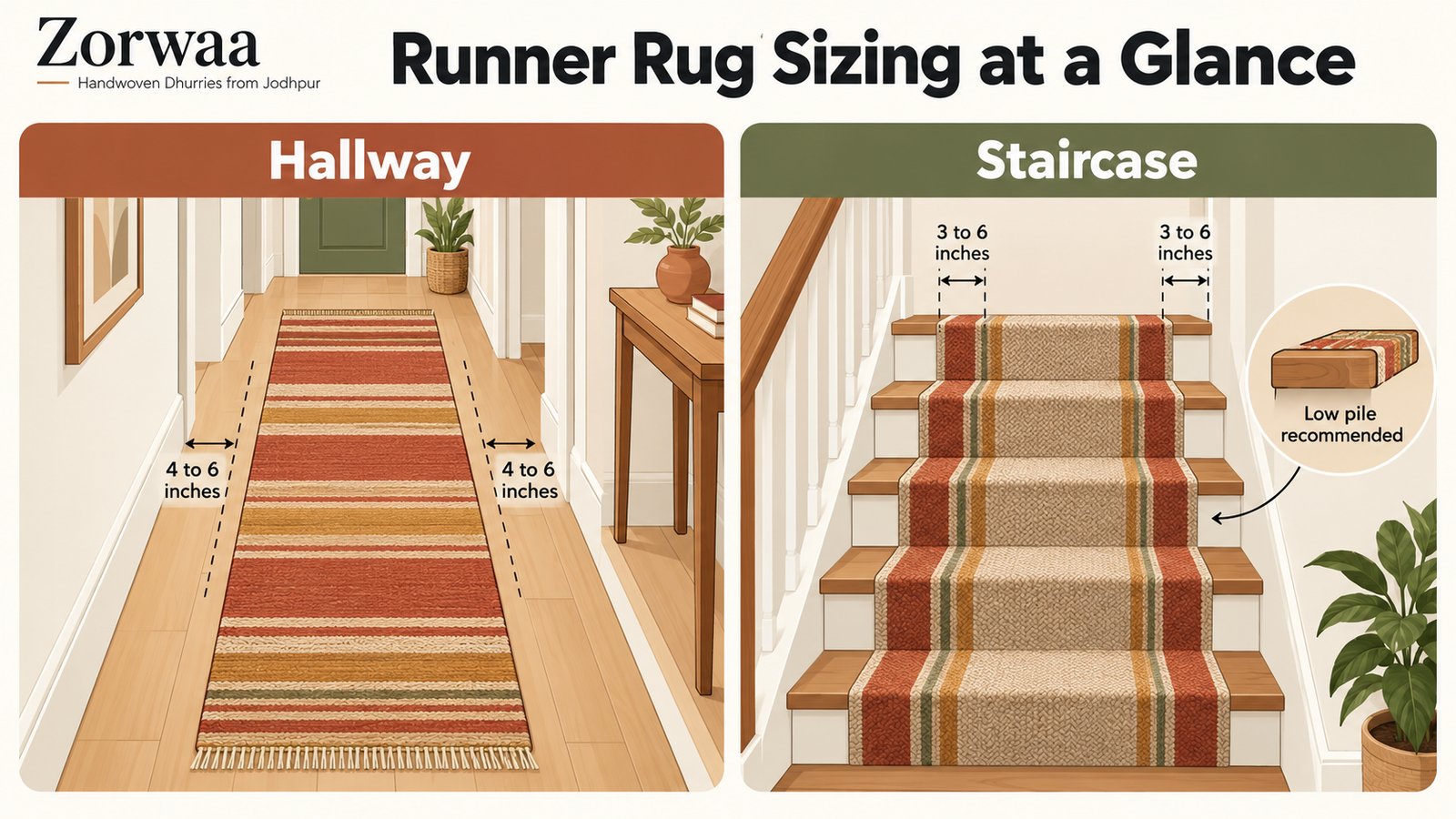
Hallway runners are the more forgiving of the two to get right. As a general rule, leave 4 to 6 inches of floor visible on each side of the runner rather than running it edge to edge across the full width, which is why standard runner widths tend to sit around 2, 2.5 or 3 feet rather than matching a hallway's exact width. Our rug size guide covers the same margin principle for full rooms, if you want the broader version of this logic.
Length works the same way at each end, leave a small gap, a few inches, at doorways or where the hallway opens into another room, rather than running the runner wall to wall. For a long, continuous hallway with no natural break, running close to the full length looks intentional. For a hallway that connects to several doorways, stopping short of each threshold usually reads cleaner than running underneath it.
Sizing A Runner For A Staircase
Stair runners use different math entirely, based on the shape of the stairs themselves rather than a simple length and width.
For length, measure the depth of one tread plus the height of one riser, including the nosing, the rounded edge at the front of each step, then multiply that total by the number of steps. Add roughly 6 to 12 inches on top for trimming and for tucking the ends neatly at the top and bottom landings.
For width, the same margin principle from hallways applies, just on a smaller scale. Leave 3 to 6 inches of exposed tread on each side rather than running the runner the full width of the staircase, standard widths of 27, 30 or 36 inches cover most residential stairs. Measure the narrowest point of the staircase if the width varies at all along its length, and use that measurement rather than an average, a runner that's slightly too wide anywhere along the run won't sit correctly.
Why Pile Height Matters More On Stairs Than Anywhere Else In The House
This is worth taking seriously rather than treating as a styling preference. Federal accessibility guidance from the U.S. Access Board caps carpet pile at half an inch for safe, firm footing generally, and notes plainly that a lower pile provides easier, more stable footing. On a staircase specifically, many installers and rug specialists recommend going considerably lower than that, under roughly a quarter inch, since a pile any higher creates an uneven edge along the front of each tread, exactly the kind of unevenness that can catch a foot, especially going down rather than up, when your foot is naturally reaching for a flat surface it can't fully see.
Flatweave and low-pile constructions are consistently recommended as the safer choice for stair use for exactly this reason. A dhurrie's flat profile has no raised edge to catch on at all, a genuine, practical safety advantage on a staircase, not just a texture preference. If you're choosing a runner for a hallway alone, pile height is mostly about feel and maintenance. On a staircase, it's worth treating as a safety detail first and a style choice second.
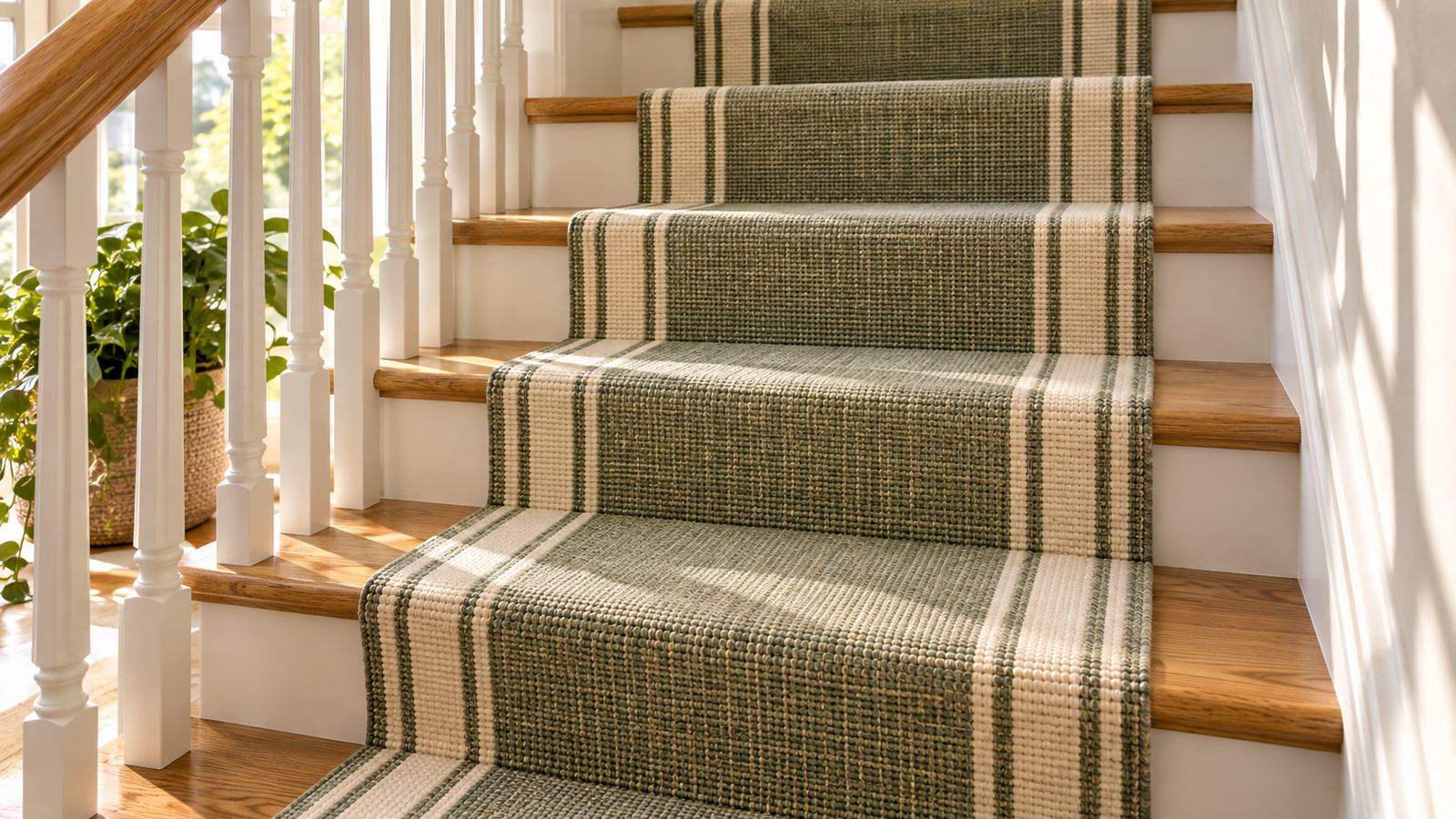
Installation is where hallway and stair runners genuinely differ
A hallway runner is close to a lay-it-and-go job. Add a non-slip pad underneath if the floor is smooth, and that's usually the whole installation.
A staircase runner is a different undertaking, and it's worth budgeting for that difference rather than assuming it's the same task scaled down. A runner on stairs needs to be properly secured, typically with tackless strips, staples, or carpet tape specifically rated for stair use, not just laid on top and left to sit. An unsecured runner on a staircase is a genuine slip and trip hazard in a way an unsecured hallway runner simply isn't, since a shifting runner on a flat floor is an inconvenience and a shifting runner on a step is something closer to a fall waiting to happen.
Professional installation is a common and entirely sensible choice for a staircase specifically, given what's actually at stake, even for people who'd happily lay a hallway runner themselves without a second thought.
When A Standard Width Or Length Doesn't Fit
Standard runner widths and lengths cover a lot of homes, but not all of them. A hallway noticeably wider or narrower than the usual range, a staircase with an unusual tread depth or riser height, a winding or split staircase with treads that change width partway through, or a run long enough that you'd otherwise need to piece together multiple standard lengths, are all situations where an off-the-shelf runner starts to compromise rather than fit.
Custom sizing solves this the same way it does for any other room, by working from your actual measurements rather than the nearest standard option. For a staircase specifically, that can mean a single continuous custom length rather than joining shorter pieces together, which tends to look considerably more finished and gives you one less seam to secure properly during installation.
Quick Sizing Checklist
- Hallway: leave 4 to 6 inches of floor exposed on each side, standard widths 2', 2.5' or 3'
- Staircase: measure tread depth plus riser height, multiply by the number of steps, add 6 to 12 inches for trimming
- Staircase width: leave 3 to 6 inches of exposed tread on each side, standard widths 27" to 36"
- Choose flatweave or low pile for stairs specifically, it's a genuine safety consideration, not just a style choice
- Stair runners need to be properly secured, tackless strips, staples or rated tape, not just laid down
- Custom sizing avoids piecing together standard lengths on long or unusually shaped staircases
Frequently Asked Questions
How much floor should show on either side of a runner rug?
About 4 to 6 inches for a hallway, and 3 to 6 inches of exposed tread for a staircase, rather than running the runner the full width of the space.
How do I measure my staircase for a runner?
Measure one tread’s depth plus one riser’s height, including the nosing, then multiply by the total number of steps. Add roughly 6 to 12 inches for trimming and tucking the ends.
Is a low-pile rug safer than a plush one on stairs?
Yes. A higher pile creates an uneven front edge on each tread that can catch a foot, particularly going downstairs. Flatweave and low-pile constructions are the safer choice.
Do I need to hire someone to install a stair runner?
Not strictly, but it’s a common and sensible choice given the safety stakes involved. A stair runner needs to be properly secured rather than simply laid down, unlike a hallway runner.
Getting a runner right comes down to the same basic idea in a hallway or on a staircase, leave a consistent margin, measure the actual space rather than guessing, and take the securing part seriously once stairs are involved. If your space runs long, narrow or oddly shaped, custom sizing gets you an exact fit without the guesswork. Browse our traditional dhurrie collection for the flatweave patterns that work well in either spot.