
Flatweave Vs Pile Rugs – Which One Is Right For Your Home?

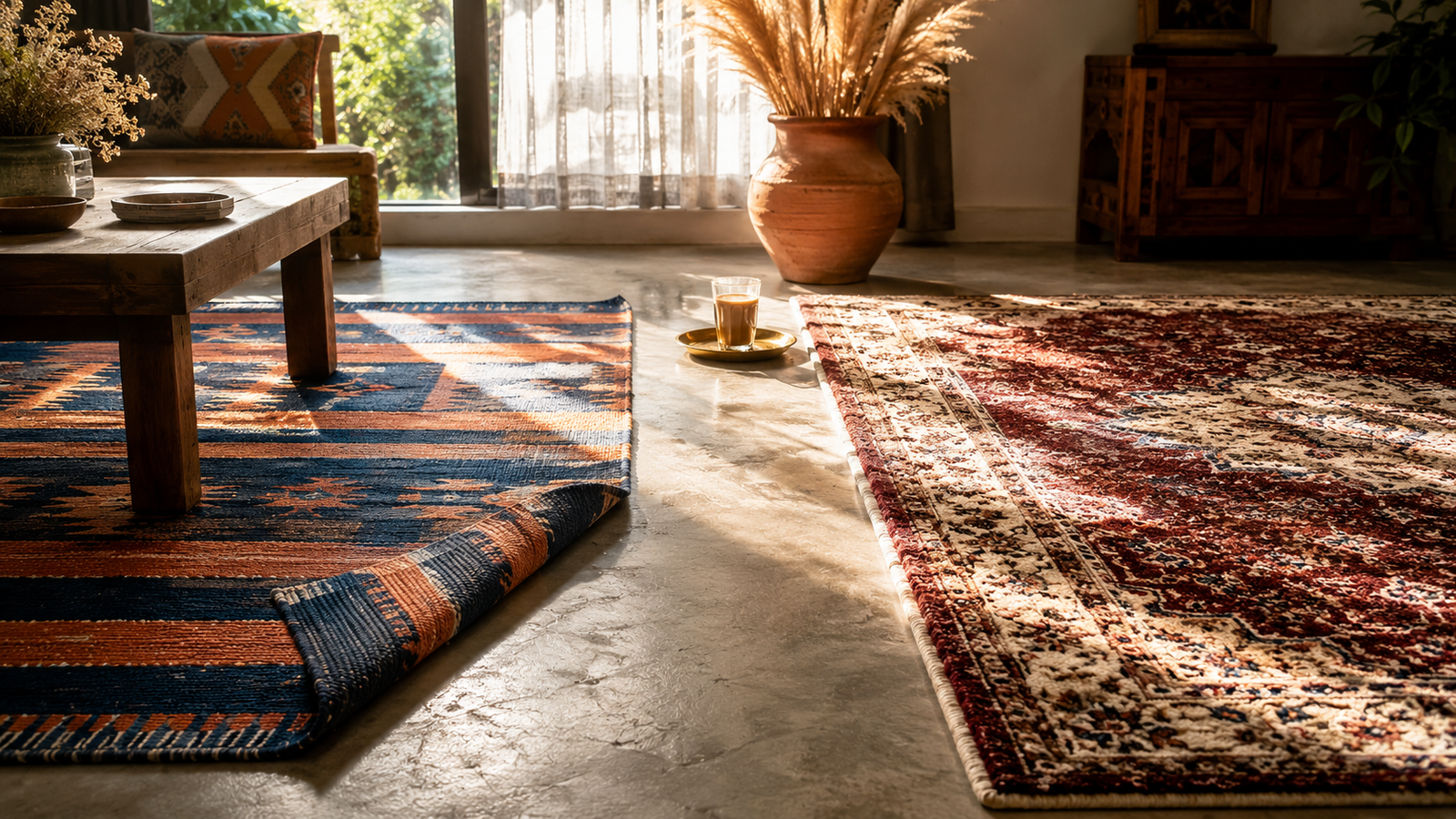
Walk into any rug shop, physical or online and you'll see both kinds. Flat, thin rugs with geometric patterns. Thick, plush rugs you want to sink your feet into. Both described as "handmade." Both available in a range of sizes and prices. Both looking perfectly fine in photographs.
The difference between a flatweave and a pile rug only becomes clear once you actually live with one. How it feels underfoot, how easy it is to clean, how it behaves in the Indian summer versus a British winter, how it ages over a decade. These are the things a product page won't tell you.
This guide will.
What Is A Flatweave Rug?
A flatweave rug is made by weaving weft threads horizontally through vertical warp threads on a loom. The two sets of threads interlock and compress against each other - no pile, no knots, no raised surface. The result is a completely flat textile, the same on both sides.
The most familiar flatweave rugs in India are dhurries, the traditional flatwoven floor coverings made across Rajasthan, Uttar Pradesh, and Haryana. A Salawas panja dhurrie, a striped cotton dari from Panipat, a geometric cotton-wool blend from Sitapur, these are all flatweaves. Different regions, different yarn weights, different design traditions but the same fundamental construction.
Kilims (Turkish and Central Asian flatweaves), Scandinavian rag rugs, and many contemporary modern rugs are also flatwoven. The technique is ancient and global, but its strongest surviving tradition in India runs through the weaving villages of Rajasthan.
Key characteristics of flatweave rugs:
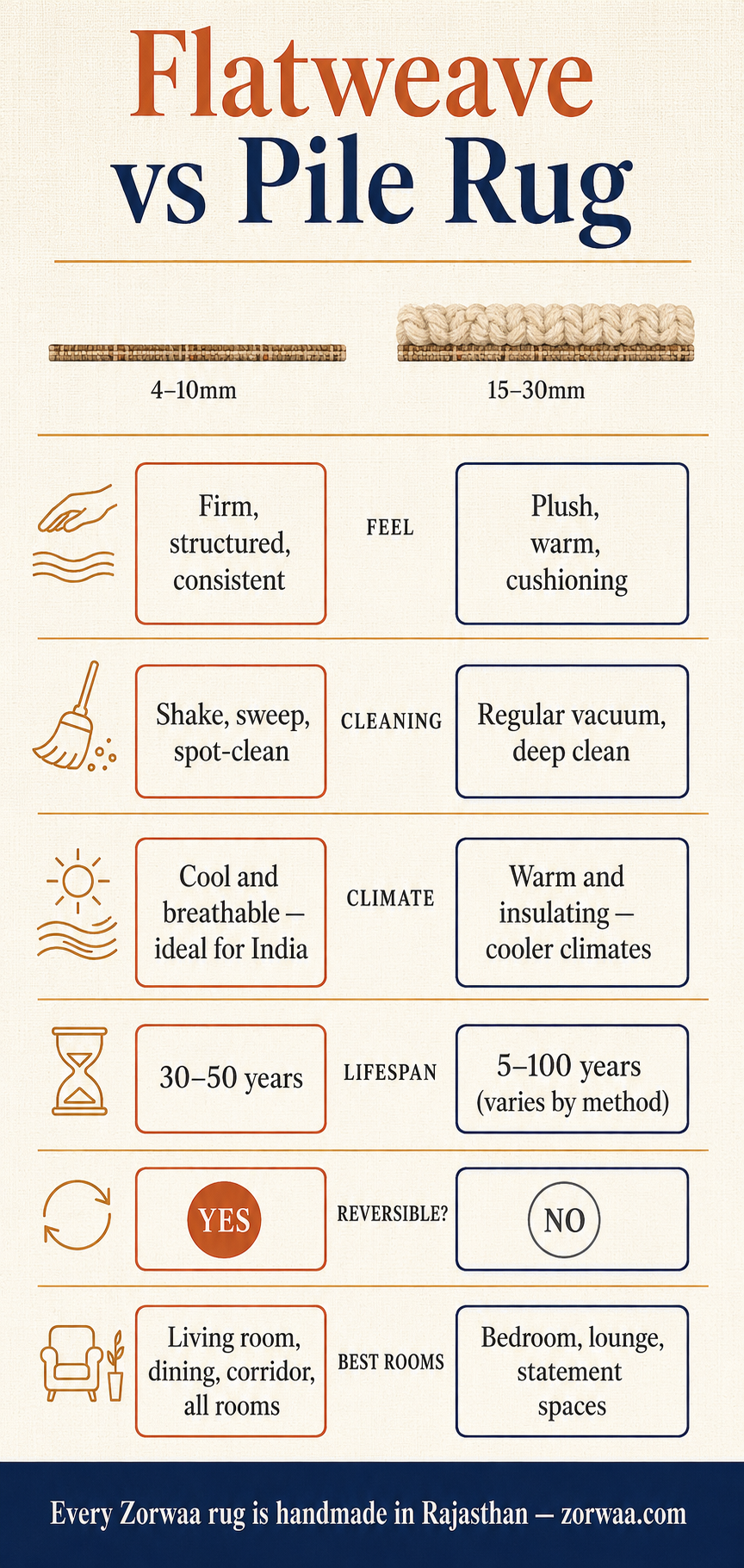
- Completely flat - typically 4-10mm thick
- Reversible - pattern visible on both sides
- Lightweight and easy to move, fold, and store
- Durable for everyday use in high-traffic areas
- Breathable - stays cool in warm climates
- Does not trap dust and allergens within the structure
- Naturally resistant to moths and silverfish
What Is A Pile Rug?
A pile rug is made by inserting or knotting lengths of yarn through a woven base, creating a raised surface - the pile, that stands upright from the backing. The density, height, and cut of the pile determines the look and feel of the finished rug.
There are two primary pile construction methods worth knowing:
Hand-knotted pile rugs are the most labour-intensive textile objects in the world. Each individual knot and a fine rug may have hundreds of knots per square inch, is tied by hand around warp threads, row by row, across the entire surface. A large, fine hand-knotted rug can take years to complete. These are the rugs described in auction catalogues and passed between generations of families. Persian carpets, Turkish rugs, Kashmiri carpets, these traditions all use hand-knotting.
Hand-tufted pile rugs are made using a tufting gun - a tool that punches yarn mechanically through a canvas backing. A latex layer is then applied to hold the tufts in place, and a secondary backing covers the underside. Faster and cheaper to produce than hand-knotted rugs. Technically still made by hand, but structurally and in terms of longevity, fundamentally different.
Key characteristics of pile rugs:
- Raised surface - typically 10–30mm thick
- Plush underfoot, adds warmth and cushioning
- One-sided - backing always on the underside
- Requires more maintenance - vacuuming, deep cleaning
- Warmer feel - better suited to cooler climates
- Pile can trap dust, allergens, and insects over time
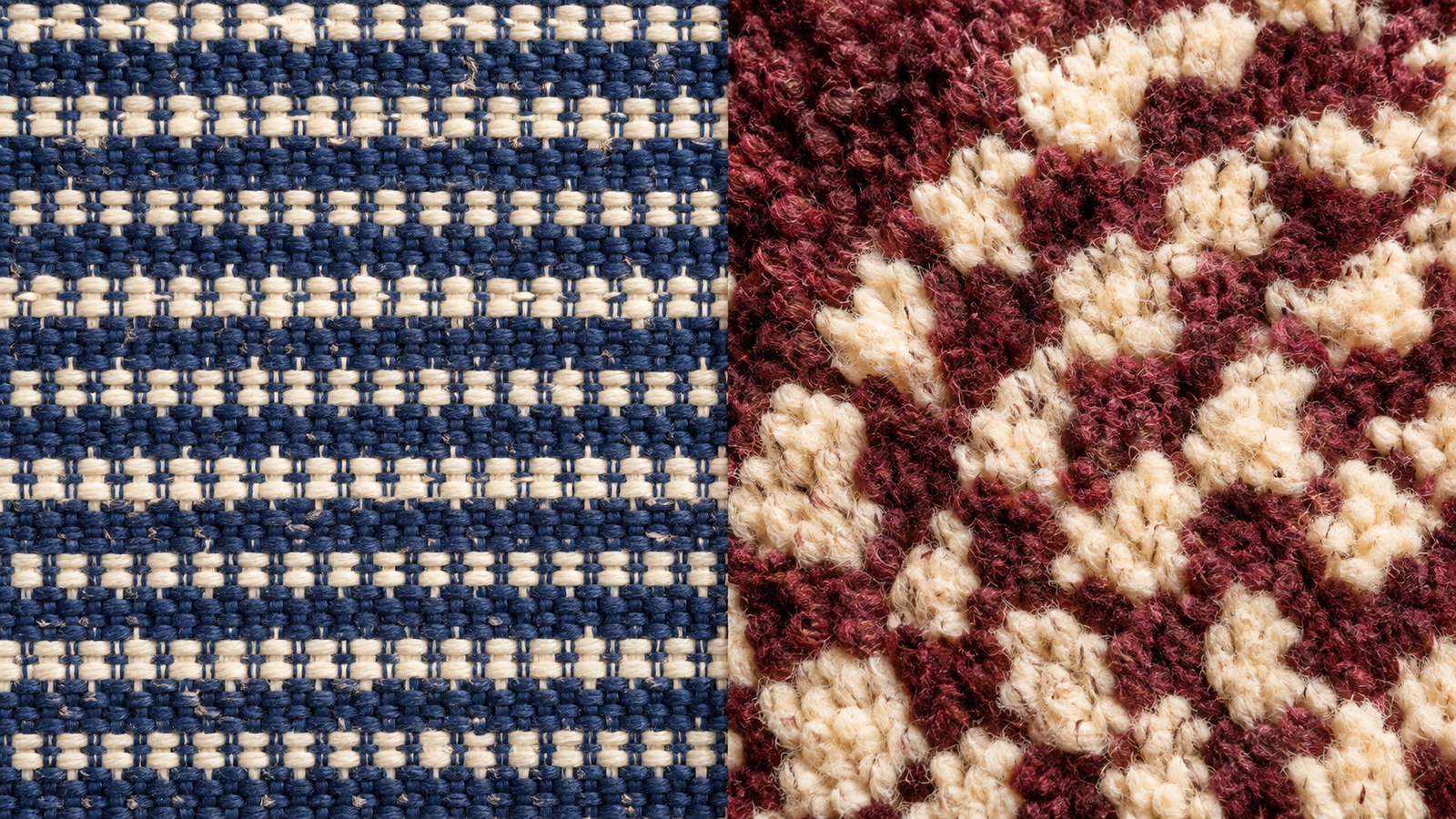
The Real Differences Between Flatweave And Pile Rugs
Comfort and feel underfoot
This is where pile rugs have a clear, undeniable advantage.
A high-pile hand-knotted wool rug is an exceptionally luxurious surface to stand or sit on. The cushioning is real. The warmth is real. If your priority is a rug you want to sink your bare feet into, especially in a bedroom or lounge - a pile rug delivers that in a way a flatweave doesn't.
Flatweave rugs are firm underfoot. They have a clean, structured feel. Some people prefer this enormously, there's no softness that wears down over time, no matting in heavy-traffic zones. The surface stays consistent for years. For living rooms, dining areas, and entryways, most people find flatweave entirely sufficient and often preferable for its practicality.
Cleaning and maintenance
Flatweave rugs win here, and it isn't particularly close.
Shake it, vacuum it on both sides, spot-clean with mild soap and cold water. The flat surface means there's nowhere for dirt to hide. Spills sit on top rather than soaking deep into pile. A flatweave dhurrie can be washed more easily than a pile rug of the same size.
Pile rugs, especially high-pile wool, require professional cleaning every one to three years to maintain properly. The pile accumulates dust, fine particles, and over time, mites and insects can nest in the depth of the fibres. Regular vacuuming is essential. In Indian homes with open windows and dusty seasons, this is a meaningful consideration.
Climate suitability
Flatweave rugs were developed in warm-climate cultures for a reason. A cotton dhurrie in a Jodhpur summer is cool, breathable, and doesn't retain heat the way a pile rug does. For homes across most of India, where summers are long and rooms are warm - a flatweave is simply more comfortable for nine months of the year.
Pile rugs make considerably more sense in cooler climates or in air-conditioned rooms where underfoot warmth is desirable. A thick wool pile carpet in a Shimla winter home, or a hand-knotted rug in a temperature-controlled apartment, works well. In a Chennai or Jaipur summer, the same rug can feel heavy and uncomfortable.
Durability
Both can be exceptionally long-lasting - if made properly.
A well-constructed hand-knotted pile rug is arguably the most durable soft furnishing you can buy. The structural integrity of individually tied knots means the rug holds together under decades of heavy use. Antique Persian and Turkish rugs several hundred years old survive in active use today.
A well-made flatweave dhurrie from Salawas or Bishnoi Village lasts 30 to 50 years in everyday use. The construction is structural, no pile to wear down, no backing to separate. The rug is simply threads interlocked with threads. It does not deteriorate in the way pile rugs do at the surface.
Hand-tufted pile rugs have a much shorter lifespan, typically 5 to 15 years before the latex backing degrades and the pile begins to shed and separate. Knowing the construction method matters enormously when you're comparing price to durability.
Reversibility and placement flexibility
A flatweave rug is reversible. Flip it when one side shows more wear. Use both sides over its lifetime. Rotate it seasonally if you use a different side in summer versus winter. This doubles the effective lifespan and gives you options no pile rug can offer.
Pile rugs are single-sided. The backing goes down, the pile faces up. That's the only configuration.
Style and design range
Both categories are vast.
Flatweave carpets cover everything from traditional geometric Rajasthani stripe patterns to clean modern minimalist designs, abstract contemporary pieces, and subtle natural-tone solid-colour rugs. The flatweave format works across styles because the pattern is in the weave itself, the geometry of intersecting threads rather than in the pile texture.
Pile rugs have their own enormous design range, from traditional Persian medallion motifs to contemporary abstract hand-knotted pieces. They add visual texture through the pile itself, the way light catches different pile directions creates a depth flatweaves don't have.
Which Rug Type Is Right For Your Home?
There is no universal answer. The honest answer is situational.
Choose a flatweave rug if:
- You live in a warm or tropical climate
- You have children, pets, or a high-traffic home
- You want something easy to clean and maintain
- You value reversibility and longevity without high maintenance
- You prefer a rug that ages gracefully without showing wear
Choose a pile rug if:
- You want maximum underfoot warmth and softness
- Your home runs cool or you have good climate control
- You're buying for a bedroom or lounge used with bare feet
- You're investing in a hand-knotted statement piece for the long term
- Maintenance is not a significant concern
For most Indian homes, particularly across the plains of Rajasthan, Gujarat, Maharashtra, and the south region, a well-made flatweave dhurrie is the more practical, more comfortable, and ultimately more sensible choice for most rooms most of the time. If you want to see what's possible with a flatweave, browse the full range and customise your own rug to your exact size, colour, and design.
Frequently Asked Questions
Can a flatweave rug go in a bedroom?
Absolutely. The firmness works well in bedrooms where you’re not spending hours on the floor. For maximum softness beside a bed, some people pair a flatweave as a room anchor with a small, softer bedside piece.
Does a flatweave rug need a rug pad?
On smooth floors – marble, tiles, polished wood – Yes, a non-slip pad underneath is recommended for any rug. On rougher stone or cement floors, flatweaves typically stay in place without one.
How long does a flatweave rug last compared to a pile rug?
A well-made handmade flatweave dhurrie lasts 30-50 years. A hand-knotted pile rug can last 50–100+ years. A hand-tufted pile rug typically lasts 5-15 years. The construction method matters as much as the rug type.
Are flatweave rugs suitable for dining rooms?
Yes and often better suited than pile rugs. Chair legs don’t snag, crumbs don’t disappear into the pile, and cleaning after meals is considerably easier.
3 thoughts on “Flatweave Vs Pile Rugs – Which One Is Right For Your Home?”
Comments are closed.