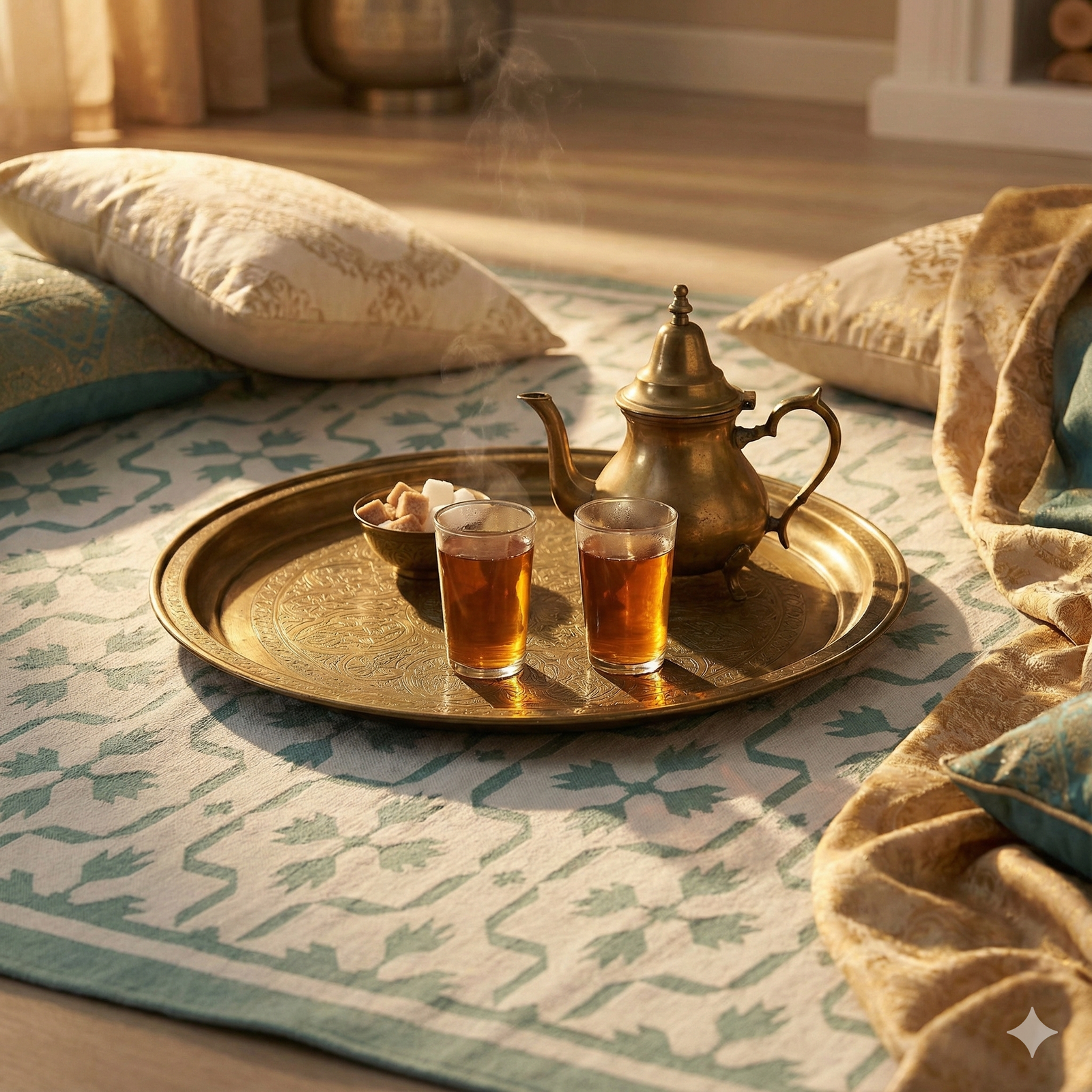

Rug Layering 101: How to Mix and Match Dhurries With Other Rugs


Rug layering is exactly what it sounds like, placing one rug over another rather than choosing just one, and it's become one of the more useful tricks in a room stylist's toolkit for a reason. It solves real problems: a room that's too big for any single affordable rug, an open-plan space with no clear zones, a floor that feels flat and one-note. Dhurries are particularly well suited to this. Their flat profile means they sit properly on top of another rug instead of bunching, and their patterns and colours read as genuine personality rather than trying to compete with a plush pile piece. This guide covers the actual mechanics of rug layering, sizing, texture, pattern, placement, so the result looks intentional rather than like two rugs that happened to end up in the same room.
Table of Contents
Why Rug Layering Works
Three practical reasons come up again and again.
The most common one: a rug you love is the wrong size for the room. A large room needs an 8x10 or 9x12 to anchor the furniture properly, but a beautiful smaller dhurrie you already have, or want, doesn't have to sit unused. Layer it over a larger, plainer base and the room reads as fully covered while the dhurrie still gets to be the star.
The second is zoning. Open-plan living and dining spaces often have no natural break between them, and a change in rug, even layered rather than swapped, signals where one function ends and the other begins.
The third is simpler: texture and depth make a room feel finished in a way that a single flat rug on a single flat floor rarely does, whatever the size.
Getting The Size Ratio Right
The base rug does the heavy lifting on coverage, the top rug does the personality. As a rough rule, the top rug should sit somewhere between half and two-thirds the size of the base, small enough that a clear, deliberate border of the base rug shows all the way around, not so small that it looks like an accident.
For a living room, a common pairing is a 9x12 or 8x10 base under all the seating, with a 5x8 or 6x9 dhurrie layered on top, centred under the coffee table. For a bedroom, the base extends generously past the sides and foot of the bed, and the top layer can be a runner alongside it or a smaller patterned piece across the foot of the bed rather than the whole surface.
Whatever the exact numbers, keep at least the front legs of major furniture resting on the base rug. That's what makes the whole arrangement feel anchored rather than like two separate rugs pushed together.
Texture Matters More Than Colour
This is the part people underestimate. Two rugs with similar pile height and similar weight tend to visually merge into one confused-looking rug, even when the colours and patterns are different. The combination that consistently works, and the reason it's become the standard layering formula, is a flatter, more textural natural fibre base with a flatweave dhurrie or kilim on top.
A jute or a plain wool-cotton base gives the floor a grounding, slightly rustic texture. A patterned dhurrie on top reads as crisp and graphic against it precisely because the two textures stay distinct rather than blending together. This is also the safest combination if you're new to layering, since natural fibre bases are close to neutral by default, which takes the colour-matching pressure off the pairing almost entirely.
One practical note: two flatweaves stacked directly on top of each other can slide against one another more than a textured base would. A thin rug pad or a few strips of rug tape between the layers solves this without changing how anything looks.

Getting Pattern And Colour To Work Together
The one rule really worth following: don't stack two busy patterns on top of each other. A geometric dhurrie over a bold traditional medallion rug fights for attention and rarely settles. A patterned dhurrie over a solid or subtly textured base, or the reverse, gives the eye one clear thing to focus on.
Colour is more forgiving than most people expect, as long as both rugs reference at least one shared tone. A rust and ivory dhurrie sits comfortably over a plain sand-coloured jute base because the warm undertone carries through both. It doesn't need to match exactly, it just needs to feel like it belongs to the same palette rather than two unrelated colour stories placed next to each other.
If you want to push it further, staying within the same colour temperature, warm with warm, cool with cool, does most of the cohesion work even when the patterns themselves are quite different from each other.
Where Layering Works Best, Room By Room
Living rooms are the easiest place to start, a jute or solid base under the seating, a patterned dhurrie centred under the coffee table. It's forgiving because the top rug only needs to work with one focal point rather than an entire room's traffic pattern.
Bedrooms benefit from a slightly different approach. A large base extending well past the bed on both sides, with a softer or patterned runner along one side for the first step out of bed, or a smaller striped dhurrie laid across the foot of the bed as more of an accent than full coverage.
Entryways and corridors are an underrated spot for this. A long runner-style dhurrie layered over a plainer flatweave in a narrow hallway adds pattern to a space that's usually left as an afterthought, and the flat profile of both means there's no tripping hazard even in a high-traffic walkway.
Dining rooms are the one place to be more cautious. Chair legs moving in and out catch on layered edges more than in any other room, so keep layering here to a single well-anchored combination rather than anything with a lot of loose edge.
Common Layering Mistakes To Avoid
A top rug that's too small is the single most common mistake, it reads as an error rather than a style choice, more like a rug that shrank in the wash than a deliberate layer. Go slightly bigger before you go smaller if you're unsure.
Stacking two rugs with the same pile height, two flatweaves or two thick shags, tends to blur together instead of creating contrast, so aim for genuinely different textures rather than just different patterns.
Skipping a grip solution is another. Two flatweaves without a pad or tape between them will shift underfoot faster than either rug would alone, which is more of a hassle than most people expect once furniture is already in place on top.
And matching two bold patterns is the one combination that almost never settles down visually, no matter how well the colours coordinate.
Quick Layering Formula To Remember
- Top rug: half to two-thirds the size of the base
- Base: flatter, more neutral texture, jute or plain wool-cotton work well
- Top: this is where pattern and colour get to lead
- Keep at least the front furniture legs on the base rug
- Match colour temperature even when patterns differ
- Add a thin pad or rug tape if both layers are flatweave

Frequently Asked Questions
What's the best base rug for layering?
A neutral, textural natural fibre rug, jute or a plain wool-cotton flatweave, works best. It’s close to neutral by default, which gives good contrast against a patterned top layer without adding colour-matching pressure.
What size rug should I layer on top of a bigger one?
Somewhere between half and two-thirds the size of the base rug, small enough to leave a clear, visible border of the base showing all the way around.
Can you layer two flatweave rugs together?
Yes, but use a thin rug pad or rug tape between them. Two flatweaves can slide against each other more than a textured base would on its own.
Do layered rugs need to match in colour?
Not exactly, but they should share at least one tone or stay within the same colour temperature, warm with warm, cool with cool, to read as intentional rather than random.
A dhurrie is, in a lot of ways, the ideal top layer, flat, patterned, reversible and light enough to move around as you refine the look. As Apartment Therapy's roundup of layered rug rooms shows, the large-jute-plus-smaller-patterned-rug formula shows up again and again for good reason, it simply works. If you're starting from scratch, our solid colour collection makes for an easy, neutral base to build on, or browse our traditional dhurries if you already have a plain rug at home and just need a patterned top layer. For more on bringing this into a broader styling scheme, our guide to styling a dhurrie in a modern home picks up right where this one leaves off.
3 thoughts on “Rug Layering 101: How to Mix and Match Dhurries With Other Rugs”
Comments are closed.