A Guide To Indian Rug Weaving Villages – Bishnoi Village And Salawas

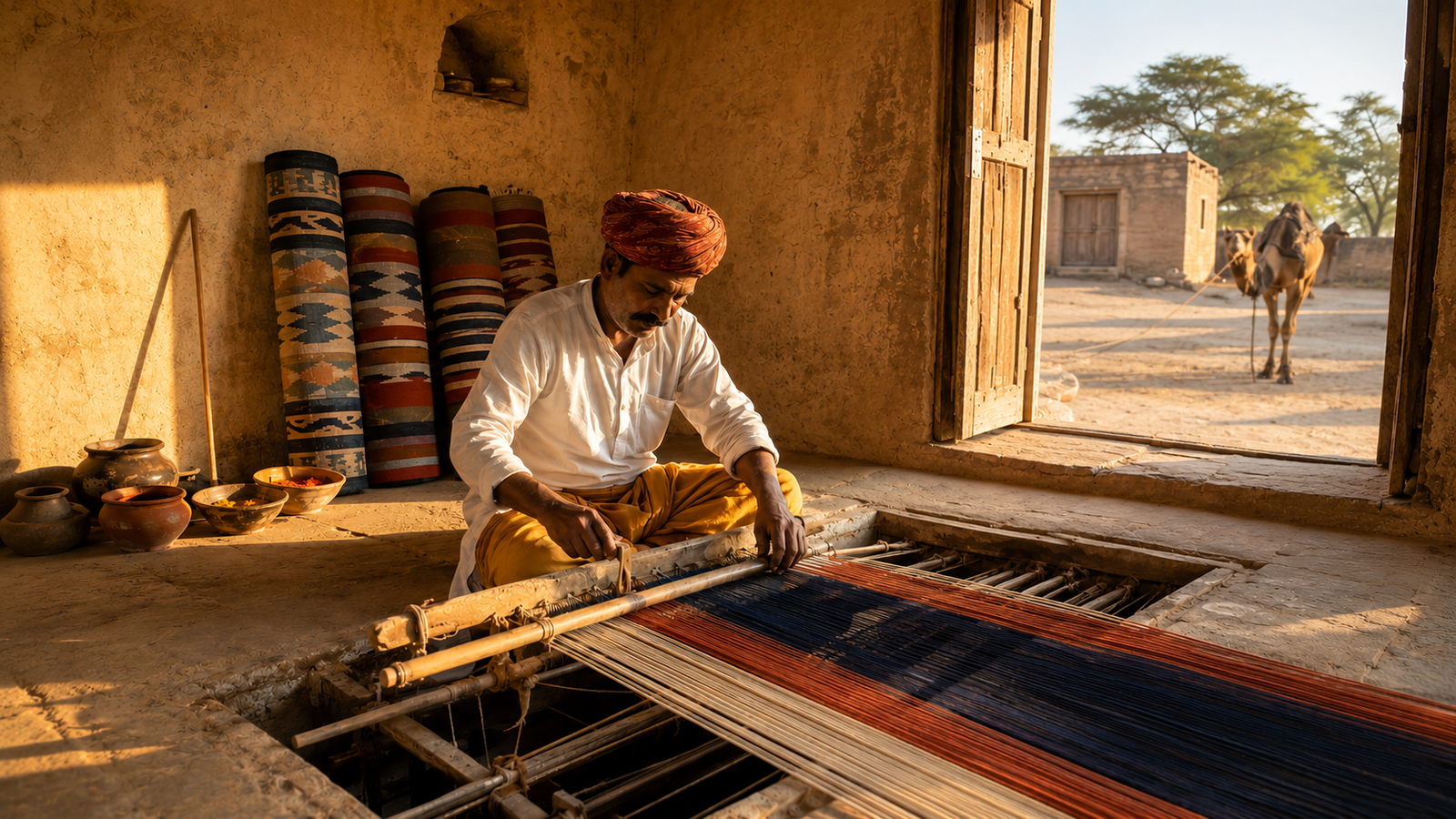
The craft doesn't start in a showroom. It starts about 20 kilometres outside Jodhpur, in two villages where weaving isn't a profession people choose, it's something they're born into.
Bishnoi Village and Salawas are where Zorwaa's rugs begin. On pit looms sunk into courtyard floors, worked by hands that have been doing this for five or more generations. The designs are often unwritten - held in memory, passed from parent to child, sometimes not changed in decades.
This guide is about those places. Who lives there, how they work, and why any of it matters when you're buying a rug.
Where Are These Weaving Villages?
Both villages sit in the semi-arid region surrounding Jodhpur - Rajasthan's second-largest city, known internationally as the Blue City. The drive from Jodhpur takes under an hour.
Salawas lies roughly 15 kilometres south of the city on the Pali road. It is sometimes described as the dhurrie capital of India, and the description holds. Almost every household has a loom. The sound of weaving, the rhythmic beat of the panja tool carries through the village lanes before you see a single rug.
Bishnoi Village refers to a cluster of settlements populated by the Bishnoi community spread across the plains around Jodhpur. The community lives alongside wildlife reserves, their homes scattered among khejri trees and open land where blackbucks graze freely.
Bishnoi Village - The Community Behind The Craft
The Bishnoi are one of the most extraordinary communities in India, and that's not hyperbole.
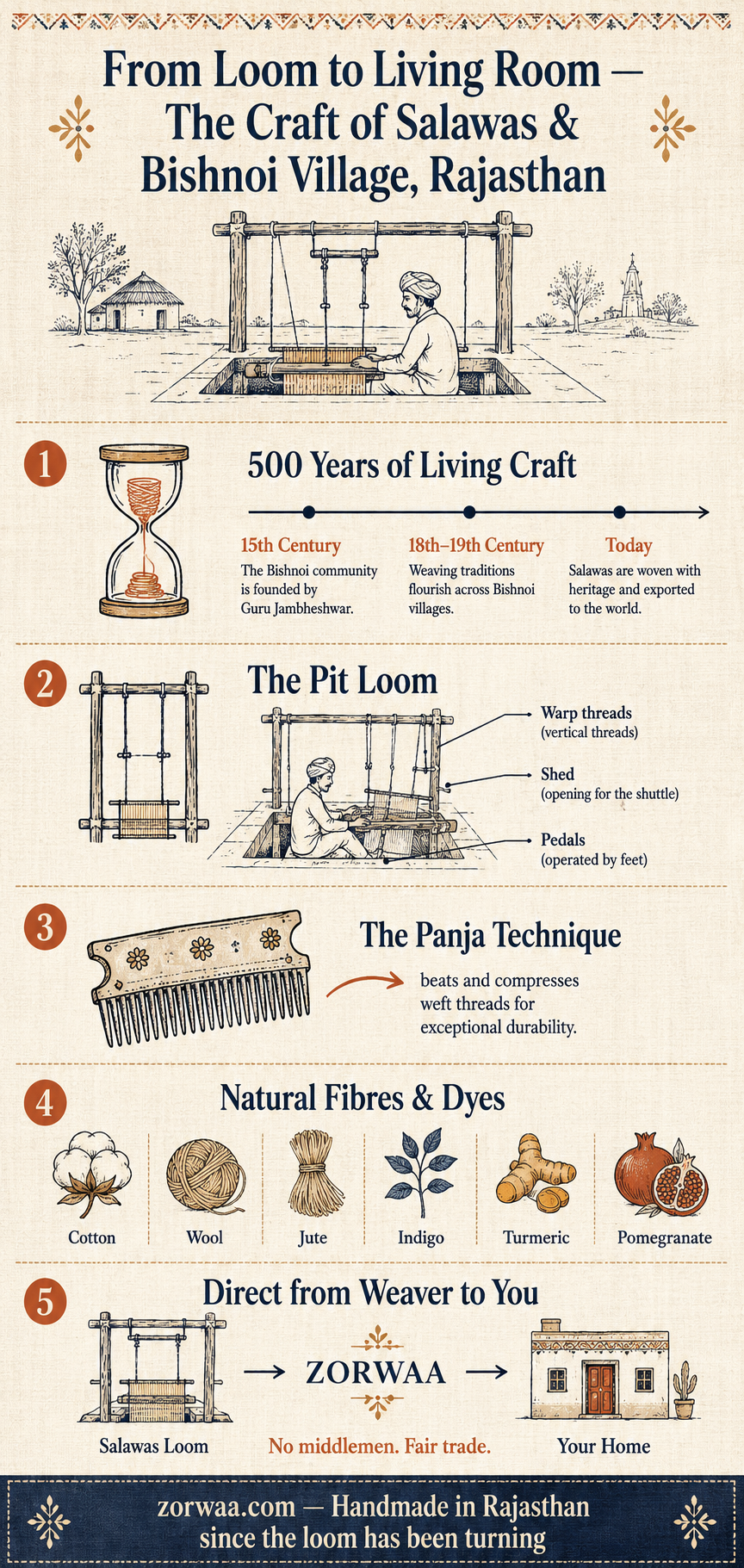
Founded in the 15th century by Guru Jambheshwar known as Jambaji, their way of life is governed by 29 principles. The name itself comes from the words bishn (29) and noi (rules). Many of these principles deal directly with environmental protection: do not cut live trees, protect wildlife, use only what you need. The Bishnoi were protecting their ecosystem five centuries before it became a policy conversation.
This isn't background history unrelated to the rugs. It's the context in which every rug is made. Bishnoi weavers work with natural fibres - cotton, wool, jute. Natural dyes. Methods that have remained consistent across generations because the community values continuity over convenience.
When a rug leaves a Bishnoi weaver's loom, it carries that context. It was made by someone whose community, for 500 years, has approached their relationship with materials and land with a kind of seriousness most modern manufacturing can't approximate.
Salawas Village - The Village That Lives And Breathes Dhurries
If Bishnoi Village gives the craft its philosophy, Salawas gives it its technical excellence.
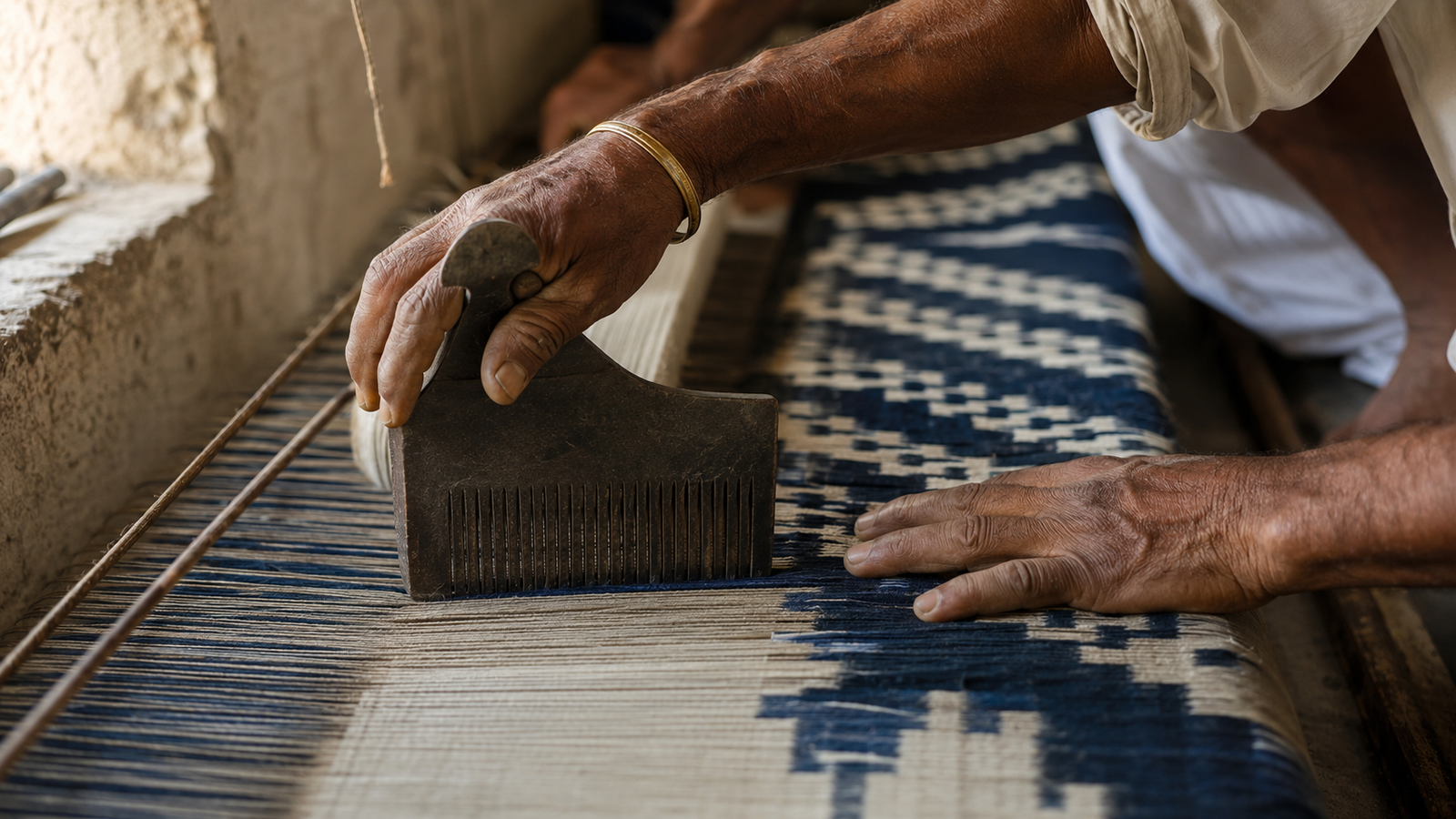
Salawas has been producing dhurrie rugs for centuries. The technique most associated with the village is the panja dhurrie which is named after the flat metal comb weavers use to beat and compress the weft threads on the loom. The tool looks unremarkable. The skill in using it takes years to build. Getting the tension right across a large rug, keeping the pattern consistent, maintaining even density from edge to edge, these are things you can't rush and can't fake.
Salawas weavers work primarily with cotton, and to a lesser extent wool. The patterns, diamond grids, chevron stripes, mosque-arch motifs, Anatolian-influenced borders are largely geometric. Many are held within families. A pattern a weaver's grandmother used in the 1970s might appear in a rug being completed this week, with minor variations that reflect the individual weaver's hand.
The village exports rugs internationally in significant volumes. Salawas dhurries reach homes in Europe, North America, and Japan. Most buyers don't know the name of the village that made what's on their floor. That's worth changing.
The Pit Loom - How These Rugs Are Actually Made
Most handmade rugs from these villages are woven on a pit loom, a traditional loom partially sunk into the ground. The weaver sits at floor level, legs extending into the pit, feet operating the pedals that control the warp thread separation below.
The warp threads, vertical threads strung between the top and bottom beams of the loom form the structural backbone of the rug. A weaver threads the weft (horizontal thread) through the shed, the gap created between raised and lowered warp threads, using a shuttle. The panja or flat beater then compresses each row tightly against the last. This is repeated thousands of times per rug.
A skilled weaver working on a medium-sized dhurrie might complete three to four inches of finished rug in a full working day. A 5x7 ft rug takes approximately two to three weeks of sustained work. There is no shortcut. The rug is built row by row, entirely by hand.
That's the structural reason a well-made handmade rug lasts 50 years. The construction is the rug. There is no glue, no backing, no synthetic infill, only thread interlocked with thread, compressed tightly enough to endure decades of use.
Natural Dyes and Materials
Traditionally, Rajasthani weavers used plant and mineral dyes: indigo from the indigofera plant for blues, turmeric and pomegranate rind for warm yellows and tans, iron mordants for greys. Some of these methods continue in active use. Others have been supplemented with certified natural dye suppliers who work within traditional colour traditions.
The cotton used in Salawas rugs is predominantly sourced from Rajasthan and Gujarat. Wool comes largely from the breeds raised on the Marwar plains around Jodhpur - a coarser, more durable fibre than Merino, well-suited to everyday floor use.
Natural-dyed yarns age differently from synthetic ones. The colours soften and develop over years of use rather than bleaching flat. A ten-year-old Salawas dhurrie in natural dyes often has more character than it did when new.
Why Buying From Source Matters
The conventional rug trade has many layers between weaver and buyer. A rug completed in Salawas might pass through a village broker, a Jodhpur exporter, an overseas importer, a regional distributor, and a retail store before reaching a home. At each step, a margin is taken. The person who actually made the rug receives a small fraction of what you pay.
This isn't an isolated problem - it's been the structural reality of Indian craft exports for decades.
When you buy from Zorwaa, you're buying from a source that works directly with weaver families in these two villages. Learn more about our weavers and the specific families and communities behind the rugs. No broker chain, no layered markups. The weavers earn fairly, and the price you pay reflects the actual cost of making the rug and not the cost of moving it through five intermediaries.
What These Villages Produce That You Won't Find Elsewhere
Rugs from Bishnoi Village and Salawas aren't interchangeable products. They're the output of specific looms, specific families, specific accumulated skills.
This has practical implications. No two large rugs are exactly the same, slight colour variation across a rug, known as abrash, is natural in hand-dyed yarns and is characteristic of genuine handmade work, not a defect. Custom dimensions are genuinely possible: a weaver can adjust the loom setup to produce your required size. And the rugs improve with age - fibres soften, colours deepen, the rug settles into its character.
If you want to see what comes off these looms, browse our full dhurrie rug collection or order a custom rug made to your specifications by these same weavers.
Frequently Asked Questions
Can I Visit Bishnoi Village And Salawas?
Yes. Both are easy day trips from Jodhpur. Salawas in particular welcomes visitors – weaving families often invite travellers in to watch the looms in operation. Seeing a panja dhurrie being made in person changes how you understand what you’re buying.
What Is A Panja Dhurrie?
A dhurrie woven using the panja technique – a flat metal comb used to beat and compress weft threads on the loom. The method produces an exceptionally tight, durable weave. Salawas panja dhurries are among the most exported handmade textiles from India.
Are The Rugs From These Villages Sustainable?
The Bishnoi community’s ecological philosophy is 500 years old. Natural fibres, natural dyes, traditional construction methods, no factory emissions, no synthetic materials. These are among the most ecologically responsible textiles you can buy.
How Do Zorwaa's Weavers Work - Are They Employed Or Independent?
The weaver families Zorwaa works with are independent artisans, not factory employees. They work from their own homes and workshops, on their own looms, producing rugs to agreed specifications. The relationship is a direct trade partnership, not an employment model.