
What Is a Dhurrie Rug? History, Materials & How to Choose

What is a Dhurrie Rug? History, Materials, and Everything You Need to Know
A dhurrie (also spelled durrie, dari, or dhurri) is a flatweave rug made by hand on a loom. No pile, no knots, no raised surface. Just thread woven tightly over thread, creating something flat, reversible, and surprisingly durable.
They've been made in India for well over a thousand years. You'd have found one on the floor of a village home in Rajasthan, on the ground at a Mughal court gathering, and in prison workshops under British colonial rule. The Maharaja of Jaipur actually introduced dhurrie weaving into jail reform programs in the 1850s. That's a strange detail, but it gives you a sense of how embedded this craft is in Indian history.
Today, the best ones still come from the same places they always did.
Where Dhurries Come From
The word traces back to the Hindi "dari," with roots likely in Persian. But the craft itself is Indian through and through.
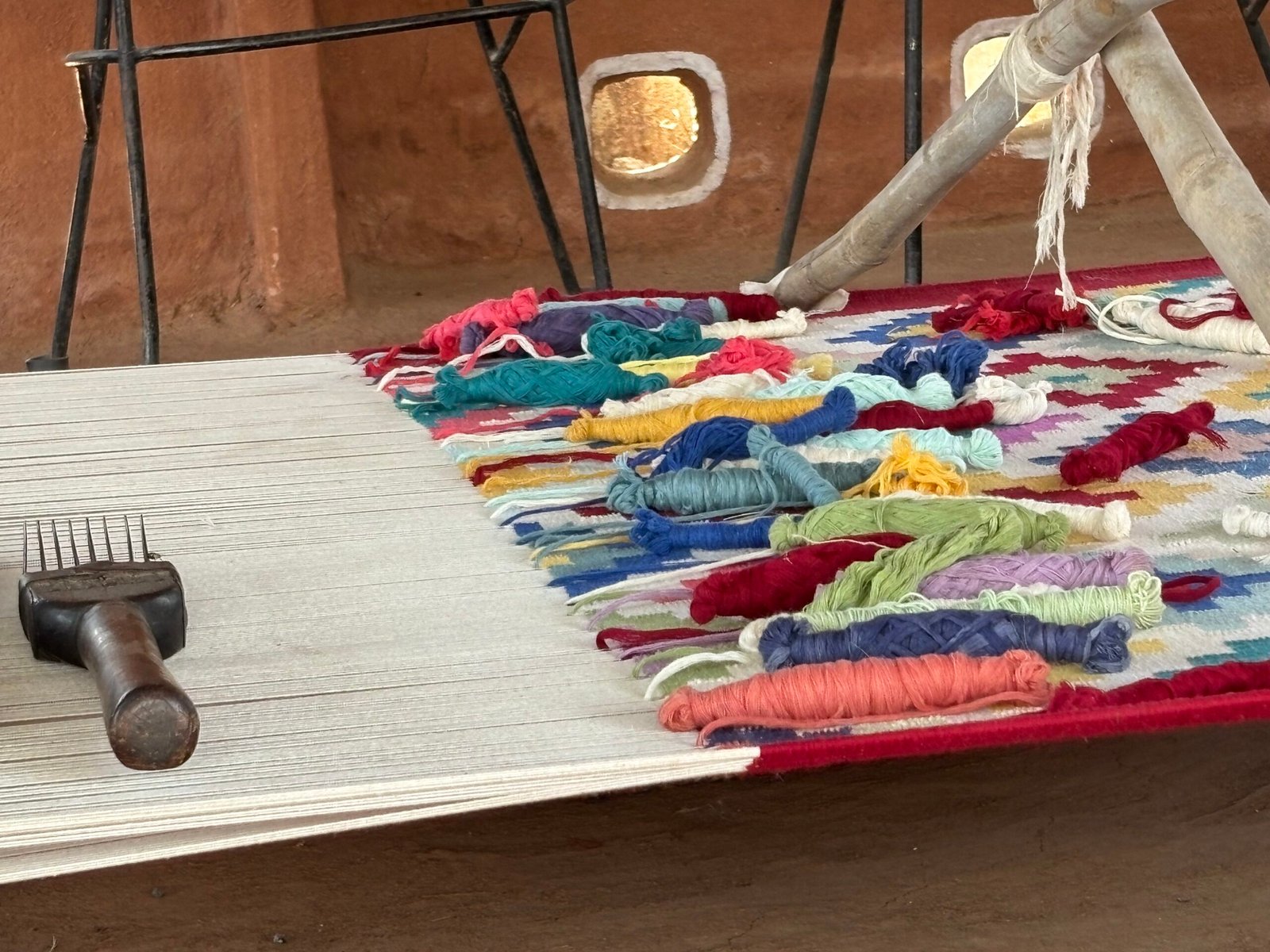
Salawas and Bishnoi Village, two weaving communities near Jodhpur in Rajasthan, are among the most celebrated dhurrie-making centres in the country. Salawas is especially known for its panja dhurries, named after the metal comb (panja) weavers use to beat and set threads on the loom. These are exported in large volumes internationally.
Other significant centres include Sitapur in Uttar Pradesh, Panipat in Haryana, and pockets of Madhya Pradesh. Each region has its own character. Rajasthani dhurries tend toward bold geometry and earthy colour. Haryana's panja dhurries are tightly woven and often used for everyday household use.
What Makes a Dhurrie Different From a Regular Carpet
This is where most people get confused.
A flatweave carpet has no pile; the threads are woven flat on a horizontal loom rather than knotted upright. A pile carpet (the kind you might think of as a "traditional Persian rug") is made by knotting short strands of yarn around the warp threads, building up a thick, raised surface.
The practical differences matter:
- Dhurries are reversible. The pattern appears on both sides, which means you can flip the rug for a fresh surface or to even out wear.
- They're lighter and easier to move, fold, and store.
- They don't trap dust and debris the way pile rugs do, though they do need regular cleaning because there's nowhere for dirt to hide.
- They resist insects like silverfish, which can destroy pile carpets.
- A well-made cotton dhurrie is actually suitable year-round in Indian climates. It doesn't retain heat the way wool pile carpets do.
What are Dhurries Made From
Traditional dhurries are woven from four core materials: cotton, wool, jute, and silk. Many modern dhurries use blends like wool-cotton and wool-jute are both common.
Cotton is the most widely used and historically the most traditional. It's lightweight, breathable, and holds dye well. A good cotton dhurrie washes reasonably well and handles daily use without much fuss.
Wool adds warmth and texture. Wool dhurries tend to be thicker and feel more substantial underfoot. They work well in cooler climates or in rooms where you want a bit more cushioning.
Jute is the rough, earthy option. Durable and cheap to produce, jute dhurries have a natural look that works well in casual or outdoor-adjacent spaces. They're not the softest underfoot, but they hold up.
Silk is the luxury tier. Silk dhurries are smoother, finer, and catch light differently. They're not really practical daily rugs and more of decorative pieces. Often blended with cotton for added durability.
Patterns and Design
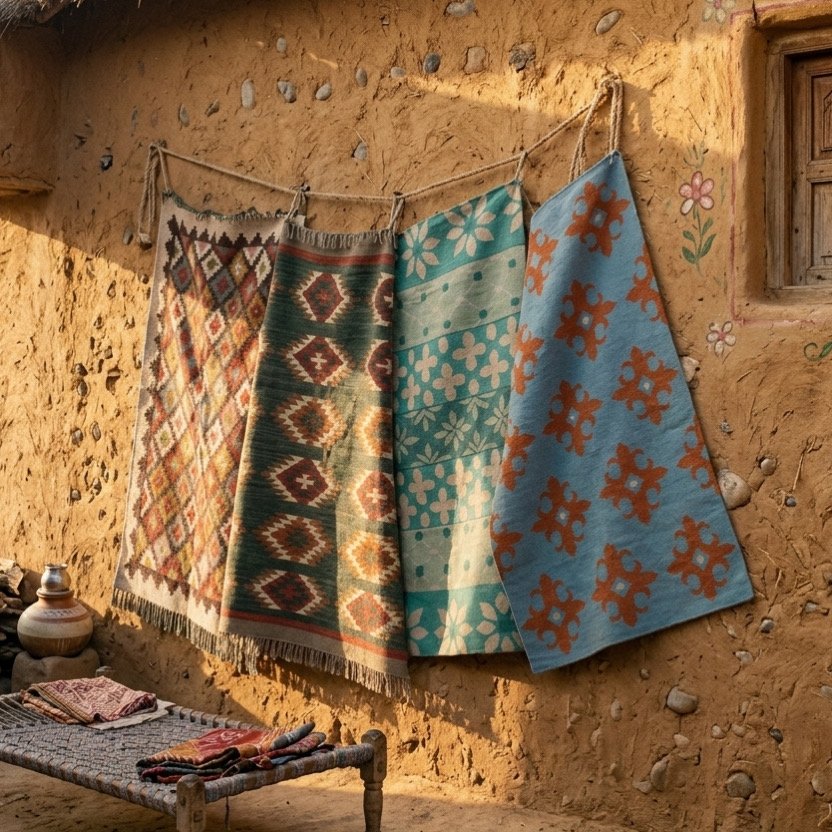
Traditional dhurrie patterns are geometric. Stripes, chevrons, diamond grids, mosque and minaret motifs designs that translate well to the horizontal loom technique. The most classic colour combination is indigo and cream, indigo being one of India's most historically important dyes.
Floral, medallion, and abstract patterns came later, many of them influenced by Mughal court aesthetics and, eventually, Western design tastes during the colonial period. Modern dhurries now cover the full range from minimal solids to bold geometric abstracts that would sit comfortably in a contemporary apartment in London or a heritage home in Jaipur.
Browse our Traditional Rajasthani rugs or Geometric flatweave carpets to see what both ends of that spectrum look like.
How to Clean a Dhurrie Rug
The care routine is simpler than most people expect.
Shake it out or vacuum it regularly both sides. Use a handheld vacuum on a low setting. Don't use a rotating brush attachment; it can loosen the weave over time. For spills, blot immediately with a clean cloth. Mild soap and cold water handles most surface stains on cotton dhurries. Wool dhurries need a slightly more careful approach, avoid soaking and let them dry flat.
For a full clean, hand washing or dry cleaning works better than machine washing, especially for larger pieces. The weave can loosen if a large rug spends time in a machine drum.
Is a Dhurrie Rug a Good Choice For Your Home?
For most Indian homes and honestly for most homes anywhere - Yes.
They're practical without being boring. They work in living rooms, bedrooms, dining spaces, corridors, even pooja rooms. They're easy to move around when you want to rearrange a space. And because they're reversible, they have roughly double the visible life of a one-sided pile rug.
The handmade ones from Rajasthan have something the machine-made versions can't replicate visible irregularity in the weave, natural variation in colour, the slight imperfections that tell you a person made this. That's not a flaw. It's what handwoven means.
If you're looking for a handmade dhurrie rug made directly by weavers in Jodhpur, that's exactly what we do at Zorwaa. We work with artisan families in Salawas and Bishnoi Village, no middlemen, no factory floor. You can also customise a dhurrie to your exact size and colour if the standard range doesn't quite fit your space.
Frequently Asked Questions
What is the difference between a dhurrie and a kilim?
Both are flatweave rugs, but they come from different traditions. Kilims are Turkish or Central Asian in origin. Dhurries are Indian. Design-wise, kilims tend to use bolder, more saturated colours with strong angular patterns. Dhurries lean toward softer palettes and more flowing, geometric designs though modern versions blur those lines considerably.
Are dhurrie rugs suitable for high-traffic areas?
Yes. Their tight flatweave construction makes them more durable than pile rugs in daily use, and easier to keep clean. They’re a practical choice for corridors, dining rooms, and anywhere shoes are worn.
What sizes do dhurrie rugs come in?
Dhurries come in almost every size imaginable from small accent pieces to large room-anchoring carpets. Traditionally, the smallest dhurries (12″ x 12″) were used as table mats. Room-sized dhurries can go up to 20 feet across for large gatherings. Browse by size: 2×3 ft | 5×7 ft | 8×10 ft | Runners | Oversized
Can I get a dhurrie made in a custom size?
Yes. Zorwaa offers full customisation on size, colour, material, and pattern. Fill in our customisation form and we’ll get back to you within 24 hours.