
Handmade vs Machine Made Rugs: What’s the Real Difference?

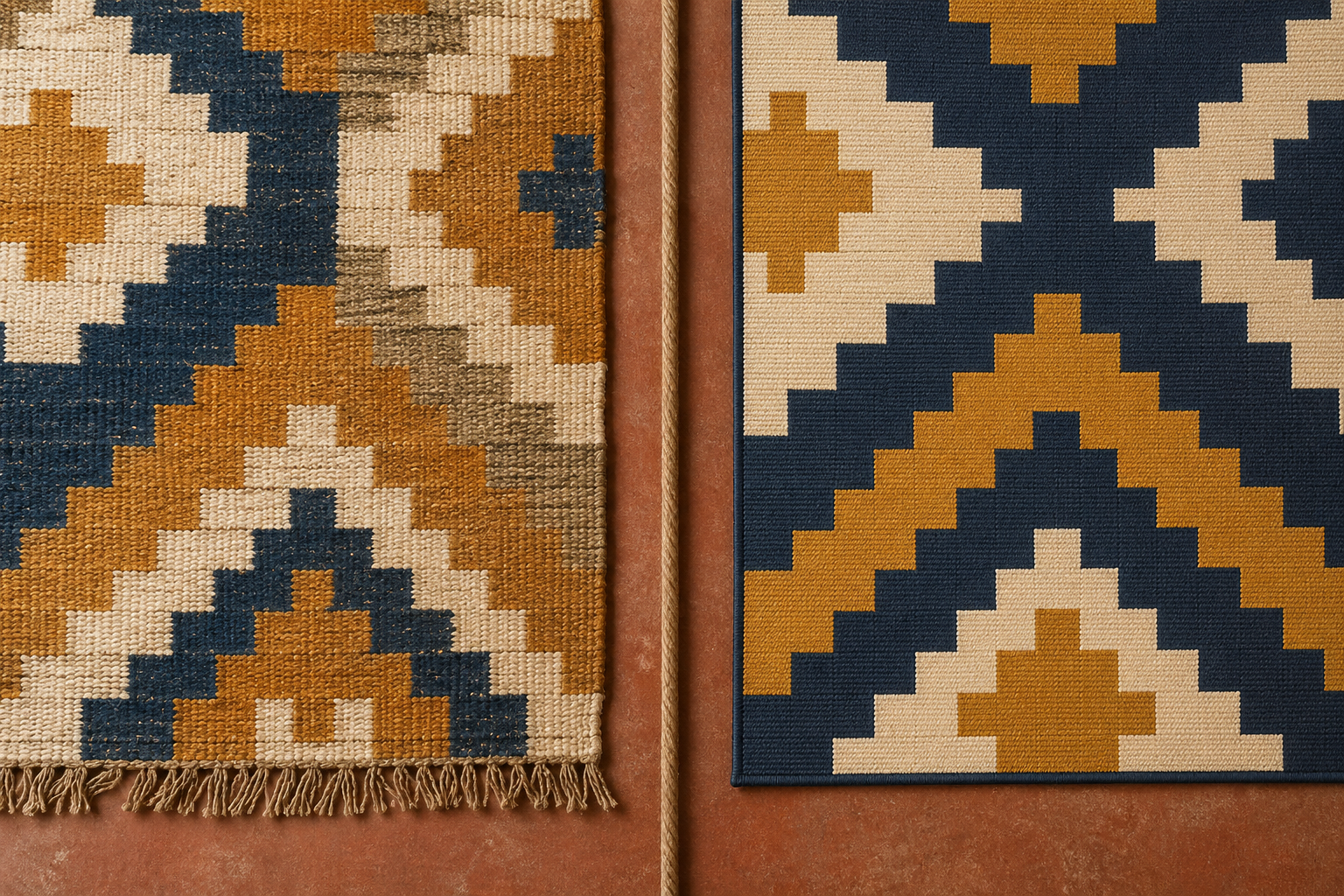
At first glance, a handmade rug and a machine-made rug can look nearly identical in a product photo. Same size, similar pattern, close enough in colour. Then one of them lasts thirty years and becomes a family heirloom. The other starts pilling at the edges before the first winter is over.
The difference between the two isn't just about price; it's about what you're actually buying.
This guide breaks it down clearly so you can make an informed decision, whether you're furnishing a new home, replacing an old rug, or buying something you want to keep for a long time.
How Handmade Rugs are Made?
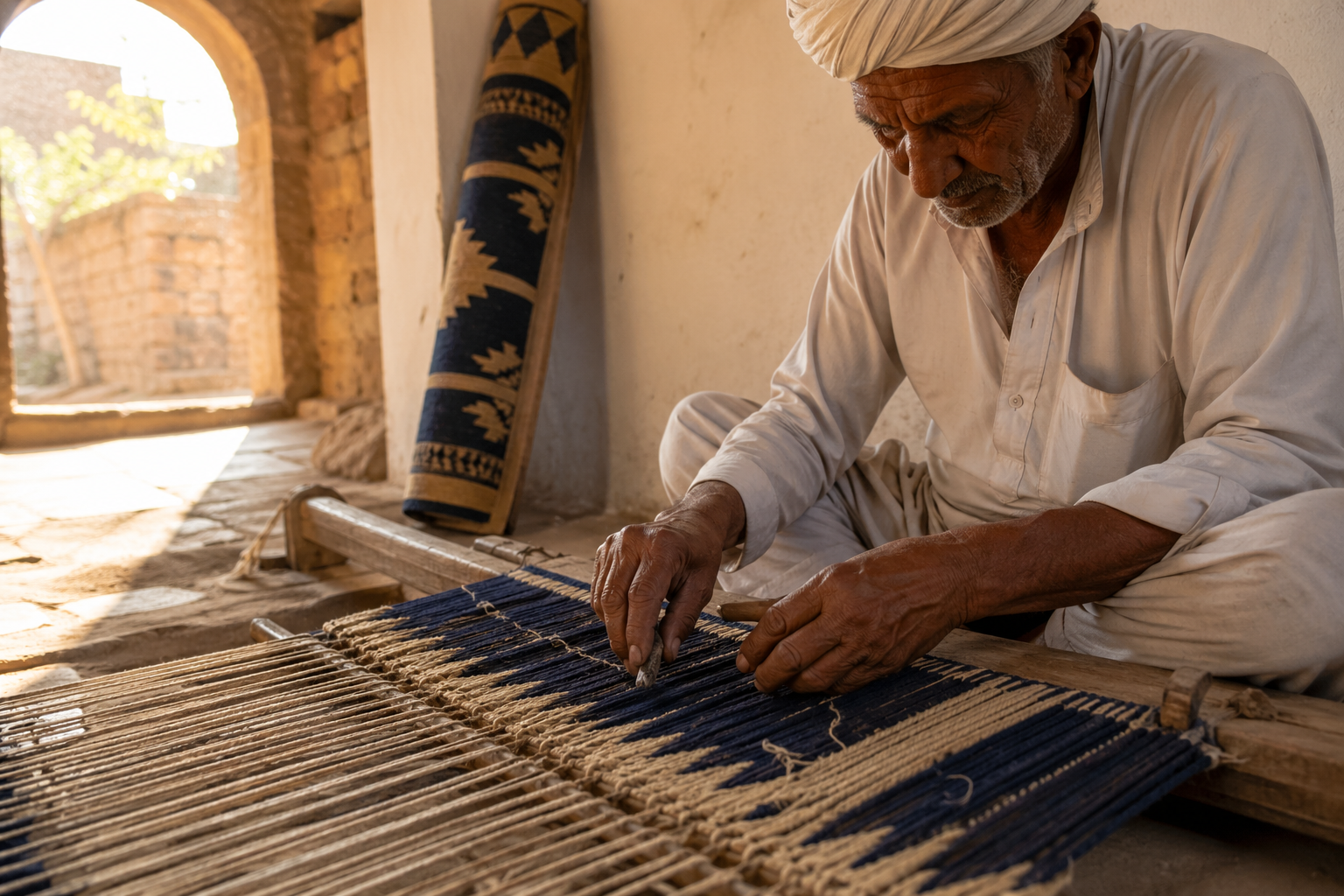
A handmade rug is made entirely by human hands on a loom. No automated machinery, no factory conveyor belt. Depending on the technique, a single rug can take anywhere from a few days to several months to complete.
There are three main handmade techniques worth knowing:
Hand-knotted rugs are the most labor-intensive. Individual knots are tied by hand around warp threads, row by row, creating a dense pile. The knot count per square inch determines the fineness of the design which means the higher the count, the more detailed and durable the rug.
Hand-woven or flatweave rugs (like dhurries) are made by weaving weft threads horizontally through vertical warp threads on a loom. No pile, no knots, just tightly interlaced threads that create a flat, reversible surface. These are the traditional Rajasthani rugs made in villages like Salawas and Bishnoi near Jodhpur.
Hand-tufted rugs sit somewhere in between. A tufting gun punches yarn through a canvas backing, which is then glued and covered. Technically made by hand, but the process is faster and less precise than hand-knotting or flat-weaving. Worth knowing the distinction when a seller calls something "handmade".
How Machine Made Rugs are Made?
Machine-made rugs are produced on large power looms - computerised machines that can weave thousands of square metres of carpet in a single day. The pattern is programmed digitally and replicated exactly across every piece.
Most machine made rugs use synthetic fibers- polypropylene, nylon, and polyester because they're cheaper to source and easier to process at scale. Some machine-made rugs use wool or cotton blends, but the weave structure and construction method fundamentally differ from handmade equivalents.
Speed is the advantage. A factory can produce a 6x9 ft rug in minutes. A weaver in Salawas working on the same size dhurrie might take a week or more.
The Real Differences: Side by Side
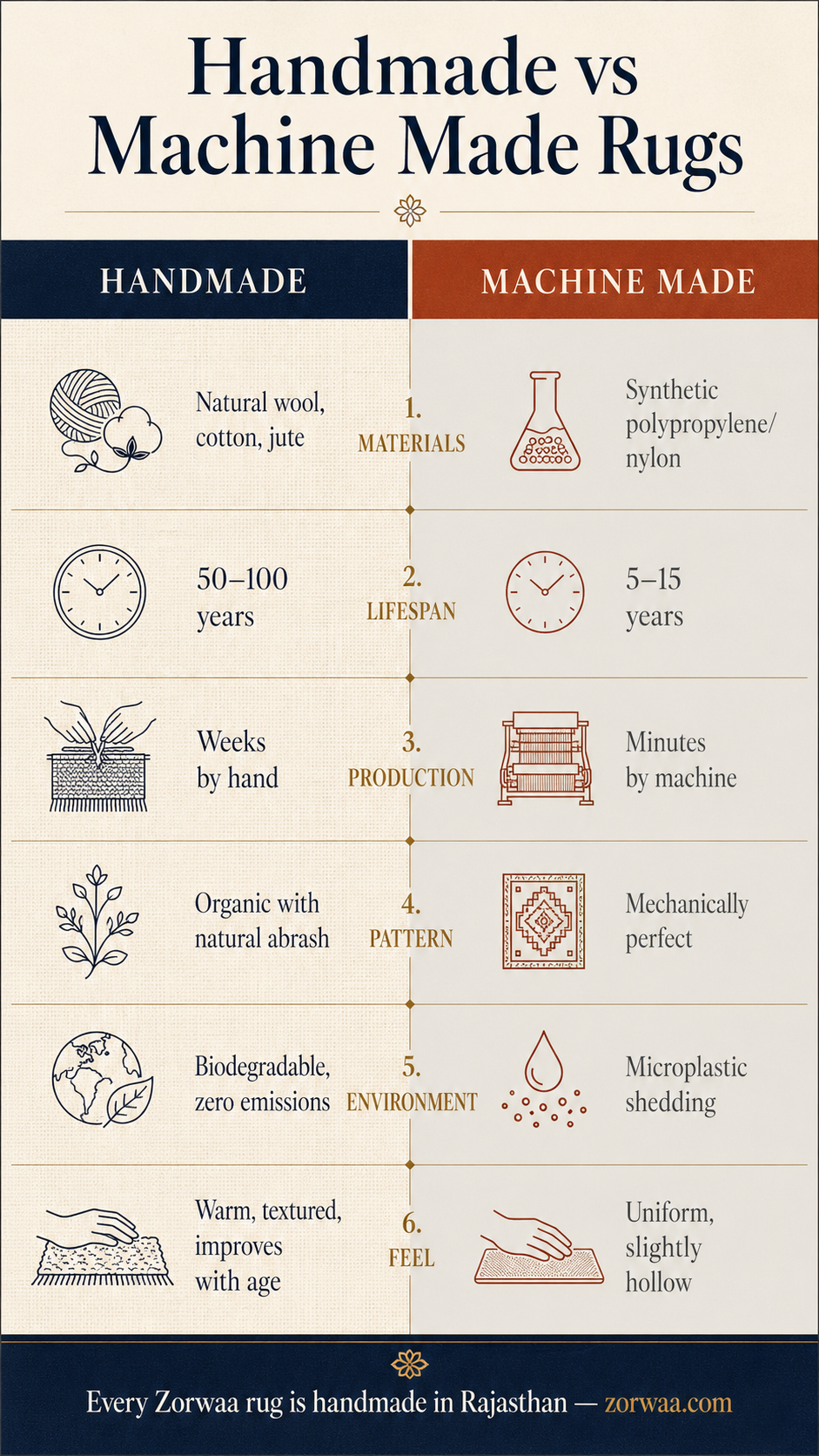
1. Materials
Handmade rugs traditionally use natural fibres like wool, cotton, jute, silk that age well, breathe naturally, and hold dye differently than synthetics. The natural imperfections in yarn create subtle colour variation that gives handmade rugs depth.
Machine made rugs mostly use synthetic fibres engineered for consistency. They look uniform because they are. That uniformity is the tell, if every section of a rug looks exactly the same under close inspection, it was almost certainly made by a machine.
2. Durability and Lifespan
A well-made hand-knotted or flatweave rug can last 50 to 100 years with reasonable care. The construction is structural, the threads are the rug, not a backing with pile glued on top.
Machine-made rugs have a typical lifespan of 5 to 15 years under normal use. The pile thins, the backing wears, and the pattern fades. They're not built to last, they're built to be affordable and replaceable.
3. Feel Underfoot
This one you notice immediately. Natural fibre handmade rugs have a warmth and texture that synthetics don't replicate. A hand-woven wool rug feels substantial. A flatweave cotton dhurrie has a firmness that softens with use. Machine-made rugs often feel lighter, slightly hollow, and occasionally slightly plastic that off-note you might have noticed in budget rugs without quite knowing why.
4. Pattern and Design
Machine-made patterns repeat with pixel-perfect accuracy. Every diamond, every stripe, every border motif is identical. That's by design, it's a feature of the manufacturing method.
Handmade patterns carry what weavers call "abrash," subtle shifts in colour or line weight as the weaver works across the rug or changes a dye batch. In traditional Rajasthani designs, this is considered part of the character of the piece, not a flaw. It's the visual equivalent of a brushstroke evidence of a hand at work.
5. Environmental Impact
Synthetic machine-made rugs shed microplastics. Every wash, every vacuum, releases tiny fibres into drains and air. Natural fibre handmade rugs biodegrade. They don't shed synthetics and their production, when done by skilled artisan weavers using traditional methods, doesn't rely on petrochemical inputs.
The weavers at Bishnoi Village and Salawas who make Zorwaa's rugs have practiced sustainable crafts for generations. The loom itself produces no emissions. The fibres - wool, cotton, and jute are renewable. That's not a marketing claim; it's how the craft has always worked.
6. Price
Machine made rugs are significantly cheaper upfront. A decent 5x7 machine-made rug might cost ₹3,000–₹8,000. A comparable handmade flatweave dhurrie of similar quality will cost more, but it will also still be in your home in 2045 when the machine-made version is long gone.The honest calculation is cost per year of use, not sticker price. On that basis, the handmade rug often costs less.
How to Spot Difference Between Handmade and Machine Made Rugs While Shopping?
You don't need a certification or provenance document. Check these three things:
Flip it over. A handmade rug's back looks almost identical to its front, the pattern shows through clearly. A machine-made rug usually has a canvas or latex backing that completely covers the underside.
Look at the fringe. On a handmade rug, the fringe is a natural extension of the warp threads, it's part of the rug's structure. On a machine-made rug, fringe is usually sewn on separately as decoration.
Examine the pattern edges. Handmade rugs have slightly organic, sometimes subtly uneven lines. Machine-made lines are perfectly mechanical. If the pattern looks like it was printed, it may as well have been.
So Which Rug Should You Buy?
It depends on what you actually need.
If you're furnishing a rental property or a high-traffic commercial space, or you genuinely just need something affordable to cover a floor for a few years, a machine-made rug does that job adequately.
If you're buying for your home, for a room you care about, for something you want to live with for years, a handmade rug is worth the investment. You're not just buying a floor covering. You're buying something made by a person, with their hands, using skills passed down across generations.
At Zorwaa, every rug is handmade in Rajasthan, flatweave dhurries, geometric carpets, and traditional designs made directly by artisan weavers. We also offer full customisation if you need a specific size, colour, or pattern made to order.
Browse our flatweave carpet collection or explore by material to find something made the right way.
Frequently Asked Questions
Is a hand-tufted rug the same as a handmade rug?
Technically yes, but practically different. Hand-tufted rugs are faster and cheaper to produce than hand-knotted or hand-woven rugs. The construction method, a tufting gun punching yarn into canvas, means the pile is glued rather than structurally woven, making them less durable over time.
Do handmade rugs require special care?
Not especially. Flatweave dhurries can be vacuumed on both sides and spot cleaned with mild soap and cold water. Hand-knotted rugs benefit from professional cleaning every few years. Both are more forgiving than their reputation suggests.
Are all Zorwaa rugs handmade?
Yes. Every rug sold on Zorwaa is made entirely by hand by weavers in Bishnoi Village and Salawas, Jodhpur. No machine looms, no tufting guns.
Can I get a handmade rug in a custom size?
Yes. We offer custom sizing, colour, and design options. Fill out the customisation form, and we’ll respond within 24 hours.
2 thoughts on “Handmade vs Machine Made Rugs: What’s the Real Difference?”
Comments are closed.