
Rug Under Office Chair: How to Choose for a Study or Home Office
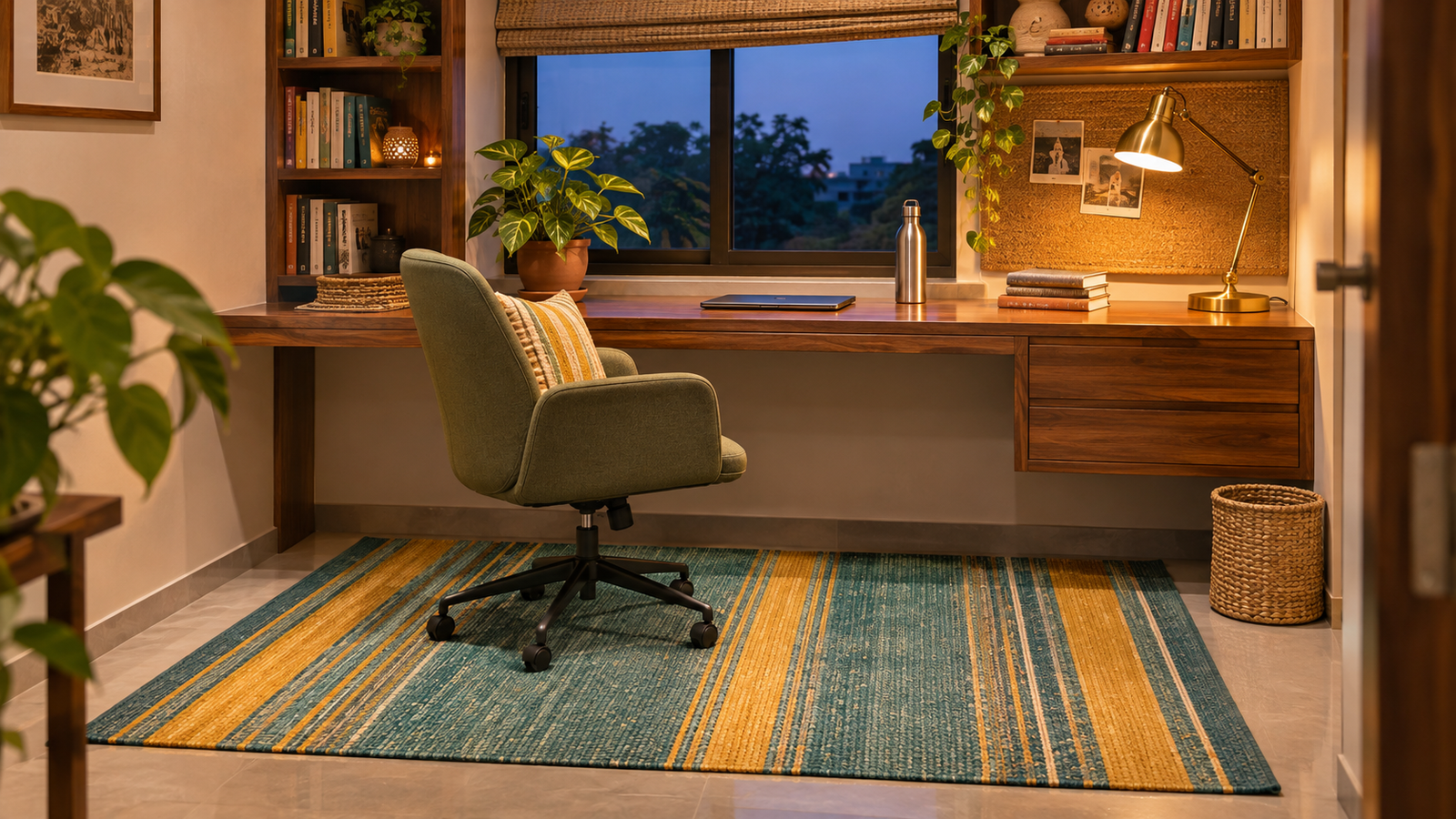
Can a rug under office chair wheels work? Every home office eventually asks, usually after the first cold winter morning on a marble floor. The short answer is yes, you can put an office chair on a rug, as long as the rug is flat, the chair stays on it and the wheels suit the floor underneath. A thick or shaggy rug will fight your chair all day. A handwoven flatweave will not.
This guide covers what kind of rug works under a rolling chair, how big it should be, which fibre lasts and how to protect both the rug and the floor. It is written for studies, home offices and kids' desks in India, but the principles hold anywhere.
Table of Contents
Can You Put an Office Chair on a Rug?
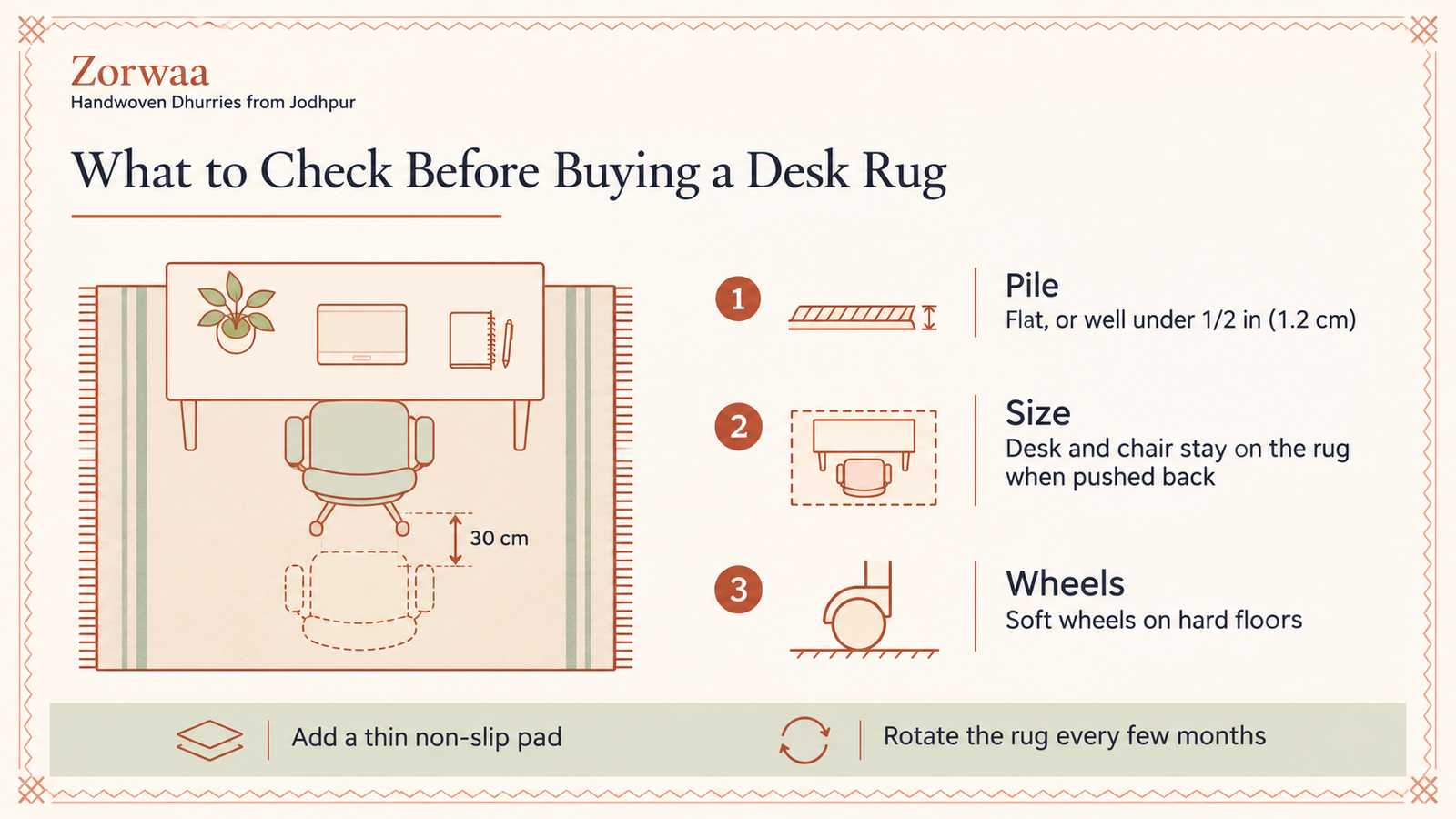
Yes, with three conditions. First, the rug should be low and flat. A rug with a deep pile makes the wheels sink, drags at your legs every time you shift and wears out unevenly. Second, the rug should be big enough that the chair stays on it, even when you push back from the desk. Third, the wheels should match the floor beneath, because a rug does not change what the wheels do to the floor it sits on.
If all three are in place, a rug under a desk chair is comfortable, quiet and kind to your floor. It also warms a cold stone floor, which matters in a winter study.
Why Flatweave Rugs Suit Office Chairs
A flatweave has no pile. Warp and weft are woven into a single dense fabric, so there is nothing for a wheel to sink into or snag on. That is the difference between a dhurrie and a shag, and it is why design advice for home offices keeps pointing to low-pile and flat-woven rugs. Our guide to flatweave vs pile rugs explains the difference in detail.
Pile height is the usual measure. Most guidance puts the limit at well under half an inch (about 1.2 cm) for a chair that rolls, and a true flatweave has none at all. A flat surface also helps a chair mat sit steadily, if you ever add one.
There is one honest limit. A flatweave rolls well, but a rug in a high-traffic spot still wears faster than anywhere else in the house, because the same few centimetres take the weight and the wheels every day. The sections below show how to slow that down.
Rug Under Office Chair Size: How Big It Should Be
The rule that matters most is that the chair should stay fully on the rug, even when you push back from the desk. A rug that only covers the desk legs leaves the chair rolling on and off its edge, which wears the edge and can make the rug bunch up.
To measure, sit at the desk, push back to the furthest point you normally roll, and mark where the back wheels land. Add about 6 to 12 inches (15 to 30 cm) beyond that mark. Then check the sides: the rug should extend at least a foot (30 cm) past each side of the desk. As a starting point, use this guide and adjust for your own room.
Desk width | Suggested rug (feet) | In cm |
3 to 4 ft (90 to 120 cm) | 5 x 7 | 152 x 213 |
4 to 5 ft (120 to 150 cm) | 5 x 8 | 152 x 244 |
5 to 6 ft (150 to 180 cm) | 6 x 9 | 183 x 274 |
L-shaped or corner desk | 8 x 10 or custom | 244 x 305 or custom |
If the desk sits against a wall, put the rug under the desk and let it run out behind the chair. If it floats in the room, centre the rug under desk and chair, with extra room on the chair side.
Study nooks, alcoves and built-in desks rarely match a standard size. In those cases a custom rug made to your measurements fits the space exactly, and a rug made to the exact depth of your chair's roll-back zone is usually better than a standard size that nearly fits.
Which Rug Fibre Works Under an Office Chair
Wool is the most forgiving choice. It is dense, springs back after the weight of a chair has pressed on it and wears well under daily rolling. A wool flatweave is the pick for a main desk that gets used for hours every day.
Cotton is lighter and flatter, and it suits lighter use, such as a student's desk or a guest-room workspace. It can show wheel marks and wear sooner, though, because the fibre is softer.
Jute is the one to be careful with. It tends to be coarse and brittle, and constant wheel traffic can break it down and make it shed. It is better as a base layer or in a spot where people walk rather than roll.
Match the Wheels to the Floor
A rug protects the floor from wheels, but only up to a point. A caster maker such as TENTE explains the general principle: use hard wheels on soft floors and soft wheels on hard floors. Hard wheels on a hard floor can scratch it.
Most office chairs ship with hard nylon wheels, which are made for carpet. If your chair sits on a rug over marble, tile or wood, hard wheels are the ones most likely to wear the weave and to mark the floor where the rug slips or ends. Swapping them for soft polyurethane or rubber wheels is cheap and quick, and it makes the chair quieter and gentler on both surfaces. A flatweave is thin enough that soft wheels should still roll freely.
If the chair feels like it is dragging, check the wheels for tangled hair and fibre before blaming the rug.
Products You May Like
-50%
Select options
This product has multiple variants. The options may be chosen on the product page
Cotton Panja Dhurrie Rug for Living Room & Lounge Area
₹3,800.00 – ₹64,800.00Price range: ₹3,800.00 through ₹64,800.00-50%
Select options
This product has multiple variants. The options may be chosen on the product page
Timeless Traditional Cotton Rug | Handmade Handwoven Multicolor Floor Rug for Elegant Living Spaces
₹3,800.00 – ₹64,800.00Price range: ₹3,800.00 through ₹64,800.00-51%
Select options
This product has multiple variants. The options may be chosen on the product page
Wool Jute Kilim Rug Handmade, Flatweave Bedroom Area Rug
₹2,399.00 – ₹43,200.00Price range: ₹2,399.00 through ₹43,200.00-51%
Select options
This product has multiple variants. The options may be chosen on the product page
Handmade Wool Jute Kilim Rug, Boho Flatweave Living Room Rug
₹2,399.00 – ₹43,200.00Price range: ₹2,399.00 through ₹43,200.00Do You Need a Chair Mat on a Rug?
Usually not on a flatweave. A chair mat is a clear, rigid sheet that goes over the rug. It makes sense over thick pile, where it bridges the surface, and it can help if your chair is very heavy or your wheels are unusually hard.
Over a thin flatweave, a mat hides the rug you chose and adds a layer that can slide. If you do use one, choose a smooth-bottomed model and avoid the spiked underside designed for carpet, because the spikes can damage the rug's backing.
Add a Thin Pad Under the Rug
A rolling chair pushes on a rug in every direction, so a rug on a polished floor needs something to stop it creeping and wrinkling. A thin, non-slip pad does that. Keep it thin, because a thick cushioned pad adds bounce under the chair and can raise the surface enough to wobble it. Our guide to choosing a rug pad for dhurrie covers thickness, size and the materials to avoid.
Cut the pad about 1 inch (2.5 cm) smaller than the rug on every side, so the edges lie flat and no one trips on a ridge.
Colour and Pattern for a Working Rug
A rug under a desk takes crumbs, wheel marks and spilled tea. A mid-tone, patterned flatweave hides all three better than a pale solid. Geometric patterns and stripes break up the lines left by wheels.
If you work on video calls, remember that the rug is often visible behind or beside you. A calm palette with one or two accent colours looks tidy on camera. A rug that is loud or very high contrast tends to pull the eye away from you.
Rugs for a Study Room or Child's Desk
A student's desk has the same needs as a home office, with a few extras. Chairs get dragged and tipped, bags get dropped and snacks get eaten. Choose a tight, low weave in a forgiving colour, and a size generous enough that the chair never leaves the rug. Our study room rugs are handwoven in natural fibres, so check each listing for the weave and pile before you choose.
How to Make a Desk Rug Last
Rotate the rug every few months, so the wear spreads out rather than concentrating where the chair sits. Vacuum regularly, because grit under the wheels acts like sandpaper on the weave. Clean up spills quickly, and check the wheels every few months for hair and debris.
Accept a little wear. A rug in a working zone will develop a soft patina in the chair area over the years, and for a handwoven rug that is part of its character.
Quick Checklist for a Desk Rug
- Choose a flatweave or a very low pile, well under half an inch.
- Pick a size where the desk and chair stay fully on the rug when you push back.
- Prefer wool for heavy daily use and cotton for lighter use.
- Replace hard nylon wheels with soft ones if the floor beneath is stone, tile or wood.
- Skip a chair mat unless the rug is thick or the chair is very heavy.
- Add a thin non-slip pad, cut about 2.5 cm smaller than the rug.
- Rotate the rug and clear the wheels regularly.
Frequently Asked Questions
Can you put an office chair on a rug?
Yes, if the rug is flat or very low-pile and large enough for the chair to stay on it. A flatweave dhurrie is one of the easiest rugs to use under a rolling chair.
What type of rug is best under an office chair?
A low-pile or flatweave rug in wool or cotton. Avoid shag, deep pile and jute that sees constant wheel traffic.
Do I need a chair mat on a rug?
Usually not on a thin flatweave. A mat helps on thick pile or under a very heavy chair. If you use one, pick a smooth-bottomed model and avoid spiked carpet mats on a decorative rug.
How big should a rug be under a desk?
Big enough that the desk and the chair both stay on the rug when you push back. For most desks that means 5 x 8 or 6 x 9 feet, and an L-shaped desk usually needs 8 x 10 feet or a custom size.
Will an office chair damage my rug?
Constant wheel traffic wears any rug over time, but a flatweave, soft wheels, a thin pad and an occasional rotation slow the wear a great deal.
A good desk rug is flat, big enough and matched to your wheels. Get those three right and your study will feel warmer, quieter and finished.