
Dhurrie vs Persian Rug: Which One Should You Buy?

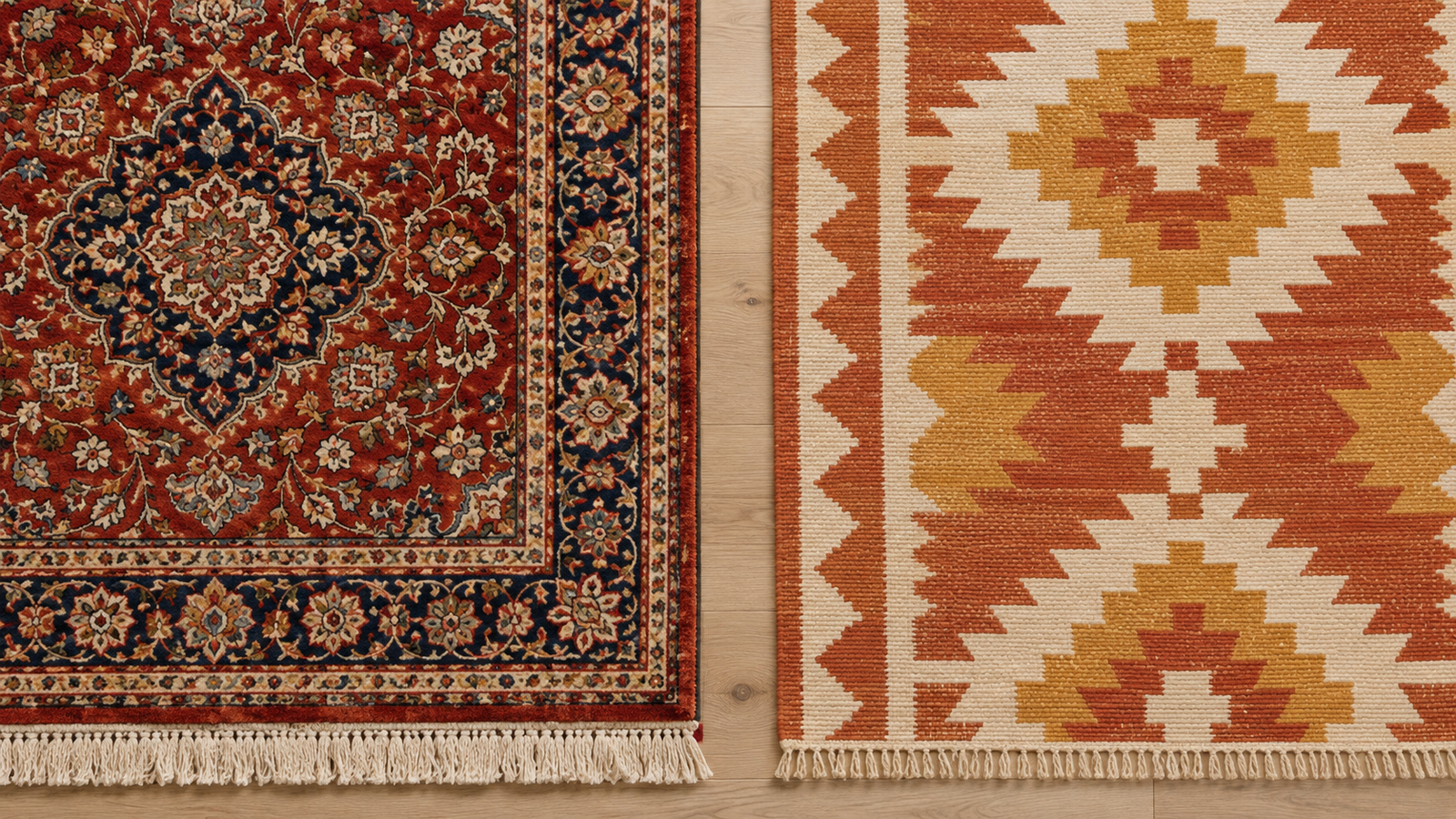
Dhurrie vs Persian rug isn't really a fair fight, and it's worth saying that upfront rather than pretending otherwise. These are two different products built by two different processes, aimed at two different budgets and two different jobs a rug might need to do in your home. A genuine hand-knotted Persian rug and a handwoven dhurrie can both be beautiful, well-made, and worth owning, they're just not usually the same purchase decision. The honest question isn't which one is better. It's which one actually fits what you need, your budget, your space, and how the rug will actually get used day to day. This guide walks through the real differences rather than picking a side.
Table of Contents
The Construction Difference That Explains Almost Everything Else
Nearly every other difference between these two rugs traces back to how each one is actually made.
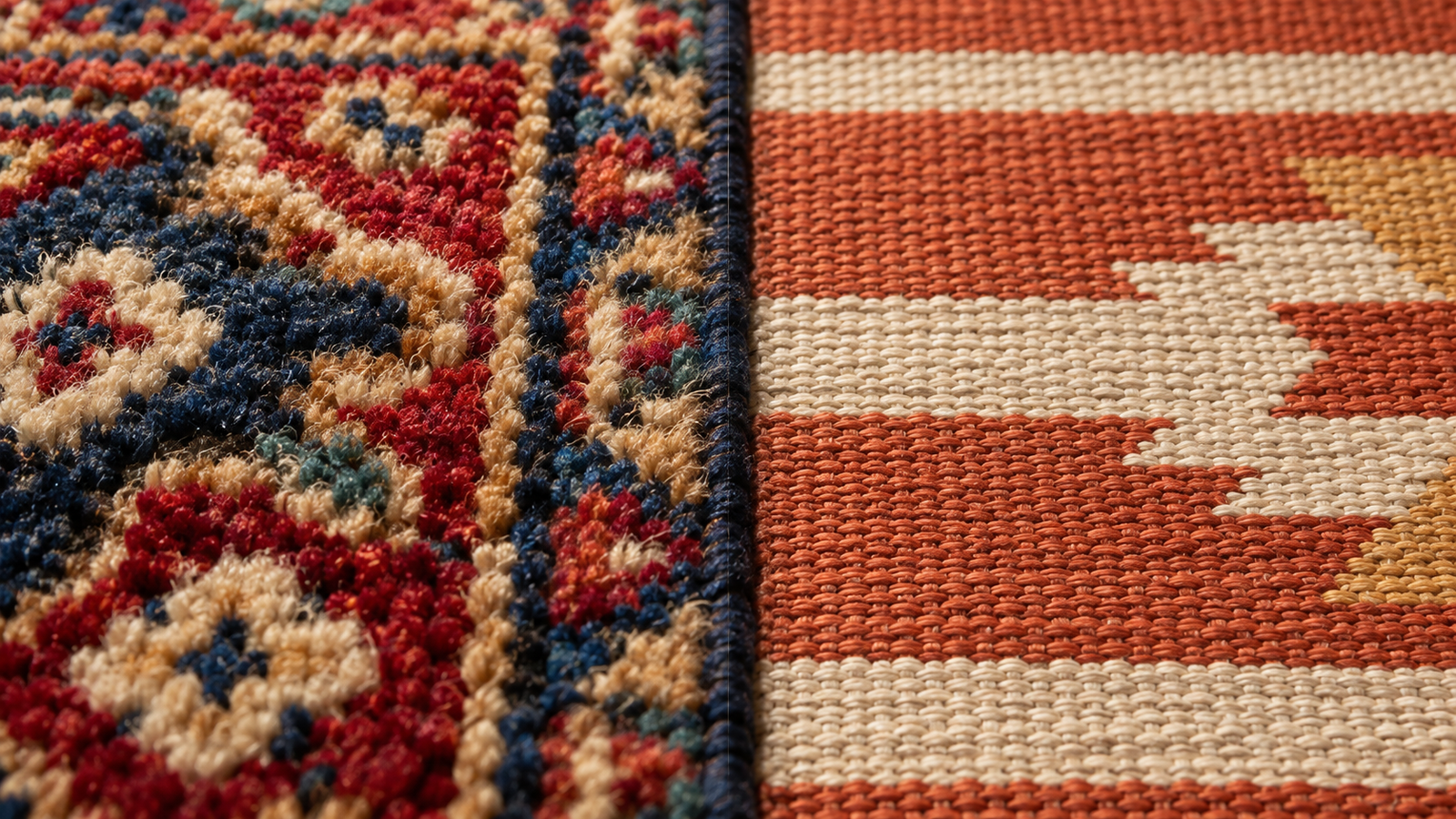
A Persian rug is hand-knotted, individual knots of wool or silk tied one at a time around the rug's foundation threads, row by row, until the pile and the pattern build up together. Persian carpet making reached its peak by the 15th century, with court workshops producing the densely detailed medallion designs the style is still known for today. A detailed piece with a fine knot count can genuinely take a single weaver more than two years of steady work, that density of hand-tied knots is also exactly what allows for the fine, detailed patterns Persian rugs are known for.
A dhurrie is flatwoven, no knots, no pile, the weft thread interlaced directly through the warp to build the pattern as the weave itself progresses, closer to how cloth is woven than how a knotted rug is made. It moves considerably faster per square foot, which is the real reason dhurries cost a fraction of what a comparable hand-knotted piece does. Neither method is a shortcut. They're just different crafts producing genuinely different objects.
Price: What You're Actually Paying For
A hand-knotted Persian rug's price reflects an enormous amount of skilled labour, sometimes well over a year of a single weaver's time for a detailed piece, plus materials that are often wool or silk of a specific, higher grade. Genuine antique or fine Persian rugs can run into the thousands of dollars, and well-cared-for pieces are sometimes bought specifically as investments, since good examples can hold or increase in value over decades.
A dhurrie's price reflects a faster weaving process on the same kind of natural materials, wool, cotton or jute, which is why a well-made handwoven dhurrie typically costs a fraction of a comparable Persian piece. That's not a quality shortcut, it's a genuinely different amount of labour going into the finished object. If your budget is built around a rug as a long-term investment piece, that favours a Persian rug. If you want real natural-fibre craftsmanship without that price tag, that favours a dhurrie.
Design And Detail Level
Persian rugs are capable of a level of pictorial and floral detail that flatweave construction simply isn't built for, densely packed medallions, curling vines, fine colour gradients built up knot by knot. This is a genuine strength of hand-knotting as a technique, and it's part of why Persian rugs read as more formal and ornate.
Dhurries work in a different visual language, geometric patterns, stripes, blocks of colour, motifs built from straight lines and repeats rather than fine curves. This isn't a lesser version of a Persian rug's detail, it's a different aesthetic entirely, closer to modern and mid-century design sensibilities than to traditional Persian ornamentation. Which one looks "better" genuinely comes down to which visual language suits your room, not which technique is more advanced.
Durability And How Each One Ages
A well-made Persian rug, properly cared for, can genuinely last generations, part of why so many get passed down as family heirlooms and why the antique rug trade exists at all. That longevity comes with more particular care requirements, though, professional cleaning is generally recommended over an at-home approach once a rug reaches a certain value or age.
A dhurrie is built for a different kind of durability, easier to clean, and reversible in a way a pile rug never can be, flip it over once one side shows wear, and you've effectively doubled its usable life. It's not positioned as a multi-generational heirloom the way a fine Persian rug is, but for everyday durability in an actively used room, it holds up well and asks a lot less of you in return.
Which Fits Your Space And Budget
A Persian rug tends to suit a formal living or dining room, a space built around the rug as a centrepiece, or a household specifically looking for a long-term investment piece worth caring for accordingly.
A dhurrie tends to suit almost everywhere else, a busy family room, a kids' space, a modern or minimalist home where geometric pattern fits the aesthetic, a first home where budget matters, or any room getting genuine daily wear rather than occasional formal use. Neither is the "starter" version of the other, they're built for different rooms and different expectations from the outset.
Where Custom Sizing Gives Dhurries A Practical Edge
This is one area where a dhurrie has a real, practical advantage regardless of budget. Because a Persian rug's pattern and knot count are built up by hand over months, an unusual custom size on a hand-knotted piece typically means a proportional increase in the already-substantial time and cost involved, often making custom Persian rugs a genuinely expensive, slow-turnaround request.
Custom sizing on a dhurrie is a considerably more accessible process, since flatweave construction doesn't carry the same knot-by-knot time penalty for an unusual dimension or shape. If your room needs a specific size or shape, an oddly proportioned space, an extra-long runner, a curve to fit a bay window, that's a much more practical ask of a dhurrie than of a hand-knotted equivalent.
Quick Answer Checklist
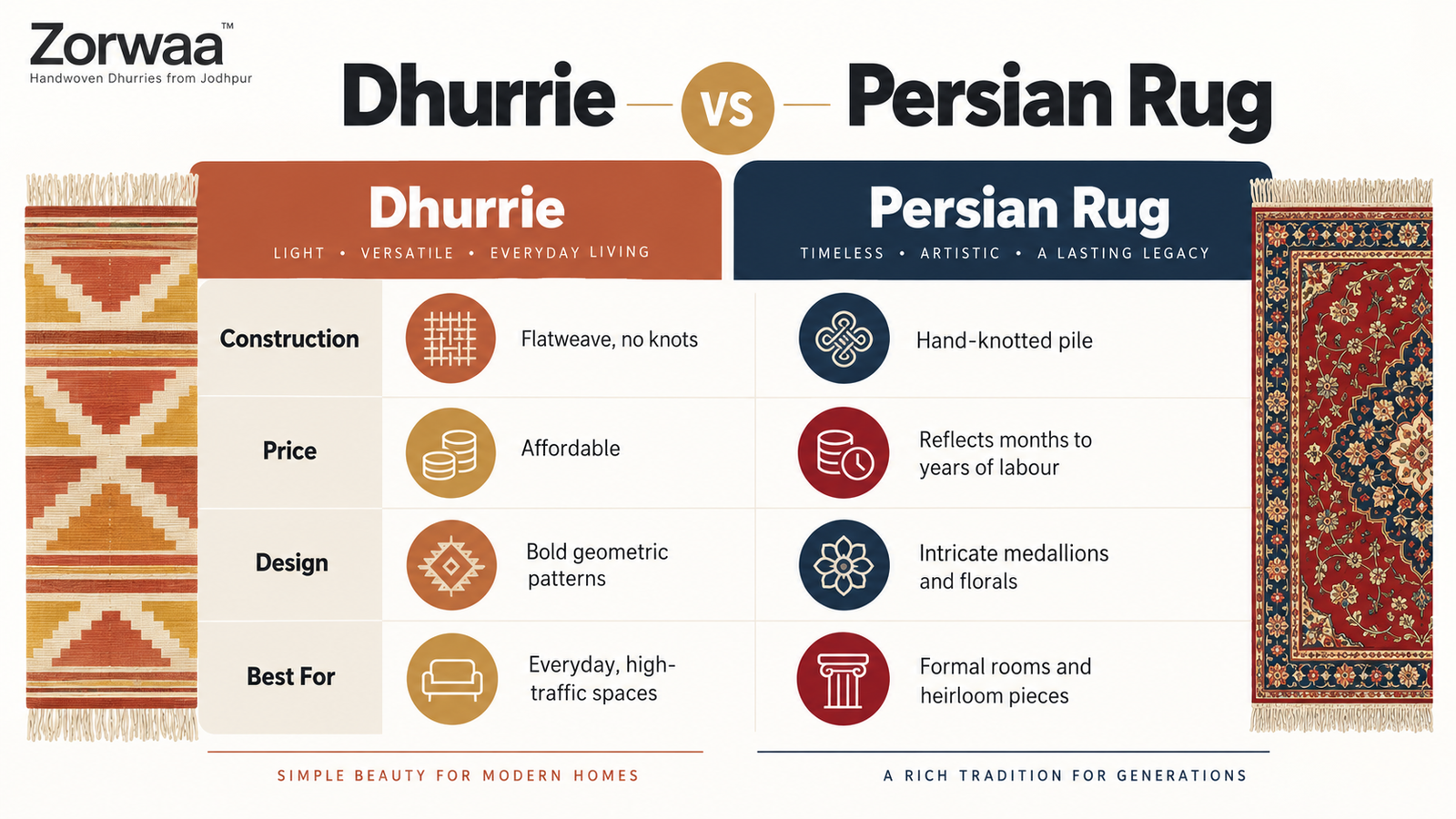
- Persian rugs are hand-knotted pile, dhurries are flatweave with no knots or pile, this single difference explains most of the rest
- Persian rugs typically cost significantly more, reflecting months to years of hand-knotting labour
- Persian rugs allow for finer pictorial detail, dhurries work in bolder geometric patterns
- A well-kept Persian rug can last generations and hold value, a dhurrie is built for easier everyday durability and is fully reversible
- Persian rugs suit formal or investment-focused spaces, dhurries suit everyday, high-traffic or budget-conscious ones
- Custom sizing is considerably more practical and affordable on a dhurrie than on a hand-knotted Persian rug
Frequently Asked Questions
Is a dhurrie the same as a Persian rug?
No. A Persian rug is a hand-knotted pile, built up knot by knot over months or years. A dhurrie is flatwoven, with no knots or pile, made considerably faster and typically far more affordably.
Is a Persian rug better quality than a dhurrie?
Not better, different. A Persian rug allows finer pictorial detail and can last generations as an heirloom piece. A dhurrie is built for practical everyday durability, easier cleaning and reversibility, at a fraction of the cost.
Why are Persian rugs so much more expensive than dhurries?
Persian rugs are hand-knotted, a much slower, more labour-intensive process that can take a single weaver well over a year to complete for a detailed piece. Dhurries are flatwoven, a considerably faster technique on similar natural materials.
Can I get a custom-sized dhurrie as easily as a custom Persian rug?
Generally yes, and more affordably. Custom sizing adds proportionally more time and cost to a hand-knotted Persian rug than it does to a flatwoven dhurrie.
Dhurrie vs Persian rug was never really a competition, it's a question of what you actually need. If you want a formal, detailed, multi-generational piece and the budget to match, a Persian rug earns its price. If you want genuine natural-fibre craftsmanship that handles daily life easily and costs a fraction as much, a dhurrie does the job well. Browse our traditional dhurrie collection to see the kind of pattern and colour flatweave does best.