
Traditional Rajasthani Rug Patterns – History, Motifs, And What Makes Them Distinct


There are rug weaving traditions across Turkey, Persia, Central Asia, and India. Most of them have a single origin point like a royal workshop, a monastery, a specific guild. Rajasthan's tradition doesn't work that way.
The craft here is distributed. It lives in weaving families in Salawas, in Bishnoi settlements around Jodhpur, in workshops in Barmer and Sitapur. No single patron defines it. The patterns have moved between generations mostly without being written down.
That makes Rajasthani rugs harder to describe in the abstract than, say, a Persian court carpet with a traceable design lineage. It also makes them more interesting.
A History That Doesn't Start Where Most People Expect
The standard history of Indian carpet-making begins with the Mughals. Akbar brought Persian master weavers to India in the 16th century and established imperial workshops in Agra and Lahore. This is accurate. The Mughal influence on Indian carpet design is visible in floral motifs, medallion formats, and the boteh, the teardrop shape that eventually became Western paisley.
But Rajasthan's flatweave tradition is older than any of that.
Cotton weaving in the Marwar region, the area around present-day Jodhpur was already a developed craft well before the 16th century. The geometric patterns most associated with traditional Rajasthani rug patterns today like diamond grids, chevron stripes, stepped pyramids and the mosque arch belong to a regional design vocabulary that predates Mughal influence entirely.
What the Mughal period brought to Rajasthan was not the foundation of the craft but an expansion of it. New patrons, new markets, new motifs that blended into existing local design languages. The result is a tradition that carries both indigenous Rajasthani geometry and Mughal-era florals, sometimes in the same rug.
The British colonial period added another chapter. In the 1850s, the Maharaja of Jaipur introduced rug weaving into jail reform programs. Prison workshops in Bikaner, Jaipur, and Agra produced flatweave rugs for colonial trade networks, many ending up in British homes and government buildings. The quality was high. The weavers were skilled. The circumstances are not something to romanticise.
Post-independence, the craft shifted to village-based cottage industry and export production. Salawas and Bishnoi Village became major production centres. That transition, and its ongoing implications for weaver livelihoods, is still working itself out.
The Six Main Pattern Types - What You Are Actually Looking At
Traditional Rajasthani rug patterns are built on geometry. This is not a stylistic preference. The loom makes the decision.
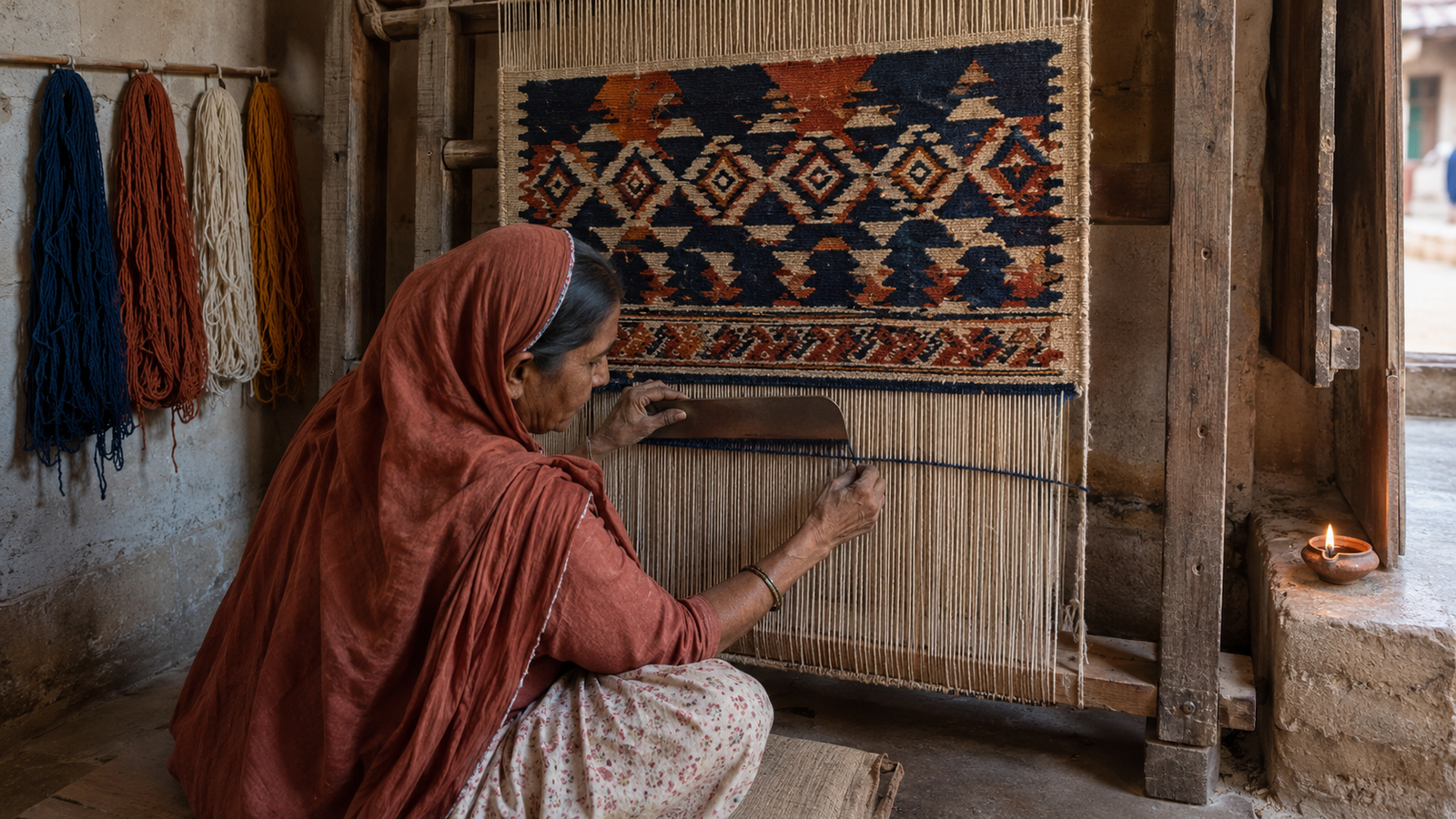
A pit loom works in horizontal rows. Every weft pass is a straight line. Curved and diagonal forms get built by stepping i.e. making small incremental horizontal and vertical moves that approximate a curve from a distance. This constraint is why the most traditional patterns are diamonds, chevrons, stepped pyramids, and zigzags. The structure of the loom shapes the design vocabulary.
Striped patterns
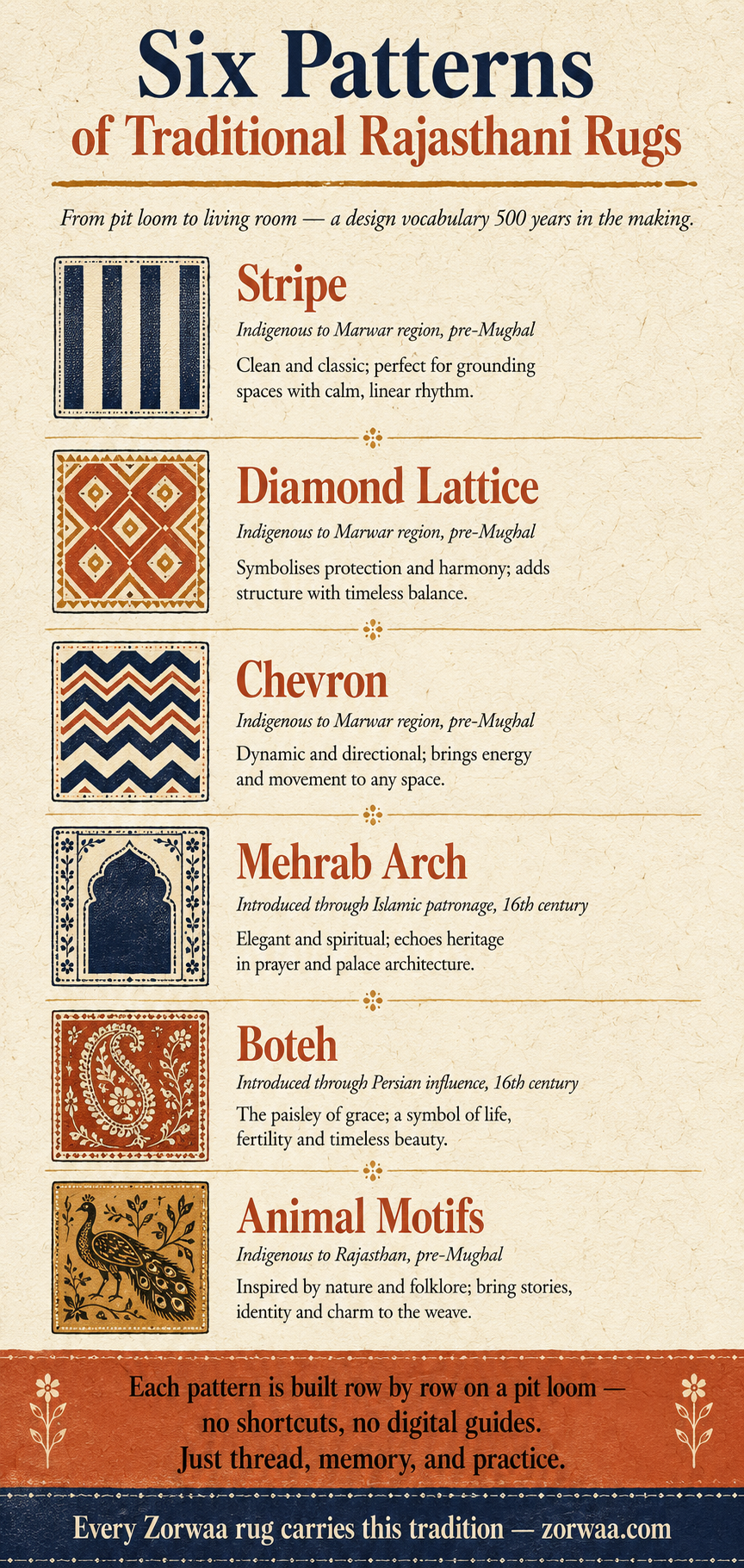
Horizontal bands of colour running across the width of the rug. The starting point of the entire tradition. This sounds simple. In practice, the proportion of each band, the colour sequence, the relationship between stripe widths, these produce results that range from crude to exceptional. A Salawas weaver working with natural-dyed cotton yarn on a panja dhurrie makes dozens of small decisions within what appears to be a straightforward format.
Diamond and lattice patterns
Stripes become diamonds when weft threads step at calculated intervals, creating a grid of repeating diamond shapes: single, nested, or arranged in repeating formations across the field. Bishnoi weavers have specific diamond proportions and border treatments that identify village origin to those who know the tradition. Not every diamond pattern is the same, and the differences are meaningful if you know what you're looking at.
Chevrons and zigzags
Made by reversing the stepping direction at the centre of the rug. Traditional Rajasthani chevrons are often worked in two or three colours, creating an optical depth that photographs consistently fail to capture. You need to see one in person to understand why the pattern holds your attention.
Mehrab (mosque arch) patterns
The arch form associated with the prayer niche in Islamic architecture. It appears across rug weaving traditions from Morocco to Central Asia. In Rajasthani rugs, the mehrab appears most often as a repeating border motif or as the organising structure of prayer mat formats. It arrived through Islamic patronage and stayed because it integrates cleanly with the flatweave geometric vocabulary.
Boteh and floral patterns
These came through Mughal contact and appear most often in rugs from the Jaipur and Bikaner traditions. The boteh, the teardrop or flame shape can be a single large central motif or an all-over repeating field. The Mughal flowering vine, where a continuous curving stem carries individual flower heads at intervals, is technically demanding in flatweave and marks a level of skill above the basic geometric formats.
Animal and nature motifs
Particularly associated with Bishnoi weavers. The Bishnoi community's ecological philosophy which is five centuries old, built around active protection of animals and trees in the desert landscape makes natural imagery culturally significant in a way that goes beyond decoration. Peacocks, blackbuck deer, and the khejri tree appear in Bishnoi textiles in forms that don't appear with the same frequency or meaning anywhere else in the Rajasthani tradition.
Colour And Natural Dyes - The Other Half Of The Pattern
Pattern and colour are not separate decisions in a traditional Rajasthani rug. The pattern creates the structure. The colour creates the character.
The traditional palette is built from plant and mineral sources:
Indigo - deep, cold blue derived from the indigofera plant. The most historically important dye in Indian textile production. Rajasthani indigo reads as dark and slightly cool, tending toward navy rather than bright cornflower.
Madder and Lac - the reds. Madder root produces warm brick red. Lac, derived from an insect resin, gives deeper jewel reds and dark crimsons. Both were traded across the subcontinent for centuries before synthetic dyes existed.
Turmeric and Pomegranate Rind - warm yellows and golden ochres. These dyes are less lightfast than indigo and madder, which is why the yellows in older pieces have often softened toward buff and cream over years of light exposure.
Undyed Natural Fibres - the cream of raw cotton, the warm tan of jute, the natural off-white of Marwar wool provide the ground tones against which the dyed yarns read.
One quality worth knowing: the abrash visible in traditional Rajasthani rugs which is subtle horizontal colour shifts as you look up the length of the rug comes from working with hand-dyed yarn batches. Different vats produce slightly different results. A weaver who changes their yarn supply mid-rug sees this in the finished piece. Among people who understand handmade textiles, this is considered part of the character of the work, not a flaw to be corrected. Machine-made rugs have no abrash because the yarn is produced in industrial batches under controlled conditions.
What Actually Makes Them Distinct From Other Regional Rug Traditions
Three things separate traditional Rajasthani rug patterns from similar textiles made elsewhere and none of them are marketing points.
The design vocabulary is local in a specific sense. The patterns of Salawas and Bishnoi Village are not simplified versions of Persian court carpets and not industrial reproductions of historical motifs. They are the output of a continuous regional tradition, still made by the same communities, on the same type of looms, using recognisably the same design language as rugs made two and three generations ago. That continuity is rare.
The construction is structural. The pattern in a Rajasthani flatweave rug is not printed, painted, or applied to a backing. It is built into the physical structure of the textile, woven in, row by row, as an inseparable part of the construction. The pattern cannot be removed from the rug because it is the rug. This is the structural reason well-made pieces survive decades of daily use without the design degrading.
The knowledge lives in people, not in archives. The designs that Salawas and Bishnoi weavers produce are held in memory learned through watching, doing, and developing proportion sense over years of practice. There are no pattern books, no digital libraries, no corporate design departments. When that stops, the tradition stops. It is a reasonable thing to consider before buying.
Zorwaa works directly with artisan families in Bishnoi Village and Salawas hence no middlemen, no broker layers. If you want to see what these looms are currently producing, browse the geometric flatweave collection or customise a rug to your specific size and colour requirements.
Frequently Asked Questions
What are the most common patterns in traditional Rajasthani rugs?
Geometric patterns dominate like diamond grids, chevron stripes, stepped pyramids, and lattice forms. Mehrab arch motifs and boteh patterns appear in more elaborate pieces. Bishnoi-made rugs frequently include peacock and animal imagery alongside the geometric base.
Why do some traditional Rajasthani rugs have colour variation across the surface?
That is abrash, a natural variation that comes from working with hand-dyed yarn batches. Different dye vats produce slightly different results. It is a characteristic of genuine handmade work, not a defect. If you see abrash, the rug was almost certainly not machine-made.
How can I tell if a Rajasthani rug is genuinely handmade?
Flip it. A genuine flatweave dhurrie shows its pattern on both sides. Check the fringe, it should be a natural extension of the warp threads, not sewn on as decoration. Look at the pattern edges closely. Handmade pieces have slightly organic lines with natural variation. Mechanical precision in a pattern edge usually means a machine made it.
Are traditional Rajasthani patterns protected or copyrighted?
No. Traditional patterns belong to the cultural commons of the communities that created them. Any weaver can use them. However, the ethical question is separate, it is about whether the weavers who carry these traditions are paid fairly for producing them.
One thought on “Traditional Rajasthani Rug Patterns – History, Motifs, And What Makes Them Distinct”
Comments are closed.