
What Are Natural Fibre Rugs? Wool, Cotton, Jute – Compared

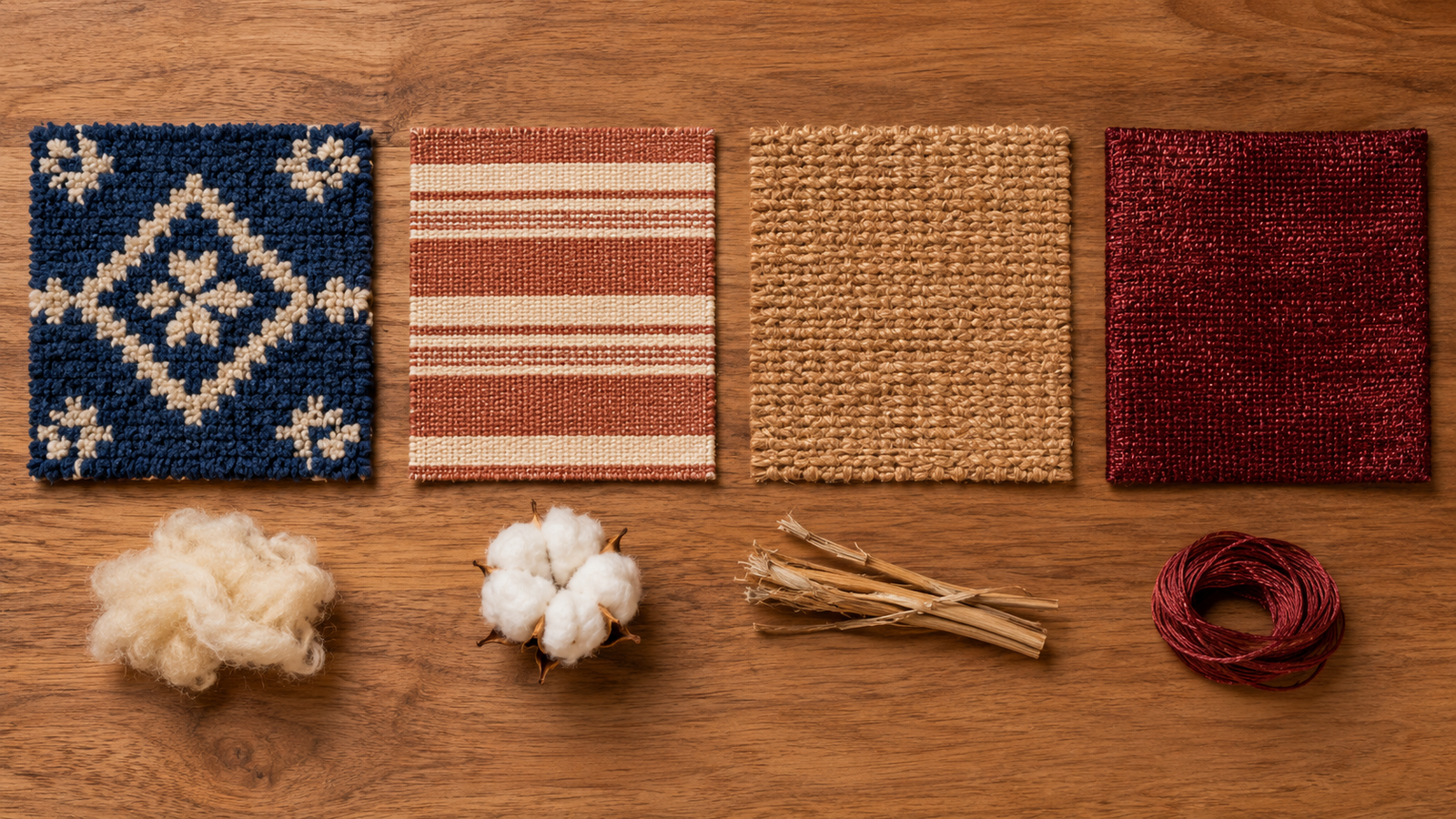
There are two ways to make a rug. You use fibres grown from the earth like wool shorn from sheep, cotton harvested from bolls, jute pulled from plant stalks or you use fibres manufactured in a factory from petrochemicals.
The difference isn't academic. Natural fibres age differently, feel different underfoot, respond differently to heat and moisture, and at the end of their life, return to the earth without leaving synthetic residue behind. Synthetic fibres shed microplastics, fade in ways that look cheap rather than characterful, and have a ceiling on how long they can last before the material itself degrades.
This guide covers the four main natural fibres used in handmade rugs which are wool, cotton, jute, and silk, what each one does well, where each one has limitations, and how to decide which is right for your home and your specific room.
Why Natural Fibres Matter
Before the comparisons, one thing worth stating plainly: no synthetic fibre replicates what a natural one does, despite decades of effort to produce alternatives.
Natural fibres have cellular structures that respond dynamically to their environment. Wool absorbs and releases moisture without feeling wet. Cotton breathes in heat. Jute becomes more characterful as it ages. These are properties built into the fibre itself, not coatings, not treatments, not manufacturing additions.
Natural fibre handmade rugs also hold dye differently. Natural and plant-based dyes bond with natural fibres in a way they simply cannot bond with synthetics. The colour you see in a wool or cotton rug dyed with indigo or madder root is structurally part of the fibre, it softens and deepens with age rather than bleaching flat or fading unevenly.
Wool - The Benchmark
Wool is the traditional rug-making fibre. Hand-knotted Persian carpets, Turkish kilims, Tibetan monastery rugs, Rajasthani dhurries and across every major rug-weaving culture and tradition, wool has been the primary material for most of recorded history. That longevity tells you something.
Why wool works so well in rugs:
Wool fibres have a natural crimp like a microscopic wave structure that gives wool textiles resilience. Press down on a wool pile rug and it springs back. Walk across it daily for years and the pile recovers rather than flattening permanently. This resilience is the structural reason well-made wool rugs last decades.
Wool is also naturally soil-resistant. The fibre's outer layer (the lanolin-coated cuticle) resists liquid absorption at the surface, giving you time to blot a spill before it sets. Dirt and dust tend to sit on the surface of wool fibres rather than penetrating deeply which is why a good shake or vacuum keeps a wool rug looking clean between deeper cleans.
The warmth properties are genuine. Wool is an excellent thermal insulator. A wool rug in a bedroom or living room adds measurable warmth to the room which is an advantage in cooler climates and air-conditioned spaces, and a consideration worth noting in hot Indian summers.
Where wool has limitations:
Wool is the most expensive natural fibre for rug-making. The cost reflects the material, the processing, and the fact that a skilled weaver works more slowly with heavier wool yarn than with cotton. Wool rugs require more careful maintenance, they're sensitive to harsh detergents, should not be soaked, and benefit from professional cleaning every two to three years.
In very humid climates or damp storage conditions, wool can develop mildew if not properly ventilated. Proper care is straightforward, but it's not zero-maintenance.
Explore our wool and cotton blend collection for rugs that combine wool's resilience with cotton's breathability creating a practical balance for Indian homes that experience both seasonal extremes.
Cotton - The Everyday Workhorse
Cotton is the fibre of the Indian flatweave tradition. The classic Salawas panja dhurrie is woven primarily from hand-spun cotton. The traditional Rajasthani dari, the everyday floor covering of millions of Indian homes for centuries - cotton.
There are good reasons for this.
Why cotton works so well in rugs:
Cotton is lightweight, breathable, and comfortable in warm weather. A cotton flatweave dhurrie in the Indian summer is the right material in the right climate. It stays cool underfoot, doesn't retain heat, and allows air to circulate through the weave structure.
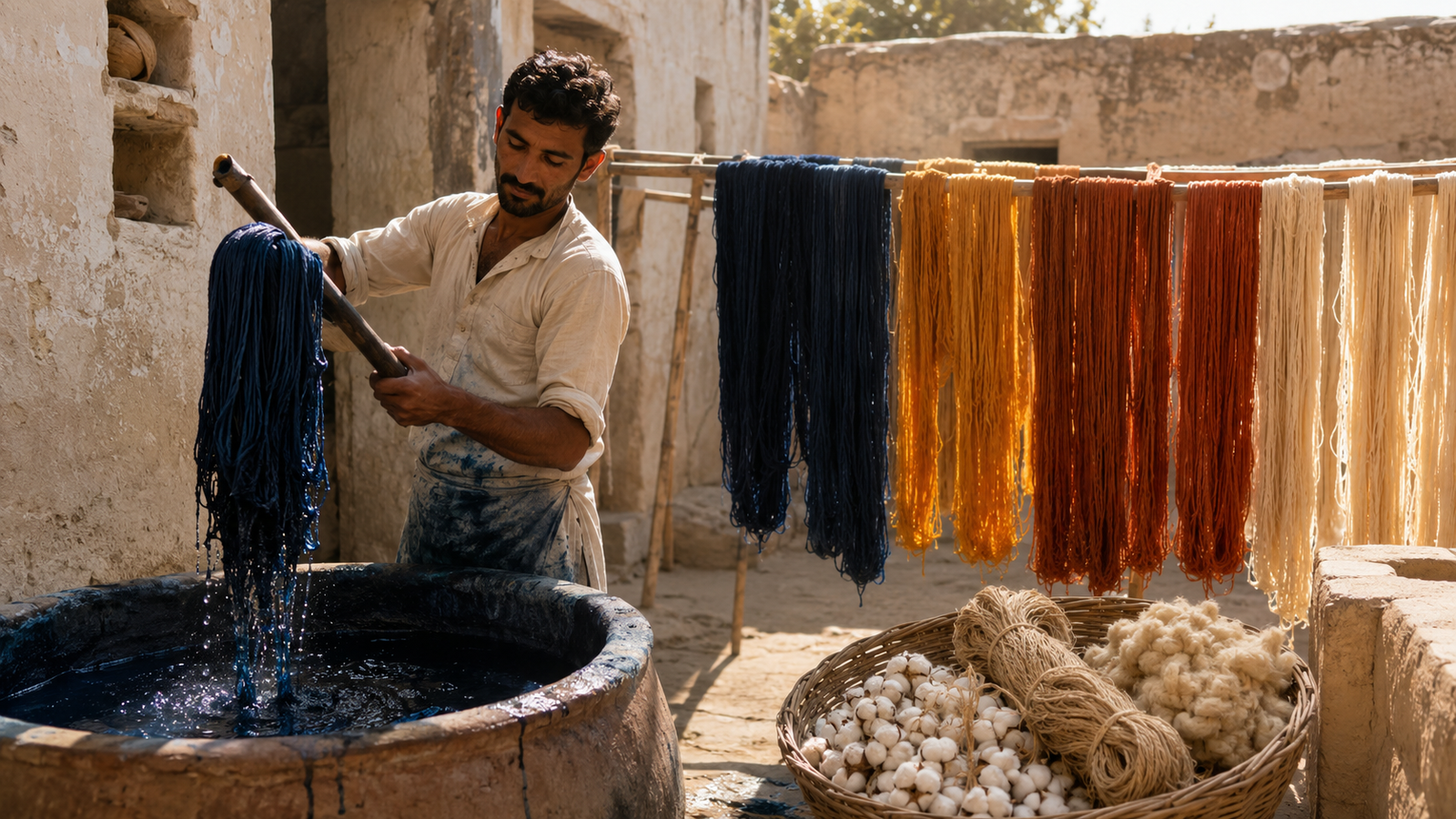
Cotton holds dye extraordinarily well. The range of achievable colours in cotton particularly with natural and reactive dyes is broader than wool, and the vibrancy is higher. The bold indigo and terracotta geometric patterns you see in traditional Rajasthani dhurries are as vivid as they are partly because cotton takes those dyes so cleanly.
Cotton rugs are also the easiest to clean of the natural fibres. A cotton dhurrie can be shaken, vacuumed on both sides, spot-cleaned with mild soap and water, and in smaller sizes hand-washed without special equipment or professional intervention. For homes with children and pets, this matters.
The flat, firm surface of a cotton flatweave is also consistent over time. There's no pile to wear down, no raised surface that thins in high-traffic zones. A well-made cotton dhurrie looks essentially the same after ten years of daily use as it did in its first year, the surface stays flat and the colours shift gracefully rather than degrading.
Where cotton has limitations:
Cotton doesn't have the inherent resilience of wool. It doesn't spring back from compression the way wool does, and it lacks wool's thermal insulation properties. In rooms where underfoot warmth and cushioning are priorities like bedrooms, winter lounges, a cotton flatweave alone may feel firm and cool in a way that isn't always desirable.
Cotton also absorbs moisture more readily than wool, which means spills require prompt attention. In chronically damp rooms or climates with very high sustained humidity, cotton rugs need proper ventilation and occasional airing.
Jute - The Natural Option For Casual Spaces
Jute is a plant-based bast fibre which is the same material used in hessian and burlap, grown extensively in West Bengal and Bangladesh. It's coarser than cotton or wool, less processed, and considerably cheaper to produce. In rug terms, these characteristics translate into a specific set of strengths and limitations.
Why jute works in certain spaces:
Jute rugs have a distinctive raw, organic aesthetic. The natural golden-tan colour of undyed jute is warm and earthy. It works well with natural material interiors, rattan furniture, raw wood, and organic textures generally. Many people buy jute rugs precisely for this visual quality rather than despite the roughness.
Jute is durable in the sense that it resists tearing and holds its structure well. It's also one of the most biodegradable flooring materials available, it breaks down completely and rapidly without leaving environmental residue.
For lower-traffic casual spaces like a relaxed reading corner, an outdoor-adjacent area, a studio or workspace, jute is a practical and affordable natural option.
Where jute has limitations:
Jute is not soft. It's the roughest of the mainstream natural rug fibres and is not appropriate for spaces where comfort underfoot is important like bedrooms, children's play areas, barefoot living rooms. The texture that gives it character also makes it unsuitable for prolonged skin contact.
Jute is moisture-sensitive. Unlike wool, which manages moisture absorption well, jute exposed to sustained dampness can discolour, stiffen, and in severe cases develop mould. It is not appropriate for bathrooms, kitchens, or outdoor spaces with rain exposure.
Silk - The Luxury Option
Silk occupies a different category from the three fibres above. it's not a material for everyday practical rugs, and it's worth understanding why before buying.
Silk rugs are extraordinarily fine. The lustre of silk, the way it catches and reflects light is unmatched by any other natural fibre. A well-made silk rug in good light is genuinely beautiful in a way that photographs struggle to convey.
But silk is a decorative material, not a practical floor covering. Silk fibres are strong individually but fragile under the sustained compressive stress of foot traffic. A pure silk rug in a high-traffic living room will show wear significantly faster than a wool or cotton equivalent. Silk rugs are better understood as textile art placed on the floor in low-traffic spaces, or displayed partially rather than walked across.
Most silk rugs sold at practical price points are silk blends, typically cotton-silk or wool-silk which give the visual character of silk with better structural durability.
Comparing The Four Fibres - At A Glance
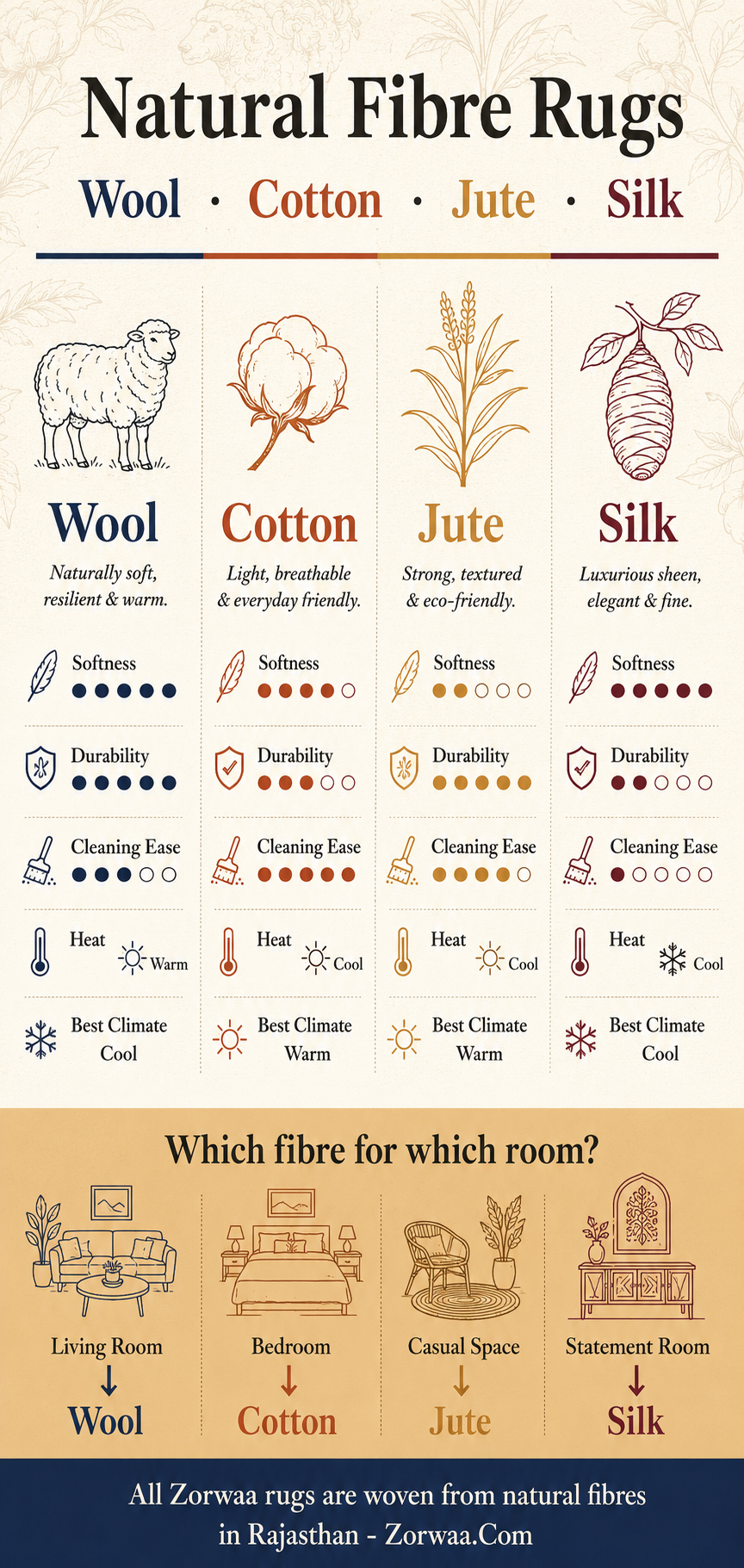
Property | Wool | Cotton | Jute | Silk |
Softness underfoot | Very soft | Firm | Rough | Very soft |
Durability | Excellent | Very good | Good | Moderate |
Cleaning ease | Moderate | Easy | Moderate | Difficult |
Heat retention | High | Low | Low | Low |
Moisture resistance | Good | Moderate | Poor | Moderate |
Lifespan | 50–100 yrs | 30–50 yrs | 10–20 yrs | 20–50 yrs |
Best climate | Cool / AC | Warm / tropical | Dry / casual | Controlled |
Price range | High | Moderate | Low | Very high |
Which Natural Fibre Is Right For Your Home?
For most Indian homes particularly across Rajasthan, Gujarat, Maharashtra, and southern India, cotton is the most practical starting point. It's the fibre the flatweave tradition was built on, it performs well in warm climates, it cleans easily, and the range of designs available is enormous.
For homes in cooler climates or for buyers prioritising underfoot warmth and long-term investment, wool is the correct choice. The higher upfront cost is genuine value over a 50-year lifespan.
For casual spaces where aesthetics and affordability matter more than daily comfort, jute serves well. For statement decorative pieces in low-traffic spaces, silk blends deliver something genuinely special.
All four fibres are available at Zorwaa in flatweave constructions. If you're uncertain which material is right for your specific room, our customisation service allows you to specify material, size, colour, and pattern and we'll advise on the best fibre for your use case before the loom is warped.
Frequently Asked Questions
Are natural fibre rugs better than synthetic?
For longevity, feel, environmental impact, and the quality of how they age: yes, across all these measures, natural fibre rugs outperform synthetic equivalents. The only area where synthetics have a genuine advantage is initial price point.
Do natural fibre rugs fade?
Natural fibres dyed with quality dyes whether natural or reactive, soften gracefully over time rather than fading unevenly. Prolonged direct UV exposure will affect any dyed fibre, but the characteristic of natural-fibre ageing is a deepening or mellowing of colour rather than the patchy bleaching synthetic rugs often show.
Which natural fibre rug is easiest to maintain?
Cotton, particularly in a flatweave construction. Easy to vacuum, spot-clean, and in smaller sizes, hand-wash at home. Wool is next, requiring more care but forgiving of light soil. Jute requires moisture vigilance. Silk requires professional handling.
Can I use a natural fibre rug in a kitchen or bathroom?
Cotton and wool with appropriate rug pads can work in kitchens where moisture exposure is limited. Jute and silk should not be used in high-moisture environments. In bathrooms, consider a small cotton flatweave that can be washed and dried easily.
8 thoughts on “What Are Natural Fibre Rugs? Wool, Cotton, Jute – Compared”
Comments are closed.