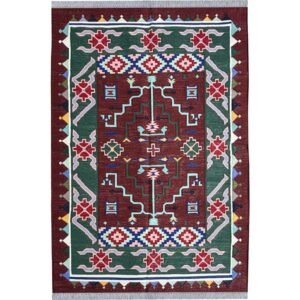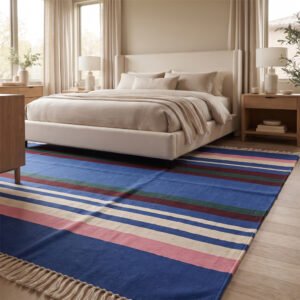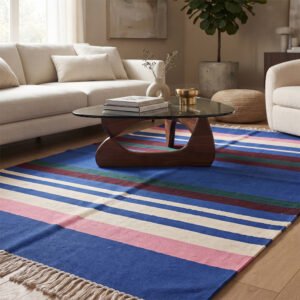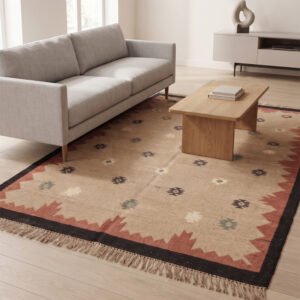

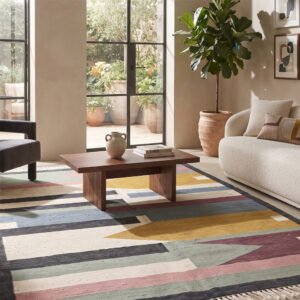
Handmade Dining Room Rugs & Carpets

A dining room is probably the hardest room in the house to buy a rug for. Chairs get dragged in and out every single day. Food and drink spills happen. Whatever you put on that floor has to stay flat, stay clean, and hold its shape under constant movement. The rugs in this section are all handmade, flatweave dhurries woven by artisans in Bishnoi Village and Salawas, near Jodhpur and most of them handle a dining room's daily demands better than a pile rug would. No pile height for chair legs to catch. No deep surface for spills to disappear into.

Filter by size if you know your table dimensions. If you're still working out what fits, the guide below the grid covers exactly how to measure for a dining room rug.

-50%
Select options This product has multiple variants. The options may be chosen on the product page

Abstract Earth Tones: Hand-Made Reversible Dhurrie

3,800.00 64,800.00Price range: ₹3,800.00 through ₹64,800.00
-40%
Select options This product has multiple variants. The options may be chosen on the product page

Abstract Multicolor Wool Jute Kilim Rug

2,850.00 54,000.00Price range: ₹2,850.00 through ₹54,000.00
-50%
Select options This product has multiple variants. The options may be chosen on the product page

Abstract Soul: Artisan-Crafted Panja Weave Flatweave durry

3,800.00 64,800.00Price range: ₹3,800.00 through ₹64,800.00
-50%
Select options This product has multiple variants. The options may be chosen on the product page

Aesthetic Earth: Hand-Loomed Cotton Rug for Boho Homes

3,800.00 64,800.00Price range: ₹3,800.00 through ₹64,800.00
-50%
Select options This product has multiple variants. The options may be chosen on the product page

Ancient Loom Magic: Artisan Panja Weave Cotton Dhurrie

3,800.00 64,800.00Price range: ₹3,800.00 through ₹64,800.00
-50%
Select options This product has multiple variants. The options may be chosen on the product page

Anti-Skid Texture: Tightly Woven Panja Flatweave Rug

3,800.00 64,800.00Price range: ₹3,800.00 through ₹64,800.00
-50%
Select options This product has multiple variants. The options may be chosen on the product page

Artisan Made Flatwoven Cotton Dhurrie Rug – Handcrafted & Reversible

3,800.00 64,800.00Price range: ₹3,800.00 through ₹64,800.00
-50%
Select options This product has multiple variants. The options may be chosen on the product page

Artisan Panja Weave: Flatwoven Perfection durry

3,800.00 64,800.00Price range: ₹3,800.00 through ₹64,800.00
-50%
Select options This product has multiple variants. The options may be chosen on the product page

Artisan Panja Weave: Flatwoven Perfection durry

3,800.00 64,800.00Price range: ₹3,800.00 through ₹64,800.00
-50%
Select options This product has multiple variants. The options may be chosen on the product page

Artisan-Made Panja Rug: Reversible

3,800.00 64,800.00Price range: ₹3,800.00 through ₹64,800.00
-40%
Select options This product has multiple variants. The options may be chosen on the product page

Artisanal Wool & Jute Flatwoven Rugs

2,850.00 54,000.00Price range: ₹2,850.00 through ₹54,000.00
-40%
Select options This product has multiple variants. The options may be chosen on the product page

Authentic Artisan Wool & Jute Flatweave Rugs

2,850.00 54,000.00Price range: ₹2,850.00 through ₹54,000.00

Why Flatweave Works Better Here Than Pile

A pile rug in a dining room has one persistent problem: the chairs. Every time a chair is pulled out or pushed in, it drags against the pile and compresses it unevenly. Within a year, a pile rug under a dining table develops a permanent imprint of where the chairs live. A flatweave dhurrie doesn't have that problem. The surface is flat and tight from edge to edge hence chairs move across it freely, without resistance, without leaving any trace.

Spills are the other issue. In a pile rug, liquid moves down into the fibres and the backing before you can reach it. In a flatweave cotton dhurrie, the surface is denser. You can catch a spill faster, and cleaning is more straightforward than with any pile construction. Most cotton rugs here can be spot-cleaned easily, and smaller sizes can be rolled and washed.

Then there's reversibility. Most of these flatweave dhurries have two usable sides. If one side picks up a stain that doesn't come out fully, you flip the rug. In a dining room where staining is a matter of when, not if, that's a practical advantage that pile simply can't offer.

Getting the Size Right - The Chair Rule

The size of a dining room rug is governed by one principle: chairs must stay on the rug, even when pulled out. If a chair slides off the edge of the rug when someone sits down, the rug is too small and nothing about a rug that's too small works in a dining room.

The calculation is straightforward. Measure your dining table, then add at least 60 cm (24 inches) on every side. That gives enough room for chairs to pull back and return without leaving the rug. For a standard 4-seater table of around 120 x 80 cm, that puts you at a minimum rug size of roughly 240 x 200 cm which in practical terms means a 5x8 ft or 6x9 ft rug. For a 6-seater table, an 8x10 ft is the safer call.

Round tables are a specific case. A round rug tends to complement a round table better visually, though a rectangular rug sized correctly works just as well functionally. The geometry matters less than the 60 cm extension rule on all sides.

Material - What Holds Up in a Dining Room

The dining room is not the place for your most delicate rug. It's the place for something practical, easy to clean, and structurally sound under daily chair movement and foot traffic.

Cotton flatweave is the most sensible choice for most dining rooms. It doesn't hold odours, doesn't trap food particles in a thick pile, and is the easiest of the three material options to clean. A wool-cotton blend is a sound alternative, the cotton content keeps cleaning manageable, while the wool adds durability in the sections that take the most chair and foot traffic.

Wool-jute is rougher and more textured. It holds up well structurally under chair movement but is harder to clean when liquid spills happen, which makes it better suited to a dining room used occasionally rather than every day. If your dining area doubles as a daily family space, cotton or wool-cotton is the more practical pick.

Pattern and Colour for Dining Rooms

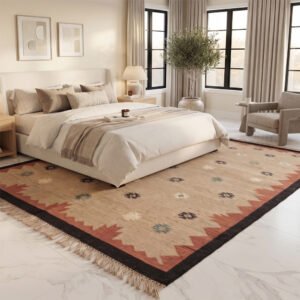
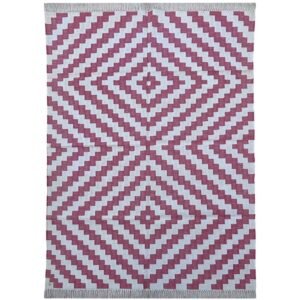
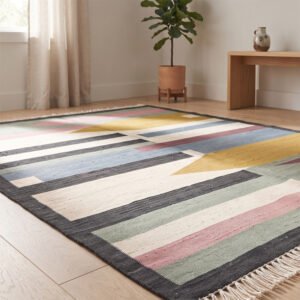
The dining room is one of the few spaces in a home where a bolder rug pattern tends to work well rather than fight with the surroundings. Furniture in a dining room is typically fixed like a table in the centre, chairs around it so there's less visual competition with the rug beneath. Geometric designs, traditional Indian motifs, and multi-colour flatweave patterns all hold their own in this kind of space.

Colour choice has a practical dimension too. In a room where spills happen, a rug with pattern or tonal variation will be more forgiving than a solid-colour piece. A small stain on a geometric or multi-tone dhurrie is far less visible than the same stain on a plain ivory rug. If you're choosing between a solid and a patterned option and you use your dining room daily, the patterned rug is the easier long-term decision.

The Craft Behind This Collection

Every rug here comes from artisans in Bishnoi Village and Salawas, two weaving communities outside Jodhpur in Rajasthan. Both produce flatweave dhurries using the panja technique which is cotton yarn beaten tightly into the warp with a comb-like tool called a panja, creating a dense, flat surface with minimal give in the construction.

That density is exactly why these rugs hold up in rooms with the kind of daily use a dining room gets. The structure doesn't loosen with time. A panja weave dhurrie from Salawas will still look like itself years into daily use which, in a room that sees three meals a day and a family around it, is the only test that really matters.

Custom Sizes for Dining Rooms

Dining rooms are often awkward sizes, and the 60 cm chair extension rule doesn't always land neatly on a standard rug dimension. If your table is unusually long, if you have a round table that needs a specific diameter, or if your dining area flows into an open-plan kitchen where standard sizes don't cover the space properly, a custom-sized rug is often the cleaner solution.

The customization page is the starting point. Bring your table dimensions, chair depth, and any colour references and the team can take it from there.

Frequently Asked Questions

Add at least 60 cm (24 inches) to each side of your dining table dimensions. This ensures chairs stay on the rug even when pulled out. For a standard 4-seater table, a 5×8 ft or 6×9 ft rug works well. For a 6-seater, 8×10 ft is a safer choice. For a round table, a round rug sized to the same rule 60 cm extension on all sides works best, though a rectangular rug sized correctly functions just as well.

Yes, in most cases. Flatweave rugs don’t catch or compress under chair legs the way pile rugs do, which means they stay looking consistent even after years of daily chair movement. They’re also easier to clean, spills stay at the surface rather than absorbing down into a pile. Most flatweave dhurries are reversible, which is a practical advantage in a room where staining is part of daily life.

Cotton flatweave is the most practical choice since it doesn’t trap food particles, is easy to spot-clean, and doesn’t hold odours. Wool-cotton blend is a step up in durability for high-traffic dining rooms while keeping cleaning manageable. Wool-jute works for rooms used more occasionally but is harder to clean when spills happen. For a dining room used every day, cotton or wool-cotton is the better long-term pick.

Patterned is the more practical choice for a dining room that’s used daily. A geometric design, traditional motif, or multi-tone dhurrie hides minor staining and wears far better than a solid-colour rug. The dining room is also one of the spaces where a bolder pattern tends to work since the furniture arrangement is fixed, so there’s less visual competition with the rug below.

Yes. Because dining room rug size is determined by your specific table dimensions plus the 60 cm chair extension on all sides, standard sizes don’t always land neatly on your requirements. Custom sizing is available for most designs. Shape adjustments including round rugs for round tables are also possible. Visit the customization page with your table measurements and requirements.